Thinking of Phillis Wheatley during National Poetry Month

Dr. David Waldstreicher opened discussing the Phillis Wheatley statue that stands on Beacon Street in Boston.

About 10-12 years ago I was having coffee with someone from work when we somehow got on the topic of Classic Studies. I mentioned that in today’s world the study of Classical Antiquity and Literature has been de-emphasized, to our detriment. I included myself in the category of those whose knowledge about these fields is woefully inadequate. That now-long-ago conversation came back to me last night when a friend and I went to the CUNY Graduate Center to hear historian David Waldstreicher discuss the progress of his current project, a biography of African-American poet Phillis Wheatley. Dr. Waldstreicher specifically mentioned our current generation’s lack of Classical Education. That so few people–again, myself included–have read the works of Virgil, Herodotus and others prevents contemporary readers from fully understanding the works of poets such a Ms. Wheatley, who incorporated themes from ancient texts into her own work.

Dr. David Waldstreicher shows the audience an image of Wheatley’s writing with Thomas Jefferson’s hand-written notes on the bottom.

Dr. Waldstreicher said during his talk that for his biography of Wheatley he has had to educate himself in two areas about which he previously knew little, the Greek and Roman Classics & West African History. Wheatley herself had come from West Africa and later self-educated herself in the Classics. These experiences were pillars in her writing. It was impressive the way Professor Waldstreicher pulled all these threads together during his talk. In passing, he mentioned Jonathan Williams, Benjamin Franklin’s grand-nephew who was the first superintendent of West Point and who shortly after that worked on the forts at Governors Island. I spoke to Dr. Waldstreicher after his talk and mentioned these Williams’s connections. He seemed duly impressed.

Waldstreicher is a Distinguished Professor of History in the Graduate Center and an authority on slavery in the early years of the Republic. He did an extraordinary job explaining the fluidity of slavery in late eighteenth and early nineteenth century American society and how it differed from bondsmanship in the Caribbean and Brazil, and later in the United States. Apparently that his talk fell during National Poetry Month was a coincidence. If it was, it proved to be a fortunate one. The lecture gave the audience a great deal to think about, which was obvious in the number of questions asked during the Q&A period, which ran long. That’s the true sign that a speaker has engaged his audience well.

April 4, 1968

Ronald Reagan signed the bill creating the Martin Luther King Jr. holiday in November 1983, fifteen years after King’s death.

I would be remiss if I did not pause and write a few words on this, the 50th anniversary of the assassination of Dr. Martin Luther King Jr. I was less than a year old when he was killed in Memphis. Oddly however, the older I get the more events like this seem less like “history” and more like current events. Here in full-blown middle-age, my entire concept of time has evolved. When my father was alive he lived within a few hour’s drive from Memphis. I visited each summer I would usually borrow his car and take an overnight side trip to somewhere or other. More than once that place was Memphis. I visited the Lorraine Hotel, site of the King assassination and home today to the National Civil Rights Museum, more than once. Walking in the vicinity one could see the empty lots that were the results of the riots and, later, urban renewal. I have not been there now in many years, but I believe that gentrification is at last moving things along.

I remember when MLK Jr. Day became a holiday in the early 1980s. Again, at the time I thought his death was part of some ancient past, and yet the creation of the holiday was only fifteen years after the shooting. The evolution of the holiday itself has a convoluted history, one mired in national and even international events. A search of the New York Times digital archive from 1983 pulls up all kinds of articles about the unresolved issues of the Civil Rights Movement as well as commentary from TASS, the Soviet news agency, offering their cynical take on the drama of the holiday hanging in the balance. When King was assassinated the Tet Offensive was in its fifth week. Bobby Kennedy gave the eulogy for King and would himself be assassinated two months later. All that spring and summer there were riots and political upheaval across the United States, in Paris, Czechoslovakiaand Mexico City just before the Summer Olympics.

Viewed a certain way, King’s activities can be seen in the context of the World Wars. His assassination came just fifty years after Woodrow Wilson issued his Fourteen Points, and twenty-seven years after FDR announced the Four Freedoms in his January 1941 State of the Union address. King knew these things. It is not an accident that the Civil Rights Movement here in the U.S., and Independence Movements around the world, developed how and when they did. One can’t help but think of things like Ho Chi Minh at Versailles after the Armistice pleading his case for an independent Vietnam. King was reluctant to speak publicly against Lyndon Johnson because of all the president had done for Civil Rights, but in the year before his assassination King’s denunciations of the war in Southeast Asia became increasingly strident. In the library where I work, over the past fifteen years, a colleague and I have been ordering the King Papers as they have incrementally released. The historiography on the release of someone’s correspondence is itself a fascinating genre. History is a humbling thing and the deeper one goes the more one sees the relationships between what are very complicated events.

(image/White House Photo Office)

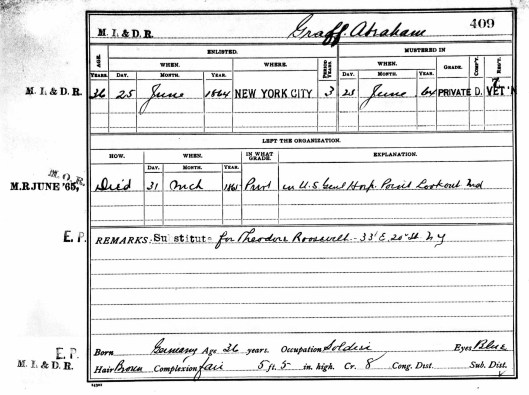
Abraham Graff, 1828?-1865

Private Abraham Graff died 153 years ago today. As you can see from the muster roll above, Graff served in the 7th Veteran Infantry Regiment. This unit mustered in just in time to serve in Ulysses S. Grant’s Overland Campaign. Graff himself did not see action in that bloody ordeal, having joined the Army on June 25, 1864. He was in Virginia for the Siege of Petersburg. What makes him interesting here, beyond that his was a life cut short, is how and why he entered the unit: Abraham Graff was Theodore Roosevelt Sr.’s replacement in the American Civil War.

Passenger manifest from the Amalie listing an Abraham Graf arriving in New York City on June 23, 1864.

Little is known about Graff. We do know however that he was a German immigrant who had just come to the United States. I cannot tell with 100% certainty but the passenger manifest above lists an Abraham Graf having arrived in New York City on June 23, 1864, two days before “our” Graff mustered in. The last name is spelled differently (with one F here) and the age may be off a year or two according to what we know, but these types of things are not uncommon in historical records. We do know that the Abraham Graff that took Roosevelt’s place was freshly-arrived. This may well be our person. How many Abraham Graff’s could have come from Germany that same week or month?

Private Abraham Graff’s death certificate, complete with notation that he was Theodore Roosevelt (Sr.’s) substitute. Note that it lists the house number as 33 East 20th Street, not 28 as we know it today.

Graff’s Civil War experience was a difficult one. He was taken prisoner, let go, and died of scurvy in a Union hospital in Maryland on March 31, 1865.

Opening Day

Today is Opening Day of the baseball season. I think it might be an intriguing summer here in New York. The Mets and Yanks are looking pretty good. Time will tell.

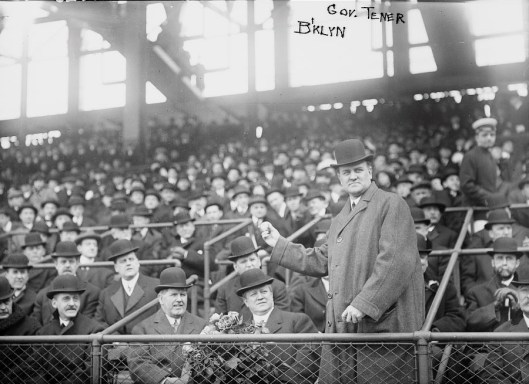
John Kinley Tener, governor of Pennsylvania and president-elect of the National League, throws out the first pitch in Brooklyn, April 1914. Four years later he would discourage NL owners from starting afternoon games an hour later during the newly-inaugurated Daylight Savings Time.

Opening Day 1918 came of April 15, which was about normal for the era; in the years of the 154-game season and no divisional playoffs, baseball started much later than today. In the weeks leading up to that season’s first pitch, baseball had an interesting issue to think through: what to do about Daylight Savings Time. Congress passed and President Wilson signed the bill creating DST in mid-March 1918. Perhaps not surprisingly the innovative Germans were the first country to try Daylight Savings during the Great War, starting the practice in 1916. The Brits, French, Dutch, Italians, Scandinavians and others quickly followed suit. It was thus inevitable the Americans would institute it as well. Daylight Saving Time here in the United States began at 2:00 am Sunday March 31, 1918. It also happened to be Easter.

Baseball teams, especially in the National League, began discussing the merits of moving weekday games from 3:30 to 4:30 pm at the time of the passing of the legislation in mid-March. Executives believed that moving games back an hour would boost revenue at the turnstiles because it would be easier for people to come to the game from work. It was the extra hour of sunlight made the potential time shift possible. Remember, night games did not begin until the mid-1930s. Much of official Washington vehemently opposed the idea, noting that the Daylight Savings measure was intended not for entertainment purposes but to save resources such as gas and coal, and to boost productivity in the munitions factories.

For several weeks after the legislative passing of Daylight Saving Time, Charles Ebbets and other owners contemplated moving games back an hour to boost attendance. The Brooklyn Daily Eagle captured Ebbets’s decision a few weeks prior to Opening Day.

One man in agreement with this was National League president John Kinley Tener. The Irish-born Tener grew up in Pittsburgh and took to baseball as a young immigrant. He participated in Albert G. Spalding’s world baseball tour in the late 1880s. Tener played for Cap Anson’s Chicago Nationals (today’s Cubs) in 1888 and 1889 and then did a brief stint in the Players League in 1890. A Republican, Tener served in the U.S. Congress from 1909-11 and then became governor of Pennsylvania. It was while serving in Harrisburg that the National League owners voted him president in December 1913.  He took the job with the condition that he finish out his gubernatorial term. Tener took the National League reins in 1915.

As early as March 19, 1918, when Daylight Savings Time became law, some baseball executives began advocating for the 4:30 start. Officially the National League Office had no position and left the matter up to individual clubs. The New York Giants wanted to move to 4:30 to better accommodate subway commuters. Charlie Ebbets, owner of the Brooklyn Robins (later the Dodgers), too was keen on the shift. Ban Johnson, president of the American League, split the difference and advocated for a 4:00 start time for his clubs. Johnson’s National League counterpart, Tener, made clear his preference that teams stay with the 3:30 start time. Ebbets eventually bowed to the pressure and kept his team’s schedule as it was in past seasons.

Enjoy the season, everyone.

(top image/Library of Congress)

Colonel John C. Fremont Tillson’s March 1918

John C. Fremont Tillson’s 1878 West Point cadet record.

As March 1918 was winding down the various armies were preparing for the spring fighting season. The Germans had begun Operation Michael on March 21, the first round in their Spring Offensive. The United States was still getting the American Expeditionary Forces up to speed. A significant aspect of that took place on Governors Island, where Colonel J.C.F. Tillson of the 22nd Regiment was in charge of rounding up shirkers from the Selective Service process. Some estimates in early 1918 put the number of shirkers from the draft as high as 250,000. Army officials crunched the numbers and were more sanguine, putting the number at around 50,000. This was still a sizable but not insurmountable number.

Colonel Tillson spent the winter and early spring of 1918 at Governors Island expediting the cases of Selective Service shirkers.

John C. Fremont Tillson graduated in the West Point Class of 1878 and spent the next forty years serving in all of the usual places one might expect an American military officer to serve in these decades: out West against the Indians, in Cuba during the Spanish-American War, the Philippines, China, and now the Department of the East. Governors Island seemed to be a holding station for slackers across the Greater Northeast. Presumably the men were held in the jail within Castle Williams while awaiting their fate. Colonel Tillson worked diligently to make sure that shirkers were given every opportunity they could to avoid true punishment. He did this by starting from the premise that most men were not draft dodgers, per se, but individuals who had not reported for training due to some misunderstanding. Often literally.

Colonel Tillson noted to reporters and to audiences at public events that many of the men whose cases he saw did not speak English. It’s not surprising. Tillson’s adult life coincided with the massive influx of immigrants to the United States in the late 19th and early 20th centuries. Seeing Ellis Island across the harbor from Fort Jay every day would have only emphasized that. Tillson often had to use translators to interview the men. Very few of these saw hard time. Most had their cases straightened out and headed off to Camp Upton on Long Island for training. Tillson remained in the Army through the end of the Great War and retired in 1920. For a decade he ran the New York State Soldiers’ and Sailors’ Home in Bath, New York. He died eight days after the bombing of Pearl Harbor. His wife died five days later. They are buried at Arlington Cemetery.

(bottom image/New York Times)


Joe College and Betty Co-ed

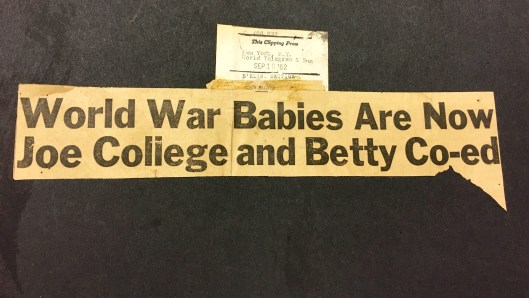
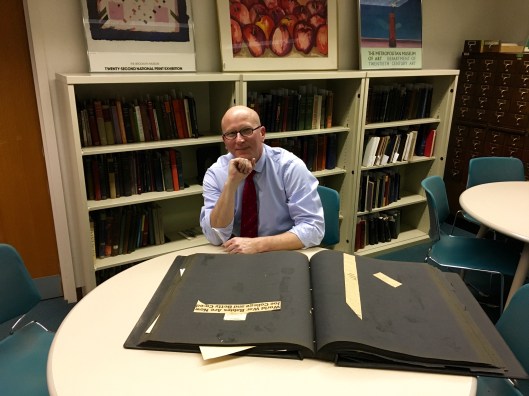
The college at which I work was founded in 1946 as a GI Bill school. Apparently in its early decades the college hired a clipping service to track the school in the press. On Wednesday a colleague and I were sorting through some of the old binders when we came across the article whose headline you see here. It’s interesting on a number of levels. First off, it’s from the New York World Telegram and Sun, a newspaper that folded in the late 1960s after the various consolidations coinciding with rising printing costs and advent of television in the decades after the Second World War. Next, the article is about Baby Boomers going off to college. This article is from September 1962. These freshmen would have been born in 1944. Demographically they would not have been Baby Boomers. As I understand it that generation technically begins with persons born starting on or after January 1, 1946. Still, it’s close enough. By the early 1960s it is not the World War II generation but their children who are the incoming student body.

One of the great tragedies of the First World War is that there was no assistance for the retuning doughboys. When they came home they were left to fend for themselves. We will never know how the 1920s and beyond would have played out had  a Servicemen’s Readjustment Act in, say, 1919 and not twenty-five years later as it did.

Nora E. Cordingley, 1888-1951

An excerpt from the New York Times obituary that starkly but accurately captured the details of Nora E. Cordingley’s death.

In February 1966, Esquire magazine published an article by Gay Talese called “Mr. Bad News.” The subject of that piece was Alden Whitman, a still-very-much-alive obituary writer for the New York Times. Many obituaries are written months or even years prior to the individual’s death. That’s why one sees a 2000 word overview of someone’s life published literally within the hour after they have passed. March is Women’s History Month. To mark the occasion editors at the Gray Lady have created a series they are calling “Overlooked,” for which they are writing obituaries for prominent women who did not receive recognition in the newspaper when the women originally died. Charlotte Brontë, Emily Warren Roebling and Ida B. Wells are three of the first fifteen subjects. Hopefully this will become something like “The Lives They Lived” section that appears the final Sunday of the year. I would like to see them do some figures from the First World War such as Edith Cavell. They are soliciting potential future articles. For whatever they regard it to be worth, I may submit a few ideas to the Times editors.

December 15, 1921 Library Journal announcement

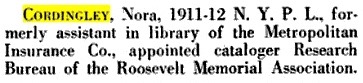
I once mentioned in passing here on The Strawfoot a woman named Nora E. Cordingley, a Canadian who worked at Roosevelt House on East 20th Street starting in the 1920s. I knew then that I wanted to expand on her story a bit more but was waiting for the time. That time came a few weeks back when something came through my feeds soliciting articles for the Women of Library History blog. They are currently running their sixth annual series on women who work in the library profession. When I saw the announcement, I knew the time had come and I started working on it right away. The editor and I agreed we should publish the article today. Nora E. Cordingley died on March 14, 1951, 67 years ago today. I am really proud to have written this article. Ms. Cordingley is one of the overlooked people who kept Theodore Roosevelt’s legacy alive and she deserves to be remembered. Read the article here.

Hitting a benchmark

William Cullen Bryant, Grolier Club

Occasionally during a semester we in my department take annual leave days to research and write. Today was one such day for myself. I was fortunate because the rain and snow came in buckets. I can hear people shoveling outside as I write this. I did not leave the house today. I did two loads of laundry downstairs and otherwise stayed in. It turned out to be an important day because I managed to finish the draft of Incorporating New York. The manuscript landed at almost exactly 75,000 words. Of course there is still a great deal of work to be done. I’ll be spending the next several weeks editing and fact checking. After that, I’m going to organize the references. These are not small things. Still, today has proven to be an an important benchmark in the project. The structure of my text is now set and these is no more primary research to be done. The task is more clerical now. I cannot tell you what a burden this lifts from me. I am going to keep grinding in the coming days and weeks to make the narrative as tight as I can make. I’m really happy with how things have turned out.

I had a small serendipitous moment last night. A friend and I attended a science fiction talk and reception last night at the Grolier Club on East 60th Street. When I was leaving I noticed the painting you see above. I did not know who it was at first but it turned out to be William Cullen Bryant, a member of the club and a good friend of, among others, Frederick Law Olmsted. Bryant is a minor character in my book. I love visiting places like the Union League and Grolier Clubs and never pass up a chance to visit when invited. I think that institutions like these provide continuity, which is no small thing in a place that changes as quickly as New York City does. This was in evidence last night; they’re constructing a modern building right next to the Grolier Club. Change is one of the themes of my book. I couldn’t help but take a quick snap of the painting before heading out last night to beat the snow home.


Sunday morning coffee

Theodore Roosevelt Birthplace, East 20th Street

I spent the day yesterday pounding out a small project that will hopefully see the light of day sometime this month. I don’t want to say too much about it right now, but I will say here that it is about the Roosevelt Birthplace on East 20th Street. It came out to about 900 words. Again, it is a low stakes projects. Little things like this though can be a lot of fun. There are so many good stories to tell. I will keep everyone up to date.

Once I finish the book manuscript, I intend to do something about the development of Roosevelt House as a cultural institution. The story is a more interesting one than people realize. Roosevelt died in January 1919 when the troops were coming home from Europe. The world was seemingly at peace but actually in turmoil. Much of the world was gathering in Paris for the peace negotiations. That summer was the Red Scare and the race riots here in America, and chaos and starvation abroad. The Russian Revolution was going on, and soon that country would be in civil war. Theodore Roosevelt was gone by the time all this happened, but that was the milieu in which the Roosevelt Memorial and Woman’s Roosevelt Memorial Associations went about the work of rebuilding the house in the early 1920s. The founders of the site saw it as a center for promoting patriotism and for fending off the world’s ills in what was an uncertain time. It is very much an untold story and I think there is a lot to go on here.