Sunday afternoon coffee

I spent the morning putting things in order in the new apartment upstairs. I’d say 95% of our belongings have now been transferred up there. I am actually downstairs again at the moment because the gas and internet are not yet on in the new place. I came down at 8:00 am to boil the water for the French press before going back up with the brewed coffee and doing some things. It has been a stressful Memorial Day Weekend with so much going on, but I’m looking at it as a little adventure; it’s the only way. I’m going to finish grading papers tonight and my colleague and I are going to get together tomorrow and compute the final grades, which are due Tuesday midnight. It’s bee one of “those weeks” but I was thankfully able to get a few days off, which has made things so much easier. I’m looking at the bright side and seeing the move as a fresh start. We have even managed to throw away a great deal.

Ray Knight walks down the red carpet to greet teammates from the 1986 Mets.

Ray Knight walks down the red carpet to greet teammates from the 1986 Mets. Note the sell-out crowd.

A friend and I squeezed in the Mets/Dodgers game last night on what turned out to be an unseasonably warm evening. The 1986 Mets celebrated their World Seres before the game. I must say that even thirty years and three Red Sox championships later I was surprised at how much it hurt to watch. Still it was fun meeting older folks–that is, people my age–enjoying the thing. Waiting in line at the john I had a good conversation with a couple of good-natured guys who remembered ’86 so fondly. Of course I didn’t tell them I was rooting for the other team during that great long ago. We got to talking about where the years went. I’m glad the Mets are home this Memorial Day Weekend and that we had a chance to go.

I noted happily that the Washington Nationals are also home this weekend. I don’t think it was planned this way–that would make too much sense–but it’s great when the Nationals play at home over Memorial Day Weekend. Rolling Thunder is going on. The President usually appears at Arlington. Baseball in the capital at this time seems so appropriate. It really should be an annual thing.
Thinking of Cantigny

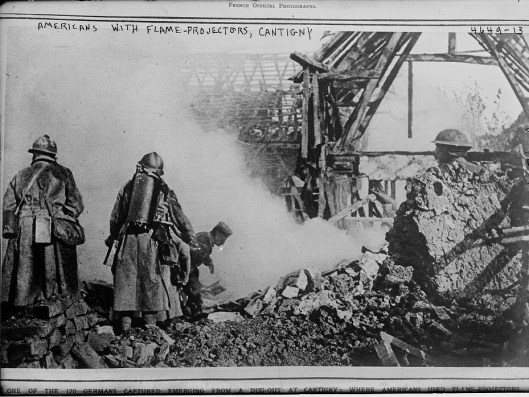
27227vToday marks the 98th anniversary of the start of the Battle of Cantigny, the American Army’s first offensive of the Great War. Truth be told the days-long battle was not much by the bloody levels set by the Europeans over the past 2 1/2 years. Still it marked a turning point. It is lost on many today how long it took the United States to become battle-ready after declaring war the first week of April 1917. Cantigny was a full thirteen months after that.

The roll of those active in the planning and fighting is a Who’s Who of the A.E.F. Robert Lee Bullard, Charles P. Summerall, George Marshall, Ted Roosevelt, and Chicago Tribune publisher Robert R. McCormick to name a few. McCormick had a lot to do with preserving the memory of the battle, and of the First Division as well. His Illinois estate became Cantigny Park after his death in 1955. In the decades after the war Colonel McCormick was an anti-New Dealer and America Firster. He used his newspapers to campaign against the Marshall Pan after the Second World War. It is somehow fitting that Cantigny falls on Memorial Day Weekend. It’s something to think about when one is out and about these next few days.

(image/Library of Congress)

Remembering Victor Carlstrom’s flight

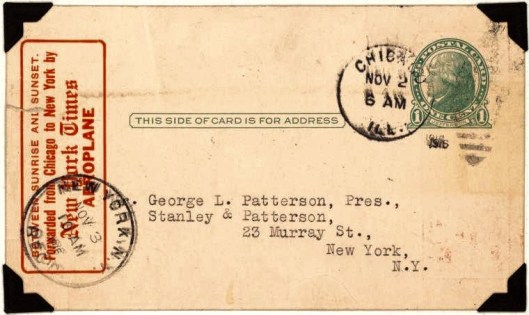
One of the approximately 1000 pieces of mail Victor Carlstrom carried on his flight

One of the approximately 1000 pieces of mail Victor Carlstrom carried on his flight

This coming week in New York is the World Stamp Show, an event I first heard was coming to the Big Apple in 2011. It was one of those things where you hear about it and say to yourself, “Yeah, but 2016 is five years away.” A friend and I have been talking about it eagerly since January and plan to attend to take it all in. An interesting thing came through my in box yesterday about aviator Victor Carlstrom, who I had not heard of until reading the article. Governors Island has a rich aviation history and it turns out that Carlstrom ran airmail for the Post Office in a plane called “The New York Times” that landed on the island in fall 1916. Carlstrom’s Chicago-to-New York run took two days and was hampered by a fuel leak that forced him to touch down a little more than half way. Apparently this one-time thing was something of a promotional stunt for both the Post Office and the Times.

And this was a fairly big event. Carlstrom landed at Governors Island, where Leonard Wood was on hand to greet the pilot. The article has a great photograph of the two men. Presumably he landed on the island because of the Army base’s proximity to Manhattan and the resulting ease to transport the mail haul across the harbor by ferry. Even more touching is that Carlstrom was a Swedish immigrant who had come through Ellis Island a little more than a decade previously. From his plane he would have seen the Immigration station, whose traffic had slowed considerably since the start of the Great War.

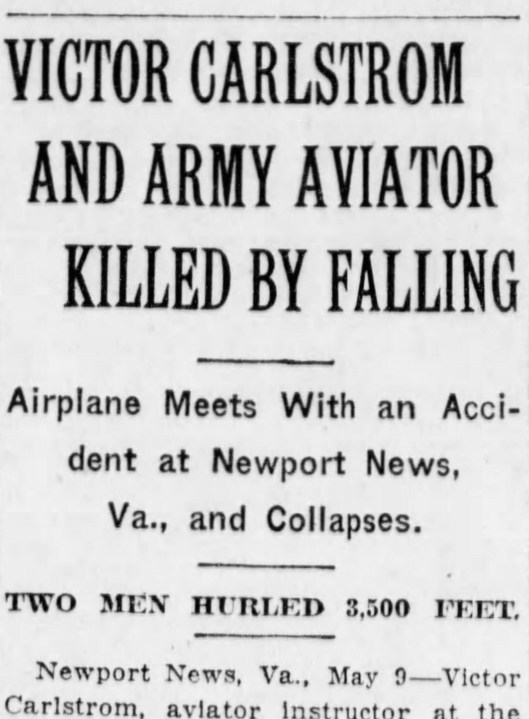
The_Brooklyn_Daily_Eagle_Wed__May_9__1917_Carlstrom set all kinds of aviator records but did not have much longer to live. When the United States entered the war the following spring he trained America’s soon-to-be flying aces. As this headline from the 9 May 1917 Brooklyn Daily Eagle shows, Carlstrom was killed in a training accident in Virginia.

(top image, NYPL; bottom, Brooklyn Daily Eagle)


Memorial Week

The reading of In Flanders Fields

The reading of In Flanders Fields

I hope everyone has been well. I promise postings will pick up again over the next week. Things have been hectic with the winding down of the semester. Complicating this is that we’re moving from our apartment to another in the same building. Taking all of our stuff from the first floor to the second, I can’t help but wonder how I acquired all this stuff. I was leaving a library event yesterday evening and on my way to the subway at 34th Street and 8th Avenue heading home I saw clusters of sailors in town for fleet week. It is always something to see them.

The Intrepid Sea, Air & Space Museum as seen today at noontime.

The Intrepid Sea, Air & Space Museum as seen today at noontime.

I took time out from grading papers to get to the In Flanders Fields Memorial event at DeWitt Clinton Park this morning. There are many doughboy statues across America, including some fine ones here in New York, but this one is striking in its simple dignity. I attended this event year and it is a moving experience to take in the ceremony and hear the reading of In Flanders Fields. I was having a conversation with someone at the reception afterwards and we were saying how fleet week and the annual In Flanders Fields program are so good for New York City because most New Yorkers are cut off culturally from their military.

The season starts this weekend at Governors Island, though I won’t be there because I’m doing the move and preparing to wrap up the academic year and submit grades. It should be a nice weekend to be on the island if one lives in the area. It’s hard to believe summer is here.

Cafard

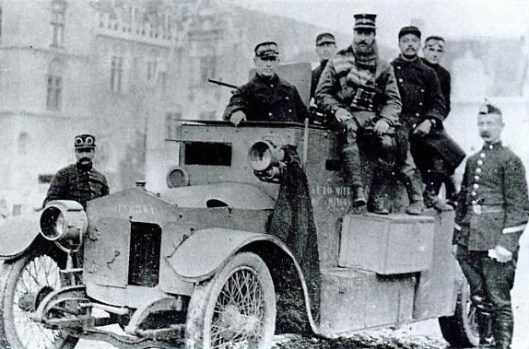
A Belgian Minerva crew similar to those depicted in Cafard

A 1914 Belgian Minerva crew similar to those depicted in Cafard

I ventured to Queens on the N Train today to catch a screening of Cafard. This animated film depicts the Great War as experienced by a group of Belgian friends and family. The protagonist is Jean Mordant, who we see winning the 1914 world wrestling championship in Buenos Aires at the same moment his fifteen year old daughter home in Ostend is raped by a group of German soldiers at a checkpoint. Eager for revenge Mordant enlists in the Belgian ACM, or armoured car division. As the war grinds on his service takes him literally around the world through various parts of Russia, Mongolia, China, San Fransisco and New York. The war’s reach is sometimes lost on us today, probably because we think of globalization as a twenty-first century phenomenon.

The film logs in at just over ninety minutes. I found the film worthwhile but sometimes a little strained and overdone. Still, I suppose it is okay to be a little overwrought when depicting something as tragic as the Great War. In an animated feature there is also more leeway to exaggerate for effect. One thing I liked about the film is that it captured the world wide reach of the conflict, especially in its handling of the Russian Revolution and its consequences. The film does a good job of showing how easy it is for individuals to get tangled in events bigger than themselves, and how little control a person has in that situation. It is a very unsettling notion. Cafard is not for the faint of heart but if one is looking for a contemporary film that depicts the First World War through both a narrow and wide lens this is a good one to check out. With all its tragedy, it even ends on a hopeful note.


Preparedness Day 1916

Boy Scouts pose with Theodore Roosevelt, May 13, 1916

Boy Scouts pose with Theodore Roosevelt, May 13, 1916

Here is an incredible photo that was taken one hundred years ago today.

May 13, 1916 was Preparedness Day, during which parades advocating for American military planning were held in various locales. This image was taken in Oyster Bay, Long Island, where Theodore Roosevelt led several Preparedness events in his hometown. Here he is on the veranda at Sagamore Hill with a contingent of Boy Scouts. Conspicuously absent from the photo is his wife Edith, who was attending a Preparedness event in Manhattan accompanied by their daughter Ethel Derby, their son Thedore Jr., and Ted’s wife Eleanor. It’s a hunch but I imagine a reason Roosevelt stayed so close to home was that by now he was too infirm to march in that bigger event being held in the city.

(image/Library of Congress)

The NPS’s Reconstruction

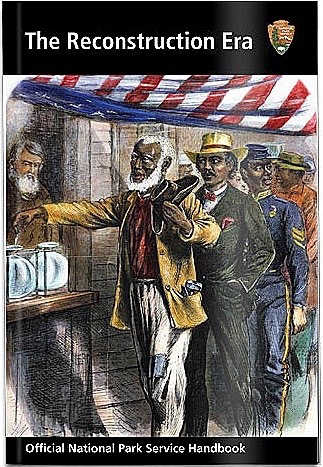
large-271953 Reconstruction_eraWhen I was at the Lee Mansion at Arlington a few weeks ago I picked up a copy of the NPS handbook on the Reconstruction Era. The handbook was published in March and follows the same formula as the NPS offerings about the Civil War, War of 1812, American Revolution and other topics. It contains 12-15 chapters on various topics on the events of 1865-77 from a number of perspectives. What I like so much about these handbooks is that they contain the latest scholarship and interpretation written by leading scholars on the subject at hand. This one has essays by David Blight and Brooks Simpson, among others. Those who followed the Civil War sesquicentennial know that it was quite consciously a do-over of the failed centennial in the 1960s. Professional historians and interpreters have changed our understanding of Reconstruction. One can imagine what Robert E. Lee would have thought about people buying such a title in the gift shop at was once his home. Still the general public has been less quick to catch up to the historians. I suppose it is not all that surprising; the late 1860s and 70s were not an especially heroic time in our history to put it mildly.

Other than Governors Island, the Park Service has few sites that deal directly with WW1. Still I would love to see Eastern National put something together during the centennial. If not the NPS, I guess it would fall to the American Battle Monuments Commission. I think there is enough to put something together, but we shall see. In the meantime make sure to consider this new offering about an era in American history that still shapes our lives in so many ways.

May

IMG_3129Good morning, all. It’s hard to believe it is May. I got back from Virginia last night. I went there for a long weekend over spring break. I spent a good part of Saturday in Arlington Cemetery, touring the Lee Mansion and taking photos of headstones for a series I will be doing in the lead-up to the start of the Governors Island season later this month. From what I understand some of the seasonals are returning to work today. Our school semester ends in three weeks. When I was in Arlington I came William Howard Taft’s headstone. I had a good conversation here with a guy from Illinois who is visiting and photographing the graves of every Congressional Medal of Honor recipient. He said he’s been at it for fifteen years now. Meeting folks like that is always special. It was a nice overcast day, perfect for being outside for an extended period.

U.S. president and Supreme Court Chief Justice William H. Taft rests today in Arlington National Cemetery.

U.S. president and Supreme Court Chief Justice William H. Taft rests today in Arlington National Cemetery.

The Easter Rising

Jeremiah C. Lynch was caught up in the Easter Rising in April 1916.

Jeremiah C. Lynch was caught up in the Easter Rising in April 1916.

Easter 2016 was in late March, but a century ago it fell on April 23. If Verdun was the seminal event of winter 1916, and the Somme the pressing issue of the summer, then the Easter Rising was the key event of that spring. Strange as it sounds, it’s hard for people to imagine how international the Great War was. I imagine this is because we think of globalization as a twenty-first century phenomenon. The war was of concern to people throughout the world however. It is worth noting that 200,000 Irish had fought in the British Army up to that point in the war. The Great War had implications for Americans of all nationalities. Irish and German Americans were watching events in far off Europe with especially keen interest. Nowhere was this truer than New York City with its large immigrant communities. The city’s many German-language newspapers covered the war in detail, and the Irish press was doing the same.

One New Yorker who got caught up in the Easter Rising was naturalized American Jeremiah C. Lynch. Lynch was twenty when he came to the United States and remained active in the Irish cause. He was in his early forties when the war began, and was working in Dublin as an insurance agent for the Cotten Exchange when the Easter Rising started on April 24. He was quickly arrested, found guilty, and sentenced to execution. The British were wasting no time; he was scheduled to face a firing squad at 4:00 am British time on May 19. Senator James A. O’Gorman (D-NY) asked the Wilson Administration to intervene with the British government for a stay of execution. Working feverishly, Wilson had directed the American Ambassador Walter Hines Page to press for some sort of clemency. Page was well-positioned to plead for leniency; he was extremely Anglophilic and understood the complexities and tensions under which the British government was working on a number of issues. J.C. Lynch’s punishment was eventually commuted to ten years in prison.

(image/Library of Congress)

April at the NYBG

pic 2

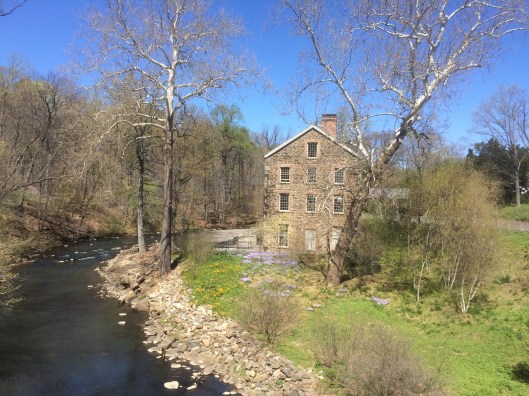
I took advantage of the beautiful weather to visit the New York Botanical Garden in the Bronx. I was there strictly for pleasure, not work, but it is worth noting that one of the co-founders of the NYBG was William E. Dodge Jr. Dodge was a good friend of Theodore Roosevelt Sr. They created and ran the Allotment Commission during the Civil War, among other things. It’s interesting to speculate on how much more Senior would have done had he not died in his mid-forties. One would have to think he might have been involved in the endeavor to brig a botanical garden to New York City. The garden opened in 1891, and is thus celebrating its 125th anniversary. Enough of that though. Just enjoy the pics.pic 6

pic 3

pic 5

pic 1