Hemingway and Roosevelt: cub reporters

Theodore Roosevelt officially began his journalism career with the Kansas City Star on October 1, 1917. With typical Rooseveltian vigor however, he wrote a few stories in the weeks leading up to his official start date; Roosevelt was typing away at a desk at Star headquarters on Saturday September 22nd. He used his platform at the newspaper primarily as a vehicle to excoriate Woodrow Wilson and his Great War policies. After that brief September stay Roosevelt returned to Oyster Bay, where he dutifully filed dispatches until his death in January 1919. Roosevelt’s collected output for the Star, published in book form in 1921, runs 295 pages.

A few weeks after Roosevelt’s debut with the Star another cub reporter joined the staff: Ernest Hemingway. Hemingway began on October 18th, less than three weeks after Roosevelt. For the next six months he wrote the types of stories—fires, accidents, petty crime—to which young reporters are invariably assigned. He was only a teenager. Hemingway always maintained that the Star’s daily grind was the best thing that happened to his writing career.

Grover Cleveland Alexander was the ninth inductee and fourth pitcher inducted into the Baseball Hall of Fame

Grover Cleveland Alexander was the ninth honoree, and fourth pitcher, inducted into the Baseball Hall of Fame. He entered Cooperstown in 1938.

It had its moments. In March 1918 young Hemingway met pitching great Grover Cleveland Alexander at Kansas City’s Union Station. The right hander was en route to California to join the Cubs in spring training. Hemingway dutifully filed a report. After all he had a scoop on his hands: The pitcher wanted a $10,000 signing bonus. The Cubs saw things differently and the two sides were at an impasse. That Alexander was even thinking of going to California to join the team was a story.

Alexander only pitched three games for Chicago that season, though he did go 2-1 with a 1.73 ERA. Hemingway was not long for the Star. He left the newspaper a month later. By mid-summer both were in Europe helping the Allied cause. Hemingway was driving an ambulance in Italy and “Old Pete” Alexander—now in his thirties—was wearing an A.E.F. uniform in France.

The war was hard on Alexander. He already suffered from epilepsy and his military experiences exacerbated an already growing drinking problem. He almost certainly suffered from post-traumatic stress disorder. Still, when he returned Alexander had plenty of baseball left in him. In 1926 he led the St. Louis Cardinals to a World Series title over Babe Ruth’s Yankees. Alexander went 2-0 (two complete games) and had a game seven save to seal the deal. He pitches 20 1/3 innings and had a 1.33 era. Babe Ruth ended the series when, with Alexander on the mound, he unsuccessfully tried to steal second base.

That same year Ernest Hemingway published The Sun Also Rises, his story of the disilussioned Lost Generation living in Paris after the war. Future decades proved difficulty for both men but the Twenties were good years. Alexander was a twenty-one game winner at the age of forty in 1927. The aging star posted winning records in 1928 and again the following year. Hemingway’s career was now in full swing. He published A Farewell to Arms in 1929.

(image/Library of Congress)
Frum on the limits of exceptionalism

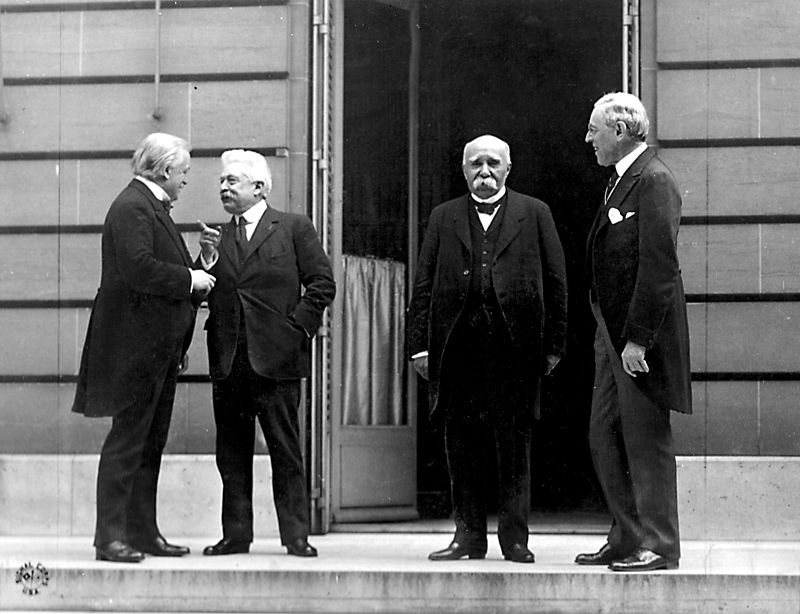
The Big Four at the Paris peace conference, May 27, 1919

The Big Four at the Paris peace conference, May 27, 1919

David Frum, recently returned from a trip to France, has written a sobering and thought-provoking editorial about the lessons he believes Americans should take when commemorating the Great War. I am not the type to wring my hands but Frum offers much to dwell on. I agree with him that the world of 2015 looks much more like the world of 1920 than of 1945. That said, the years after the Japanese surrender on the Missouri were much darker and more violent than we tend to remember. This was true in Europe and truer still in other parts of the world.

This evening when I got home the latest copy of Civil War Monitor was waiting for me in the mailbox. It is the special “War is Over” issue. The past four years have added much to our understanding of the causes and consequences of the War of the Rebellion. The myth of the Lost Cause is held on to now only by the most bitter of bitter enders. They’re still there, but have pretty much lost the war of ideas. In that sense the sesquicentennial served its function. The Great War never had a romantic mythology of its own because the ideas for which Americans went to war, such as Wilson’s Fourteen Points and the League of Nations, came to nothing so quickly. It might be, as Margaret McMillan argues in Paris 1919, that the leaders in Versailles did the best they could given the circumstances. And the circumstances were indeed complicated. I hope Americans, Europeans, and people around the world think soberly about the events of 1914-1919 and what they can teach us in our own difficult times.

(image/”Big four” by Edward N. Jackson (US Army Signal Corps) – U.S. Signal Corps photo. Licensed under Public Domain via Wikimedia Commons – http://commons.wikimedia.org/wiki/File:Big_four.jpg#/media/File:Big_four.jpg)

A quick take at the the Grant-Greeley campaign

In the May 11, 1872 issue of Harper's Weekly Thomas Nast railed against Carl Schurz and other Republicans who were abandoning Ulysses S. Grant in the upcoming election. Like Greeley, Nat was a member of the Union League Club of New York.

In the May 11, 1872 issue of Harper’s Weekly Thomas Nast railed against Carl Schurz and other Republicans who were abandoning Ulysses S. Grant for Horace Greeley in the upcoming election. Like Greeley and many of the other players, Nast was a member of the Union League Club of New York. Nast had attended the meeting for Grant at the Cooper Institute a few weeks previously.

I was in the city this past Friday to attend some work-related meetings. There was a gap between the two functions and with time to kill I walked up the block to the New York Public Library on 42nd Street. I started searching a few of the old newspaper databases more or less at random when I stumbled upon a small article in the April 18, 1872 Baltimore Sun. It described a meeting held at the Cooper Institute in New York City at 7:00 pm the evening before. The Friends of Grant were holding a rally for the re-election of the president. Grant was running against newspaperman Horace Greeley. What made the 1872 election so interesting was that it exposed a schism within the Republican Party that never fully healed, despite the fact that the Party of Lincoln held on to national power for most of the late nineteenth and early twentieth centuries.

It was fitting, and probably not coincidental, that the Friends of Grant were meeting at Cooper Institute; it was there in February 1860 that Lincoln had given the address that launched him to national prominence. In attendance that spring evening in support of Grant twelve years later were such heavy hitters as Henry Ward Beecher, Thurlow Weed, Peter Cooper, shopping magnate A.T. Stewart, Thomas Nast, Roscoe Conkling, and Theodore Roosevelt Sr.

What made the election so emotional was that Greeley had once been a passionate advocate for Lincoln, the Party, and the Union cause. After the war however he grew frustrated with the way the country was going; he even helped raise Jefferson Davis’s bail. Greeley’s defection, if that’s what it was, cost him. In a drawn out process he was nearly expelled from the Union League Club. He of course lost to Grant in November 1872 and died died later that same month. In a reconciliationist gesture Grant attended Greeley’s funeral.

That is all fascinating enough, but the undercurrents are even more intriguing. Just five years later Senator Conkling became involved in a bitter dispute to keep Theodore Roosevelt Sr. from becoming the head of the U.S. Custom House in New York during the Rutherford B. Hayes Administration. Other subplots were also  in play. In 1872 Carl Schurz supported Greeley. Four years later Schurz returned to the fold and supported Hayes. He was rewarded with an appointment as Secretary of the Interior. In 1884 he and other Mugwumps would support Grover Cleveland over GOP candidate James Blaine. Theodore Roosevelt Sr. was gone by this time, but his son held his nose and stayed with the Party and Blaine. Schulz supported Bryan over Roosevelt in 1900.

Too often people jump from the assassination of Lincoln to the murder of McKinley and the rise of Theodore Roosevelt. That is a major disservice to ourselves and the people who struggled with the complicated issues facing the nation in the years after the Civil War.

(image courtesy of New York Public Library; permalink: http://digitalgallery.nypl.org/nypldigital/id?3905312)

Remembering Joseph Roswell Hawley

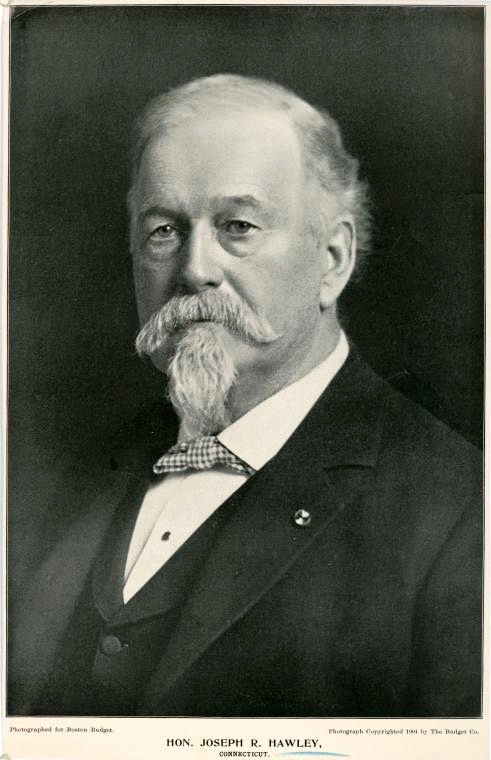
Joseph Roswell Hawley: 1826-1905

Joseph Roswell Hawley: 1826-1905

Joseph Roswell Hawley died 110 years ago today. Longtime readers may remember way back when I mentioned that I was working on a book project about the general. I thought it was a good time for a progress report. The Hawley project is still in the works though it has taken a back seat to the Theodore Roosevelt Sr. monograph. My original intention was to work on both at the same time. That proved to be impossible. Early this past fall I made the decision to go full steam on one or the other. It was difficult because they both mean so much to me. Ultimately it came down to the advice of my wife and one of the rangers at the Theodore Roosevelt Birthplace. Both told me that Roosevelt Sr. should be my focus. And so that’s what it became.

A biography actually came out in late 2013 called ‘Fighting Joe’ Halwey by a journalist from Connecticut named Kevin Murphy. Murphy did a fine job. My book will focus on Hawley’s life in a somewhat different manner. Hawley was a Zelig-like character who always seemed to be where history was being made. Actually the overlap between Hawley and the Roosevelts is quite fascinating. Hawley and Roosevelt Sr. were both friends with Frederick Law Olmsted for instance. Years later, when Hawley was in the Senate and Theodore Roosevelt Sr. was long gone, Hawley was an ally of President Theodore Roosevelt. Hawley left the Senate after eighteen years of service just as Roosevelt was about to be sworn in for that second term in early March 1905. He died two weeks later. As you might be able to tell, I am eager to get back to this. All in due time.

(image/NYPL)

Erik Larson at Roosevelt House

IMG_2050I just got back from Roosevelt House on East 65th Street, where Erik Larson spoke about his just-released book Dead Wake: The Last Crossing of the Lusitania. I have not yet read the book, though I intend to before the 100th anniversary of the ship’s sinking on May 7. I always found it strange that we pay so much attention to the Lusitania and yet neglect other maritime incidents from the war. This is so true that many believe the sinking of the Cunard ship was the direct cause of American involvement in the war. The Americans of course did not come in for another twenty-three months, and even then U.S. troops were slow to mobilize. As Larson pointed out, many ships went down under similar circumstances and are all but forgotten today.

Larson was quite the engaging speaker, telling funny anecdotes but never losing control of the narrative or forgetting the seriousness of the topic. He is one of those writers who has managed to achieve independence and give all his time to writing and researching. That is no mean feat. As befits the topic, he went to many places to find the story. The Hoover Institute and elsewhere here in the United States, and also an extended stay in Europe. He told the audience that he made Paris his base and took research trips to London, Cambridge, Liverpool and Denmark. In that last place he saw the remnants of U-20, the u-boat that sank the Lusitania and grounded a year later on the Danish coast. He described the remnants as looking anticlimactically like “a used refrigerator.”

Material culture seems to be a muse for Larson; he described the poignancy of an archivist bringing out a plank of wood and explaining that it had once been part of the ship. The archivist told him it had washed ashore and was found next to a victim of the sinking. This was the ah-ha moment when Larson realized he had a story to tell and that it wasn’t just about memorizing dates as he once had back in high school. There was worse, including photos taken in British morgues in the days just after the attack.

The subtitle describes the book’s contents. Larson explained that he did not cover too much of the diplomatic wrangling that went over the following months and years. I don’t know if that is good or bad–again, I have not read the book yet. But if he tells the story of this cataclysmic event as well as he described it tonight, he has added something to our understanding of this human tragedy.

The Lost Sketchbooks of Edward Shenton

Camp Meade, Maryland, where 21-year old Edward Shenton and the men in his company arrived on 4 July 1917

Camp Meade, Maryland, 1917: 21-year old Edward Shenton and the men in his company arrived here on July 4 of that year

When I got home from work late on Monday evening there in the mailbox was The Lost Sketchbooks: A Young Artist in the Great War. Its author, Rex Passion, sent it to me after seeing something I had written recently about John W. Thomason. I intend to write more in depth about Rex’s new book after I finish and fully absorb it. I have spent the past few days reading it on the subway during my daily commute. Rex has written the book around the drawings of Edward Shenton. Shenton, who had not heard of until Rex’s initial email, enlisted in the Pennsylvania National Guard in 1917 and served as an engineer in France. Like John W Thomason he was both soldier and artist. Their styles are similar, though I would say Shenton had a greater command of depth while Thomason better depicted motion. Both left a strong visual record of the war as they saw it, from the mundane to the horrific.

Shenton’s sketchbooks were tucked away in family closets and basements before being rediscovered by his descendants a few years ago. Thus began the project to tell Shenton’s story and bring his work to a larger audience. I hope his artwork finds the reception it deserves over the next few years during the centennial.

(image/Library of Congress)

The fourth Roosevelt assistant navy secretary

Henry L. Roosevelt was assistant navy secretary from March 1933 until his death in February 1936. After his death his aid John W. Thomason arranged his funeral at Arlington National Cemetery.

Henry L. Roosevelt was assistant navy secretary from March 1933 until his death in February 1936. After Roosevelt’s death his aid John W. Thomason arranged his funeral at Arlington National Cemetery.

I have been going a little deeper down the John W. Thomason rabbit hole in recent weeks. This morning I finished The World of Col. John W. Thomason USMC by Martha Anne Turner and found it in depth and informative. The book is largely a sympathetic account of Thomason’s life. One interesting sub-theme is the book’s underlying whiff of Lost Causism. The biography was published in 1984 and contains some passages one would not see today. These things are fascinating in and of themselves beyond the subject matter. That’s not what brings me to Thomason here however.

One thing I did not know until reading the book is that he was a long-serving aid to Assistant Navy Secretary Henry L. Roosevelt. Henry L. was the fourth Roosevelt to hold that office, after Theodore, Franklin, and Ted. There was even a fifth if one counts Corinne’s son, Theodore Douglas Robinson. Henry L. was appointed by his cousin FDR in March 1933. It was an interesting moment in history. Military men like Henry L. Roosevelt, John Thomason and others had come up in the late nineteenth and early twentieth century, fought in the Great War and then toiled away in anonymity in the interwar years. Like seemingly all the Roosevelts Henry had an enormous capacity for work. Thankfully in Thomason he had an adjutant who was up for the task.

There is an interesting scene in the book where the two men are meeting with President Roosevelt. Going by his letters home, one gathers that Thomason did not think much of FDR as president. The Democratic Party was a big tent in the 1930s, with urban Northeasterners like Franklin Roosevelt aligned with conservative Dixicrats such as his own vice president, Cactus Jack Garner. Thomason fit into the later category, though as a military man he kept his opinions to himself. It is interesting to note, however, the high regard Thomason had for Franklin Delano Roosevelt as assistant navy secretary during the Wilson Administration. It is an aspect of FDR’s career that we often give short shrift. He was an integral part of the Preparedness Movement and did much to keep the Navy afloat, especially in Wilson’s first term.

(image/University of Houston)


What’s in a name?

IMG_2014One thing I often talk about in my talks at Governors Island is the way Americans used to name their offspring. It comes up when we’re standing in front of the Commanding Officers House and discussing Winfield Scott Hancock. Hancock was of course named after Old Fuss and Feathers himself, Winfield Scott. Hancock’s own father was Benjamin Franklin Hancock. I wouldn’t put too fine a point on it, but naming one’s children after famous Americans was a way for people to identify with the fledgling nation in the early years of the Republic. Horror writer H.P. Lovecraft’s father was Winfield Scott Lovecraft. Then there is Benjamin Franklin Butler, John Quincy Adams Ward. There is no shortage of examples.

This was a phenomenon that lasted into the twentieth century but seems to have fizzled out around the time of the Great War. I have no way of knowing for sure, but it doesn’t seem anyone was naming their kids after John Pershing or other military figures from that conflict. I suppose by 1918 people were too jaded and the culture just moved on. There was a bit of an uptick during the Depression and WW2 when many named their kids after Franklin Delano Roosevelt.

The reason I bring this up is because of this image I stumbled upon the other day. The caption explains it all. With a little digging I learned that a William H. Signet in Pennsylvania named his twentieth child Theodore Roosevelt Signet. In appreciation the president sent Mr. Signet a letter of thanks in 1903. The image above was taken on November 10, 1923, just three weeks after Roosevelt House opened. What I find striking is the width of the age gap within the group. The Theodore Roosevelts you see here ranged from ten months to twenty-five years old.

Sunday Morning Coffee

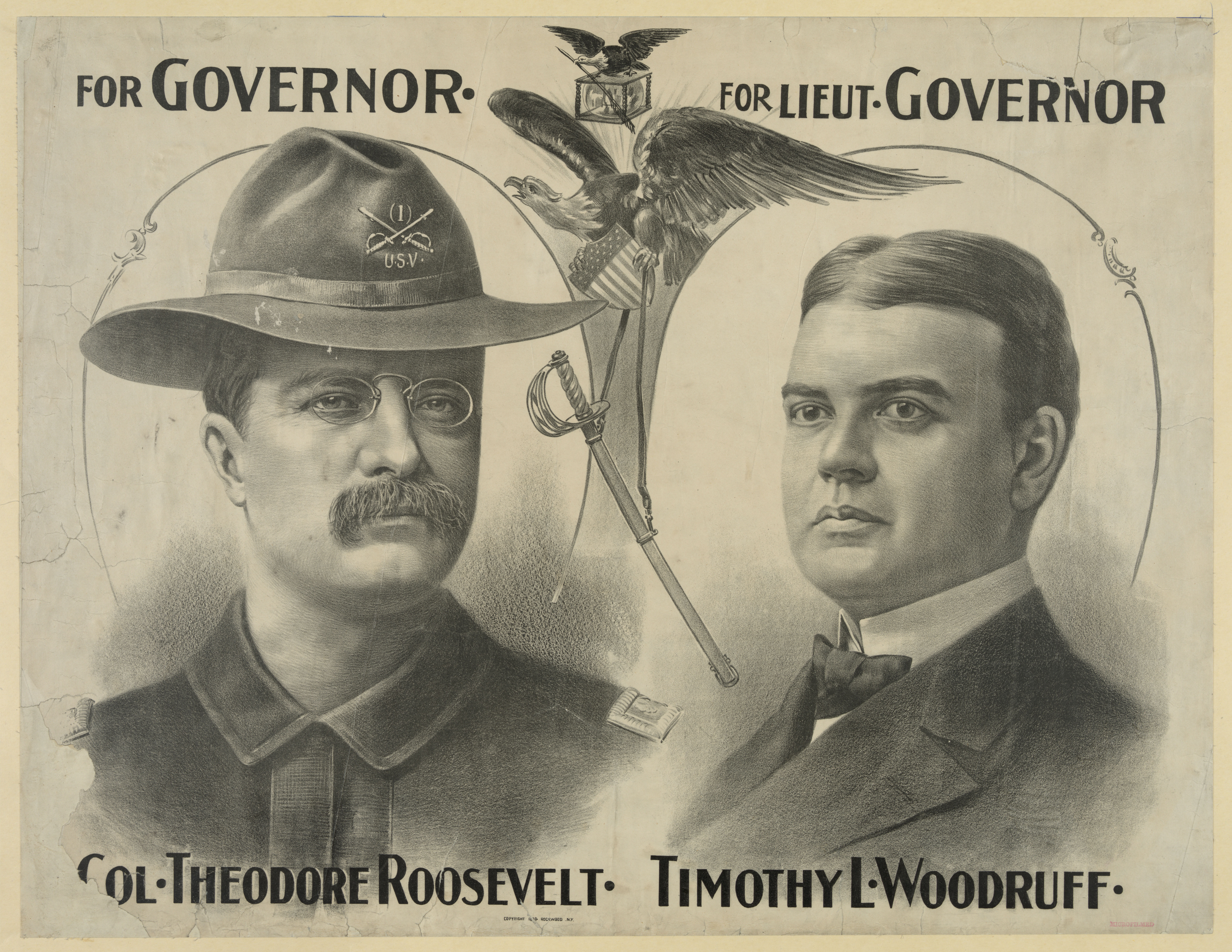
Roosevelt-Woodruff poster (1898)A post last Sunday included a photograph of Leonard Wood. Behind Wood in that image was a campaign poster that I believed was from the 1900 presidential campaign. I could not make out the wording above each candidate’s head and believed it read “The Governor” and “The Governor.” Woodruff also bore a striking resemblance to McKinley. I was in error about the true provenance of the photo.

Earlier this week political consultant and writer Gerry O’Brien contacted me and let me know that the poster actually was from the 1898 New York State gubernatorial race. Gerry also kindly sent me not one but two images of that poster. There it is above. I would like to thank Gerry again for taking the time to respond and to answer so thoughtfully. Check out the link to Gerry’s alternative history novel, 1901: Theodore Roosevelt, Robot Fighter.

A dollar for the RMA

IMG_1958I was at the NYPL Central Library going through old issues of the Roosevelt House Bulletin this afternoon. They are fascinating glimpses into a New York City and an America that no longer exist. There are also tidbits large and small that shed light on the Birthplace. Often I take what I learn in my digging and work it into posts for the Park Service’s social media platforms. Those linked to the TRB Facebook page will see something in the coming weeks about Gene Tunney visiting the Birthplace in 1940. Just remember that you heard about it here first.

My favorite era in the history of the house is the 1920s. For one thing Anna (Bamie) and Corinne were both still alive and leaving their mark on the historic site. It was quite a scramble to raise the funds and to build the house and museum. I am increasingly aware of just how tough the task was. I came across a touching blurb today from one of the 1919 issues of the Roosevelt House Bulletin. (As you can see in the image above, it was later renamed The Roosevelt Quarterly.) The RMA received a contribution of $1 from a private in the 31st Infantry, American Expeditionary Force. What was so incredible is that the 31st was stationed in Siberia at the time. The Siberian Intervention lasted from 1918-22 after the collapse of the Czarist Empire, the Russian surrender at Brest-Litovsk, and the onset of the Russian Civil War. The Americans and other Allies were there to protect the stores of weapons given to the czar and to prevent those weapons from getting into the hands of the participants in the internal struggle now taking place within Russia. From halfway around the world this young doughboy’s dollar made it all the way to New York City and to the headquarters of the Roosevelt Memorial Association.