Booker T. and Theodore break bread

Last night I finished Guest of Honor: Booker T. Washington, Theodore Roosevelt, and the White House Dinner That Shocked a Nation. Deborah Davis’s book tells the story of Booker T. Washington’s October 1901 visit to the White House and the succeeding fallout. African Americans had been guests at the Executive Mansion before; what made this so controversial was that it was the first time a black person had sat sat down there for supper.
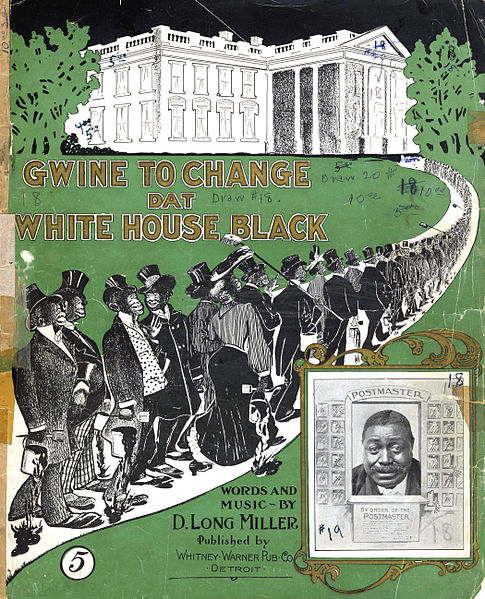
Gwine to Change dat White House Black

Gwine to Change dat White House Black, sheet music

Booker T. and Roosevelt had met previously and, hitting it off, agreed to meet again. The circumstances had changed significantly in the meantime. Now he was President Roosevelt. The youngest president ever had only been in office for all of a month. What’s more, he had ascended to the presidency because of the McKinley assassination, not the electoral process. He was turning to Booker T. for advice on governmental appointments throughout the Land of Dixie. A wise judge of character, Washington proved to be a good consultant.

To say that there was an uproar over the dinner would be an understatement. Bourbon Democrats such as Pitchfork Ben Tillman had a field day explaining the political and sexual implications of the dinner to outraged constituents. Ragtime musician Scott Joplin even wrote an opera, called “A Guest of Honor,” about the episode. Sadly, the musical score has been lost and so we know little about it today other than the title. As you can see from the image above, Joplin was not the only one finding material in the controversy.

The book is an easy read and I learned a great deal about both men, especially Washington. Davis does a good job explaining who these men are and how they arrived at where they are. There is much on the relationship between Washington and W.E.B. DuBois as well.

Roosevelt was taken aback by the controversy and did not have Washington or any other African American to the White House during his presidency. Still, the two had a good working relationship. Many judges, postmasters, and others–white and black–would eventually owe their presidential appointments to Washington’s invisible hand. This was no small think in the impoverished postwar South.

(image/D. Long Miller’s popular song is believed to be a response to Booker T. Washington’s 1901 visit to the White House)

Remembering the Armory Show

This past Friday I went to the New-York Historical Society to see “The Armory Show at 100.” This N-YHS exhibit is in observance of the groundbreaking 1913 event at the 69th Regiment Armory. The 69th Armory is on East 25th Street, not five blocks from the Theodore Roosevelt Birthplace.  Many of the original pieces are on display. I had seen some of them before because many are now famous and situated in major museums. Still, seeing so many in one place is something different entirely.

Roosevelt wasn't much for Wilhelm Lehmbruck's Femme a genoux

Roosevelt wasn’t much for Wilhelm Lehmbruck’s Femme á genoux

The 1913 Armory show was a huge event, attended by many thousands and written about extensively. For many Americans, it was the first time they had seen a Matisse or Picasso. One self-described layman who attended was Theodore himself. In fact, the Colonel even penned a review for Outlook magazine describing his thoughts on the show. “A Layman’s View of an Art Exhibition” hit newsstands on 29 March 1913.

One may not associate art with Theodore Roosevelt but there is a stronger connection than one might realize. When Theodore was a child, the Roosevelts spent considerable time in Europe, Egypt, and the Middle East soaking up art and culture. His father was one of the founders of both the American Museum of Natural History and the Metropolitan Museum of Art. As president, Roosevelt had given a guiding hand in the creation of the Freer Gallery in Washington, D.C. He was also a good friend of sculptors Augustus Saint-Gaudens and Frederic Remington. What’s more, he had sat for many painters over the years, including John Singer Sargent.

So, Roosevelt was a layman but one who knew a little more about the art world than he let on.

Reading Roosevelt’s article one cannot help but think of Marshall McLuhan’s adage that art is whatever you can get with. At one point he compares the Cubists to P.T. Barnum. More than once he calls them extremists. Still, he is not entirely skeptical; at times he is even generous. Modernism per se did not seem to bother him, just certain elements within it. For a man seemingly ambivalent he has a lot to say. In the last line he explains that “All I am trying to do is point out why a layman is grateful to those who arranged this exhibition.”

The show at the New-York Historical Society runs through 23 February 2014.

(image/Armory Show postcard)

Arthur Kennell

799px-Evercemadams_gatehouseOne of the last  vestiges of Dwight Eisenhower’s Gettysburg is no longer with us. Eisenhower’s  local caddy and longtime superintendent of Gettysburg Country Club, Arthur Kennell, has passed away at the age of 86. Kennell worked at the GCC starting in the 1950s and retired in 1976 because he found the job so stressful. That Bicentennial Year he took a job of even greater prominence: caretaker of Evergreen Cemetery. As such, he lived in one of the most recognizable structures in all of Civil War iconography, the Evergreen Gatehouse.

The wife and I visit Gettysburg every summer but it was not until two years ago that we first made it to Evergreen. It instantly became my favorite place in the town. Cemetery Ridge is called Cemetery Ridge because of Evergreen; the fighting went right through it. What I find most touching walking the grounds is the way one sees the history of the battle and the town in front of you. The Culps, the Herbsts, even Gettys himself, are right there. It was all managed in such detail by Mr. Kennell, and now by his son Brian. When he was a kid, Boy Scout Art assisted elderly veterans during Franklin Delano Roosevelt’s 1938 visit for the 75 anniversary of the battle. Now there is a reminder that the war was not long ago in the grand scheme of things. Imagine telling that one to Ike.

What is perhaps most impressive about Mr. Kennell’s work at Evergreen is the manner in which he modernized the cemetery without detracting from its traditions in any way. For instance, in his years of service he gave increased prominence to the women of the town in their service during the war.

Art caddied hundreds of rounds for President Eisenhower adding up to over 1,000 hours on the bag. Having the groundskeeper as one’s caddy would be  decided advantage. He helped design the putting green at the Eisenhower Farm as well. It is sad to know that this unique individual is no longer part of Gettysburg.

(image/Donald E. Coho)

Happy Thanksgiving

Proclamation 776 – Thanksgiving Day, 1907
October 26, 1907

By the President of the United States of America

A Proclamation

Once again the season of the year has come when, in accordance with the custom of our forefathers for generations past, the president appoints a day as the special occasion for all our people to give praise and thanksgiving to God.

During the past year we have been free from famine, from pestilence, from war. We are at peace with all the rest of mankind. Our natural resources are at least as great as those of any other nation. We believe that in ability to develop and take advantage of these resources the average man of this nation stands at least as high as the average man of any other. Nowhere else in the world is there such an opportunity for a free people to develop to the fullest extent all its powers of body, of mind, and of that which stands above both body and mind – character.

Much has been given us from on high, and much will rightly be expected of us in return. Into our care the ten talents have been entrusted; and we are to be pardoned neither if we squander and waste them, nor yet if we hide them in a napkin; for they must be fruitful in our hands. Ever throughout the ages, at all times and among all peoples, prosperity has been fraught with danger, and it behooves us to beseech the Giver of all things that we may not fall into lose of ease and luxury; that we may not lose our sense of moral responsibility; that we may not forget our duty to God, and to our neighbor.

A great democracy like ours, a democracy based upon the principles of orderly liberty, can be perpetuated only if in the heart of ordinary citizens there dwells a keen sense of righteousness, and justice. We should earnestly pray that this spirit of righteousness and justice may grow in the hearts of all of us, and that our souls may be inclined ever more both toward the virtues that tell for gentleness and tenderness, for loving kindness and forbearance, one toward another, and toward those no less necessary virtues that make for manliness and rugged hardihood; for without these qualities neither nation nor individual can rise to the level of greatness.

Now, Therefore, I, Theodore Roosevelt, President of the United States, do set apart Thursday, the 28th day of November, as a day for general Thanksgiving and Prayer, and on that day I recommend that the people shall cease from their daily work, and in their homes or in their churches, meet devoutly to thank the Almighty for the many and great blessings they have received in the past, and to pray that they may be given the strength so to order their lives as to deserve a continuation of these blessings in the future.

In Witness Whereof, I have hereunto set my hand and caused the seal of the United States to be affixed.

Done at the city of Washington, this the 26th day of October in the year of our Lord, 1907, and of the Independence of the United States, the 132nd.

TR's signature


THEODORE ROOSEVELT

(source/The American Presidency Project)

Theodore’s spectacles

E. B. Meyrowitz & Dell Opticians, since 1875

E. B. Meyrowitz & Dell Opticians, since 1875

A friend of mine just got a new pair of glasses. As it turns out, he got his new specs at the same place Theodore Roosevelt got his. Knowing of my interest in TR and my volunteer work at the Birthplace, he grabbed me this brochure.

Eyewear played a significant role in Roosevelt’s life. When he was a boy, young Teedie was bullied on a carriage ride by some older toughs who mocked and bullied him because of his small stature and spectacles, a humiliation he never forgot. Years later he decked a man in a Montana bar for calling him “Four Eyes” and otherwise being a menace. The beat down added to the city slicker’s prestige among the locals, who had previously viewed him as an effete New Yorker and not the rugged outdoorsman and boxer he had been at Harvard. Lieutenant Colonel Roosevelt  reported for duty during the Spanish-American War with multiple pairs on his person; his eyesight was so poor that he was afraid an only pair might get damaged.

Meyrowitz was begun by Emil Bruno Meyrowitz of Prussia, and has been around since 1875. It is kind of cool that it is still here.

Roosevelt and Gettysburg

It is cold here in New York City this morning. Today I am going to catch up on the Gettysburg Address coverage that I did not have time to watch earlier in the week. On Friday a few of us watched the rebroadcast of Walter Cronkite’s covering the JFK assassination. It is worth noting that the assassination came three days after the 100th anniversary of the Gettysburg address, and that this was not lost on people of 1963; it certainly was not lost on the Kennedy family, who modeled the public mourning process at least in part on the events following Lincoln’s killing.

1904 U.S. government map

1904 U.S. government map

Theodore Roosevelt visited Gettysburg in 1904 and again in 1912. Roosevelt had always had a paasionate interest in the Civil War, which is not surprising being that his father did so much for the Union cause while his mother’s family served the Confederacy with equal fervor. The Civil War was personal at 28th East 2oth Street.

President Roosevelt arrived by train early morning on Memorial Day 1904, the entourage first stopping on Reynolds Avenue. One must remember that this was a mere 41 years after the battle and that the war was still part of living memory, not history; there were thousands of living veterans in attendance. The battlefield itself had been in a period of transition for the past decade. Gettysburg National Military Park was founded just nine years prior in 1895. The Electric Railway was now taking visitors across the battlefield. The year of Roosevelt’s visit his Bureau of Forestry planted over 8,000 trees on the grounds. There were still more statues to come, but the monument-building process that had begun in earnest twenty or so years earlier was just about complete by the time Roosevelt arrived in 1904.

The president had a firm grasp of military maneuvering; he had written what was still the authoritative text on the naval campaigns of the War or 1812, served as Assistant Secretary of the Navy, and been a Rough Rider. The group drove the battlefield in carriages  for almost four hours. About halfway through, they were joined by Oliver Howard and Dan Sickles. The generals and the president hit all the highlights, which is what one does when first visiting Gettysburg. They were eventually joined on Little Round Top by William M. Robbins, a major in General Law’s 4th Alabama. His presence may or may not have been coincidental. The 4th Alabama was formed in Dalton, Georgia in 1861; Theodore Roosevelt’s mother was from Roswell, Georgia.

President Roosevelt gave the Memorial Day address from the newly-renovated rostrum in the cemetery. There were 10,000 in attendance. He hit all of the notes–Union, Emancipation, Reconciliation. It is worth noting that 1904 was an election year. Roosevelt had come into office three years earlier not through the election box, but via an assassin’s bullet. He ascended to the White House when McKinley was shot in Buffalo, New York. Roosevelt yearned for the legitimacy that would come with an election victory.

He was almost halfway there. President Roosevelt was nominated by his party at the Republican Convention in Chicago less than a month later. Harry Stillwell Edwards, the Southern writer and postmaster of Macon, Georgia, was chosen to second the nomination.

Gearing up for the Great War centennial

396px-Image068hA few weeks back I mentioned the the passing of Ike Skelton, the recently appointed chairman of the World War One Centennial Commission. To the best of my knowledge, a new chairperson has not yet been selected. In separate but related news, I did note earlier this week that a Director of Strategic Engagement has been appointed at the National World War One Museum in Kansas City. This is significant because the two institutions seem to be working closely together, which makes good sense.

The Great War centennial is something I am going to focus on here on the blog and elsewhere. For one thing, it will tie neatly into my Interp at Governors Island and the Theodore Roosevelt Birthplace. I see from the small announcement I came across that the World War One Museum intends to focus on the war in its entirety, from 1914 all the way through the peace process. I hope the Commission does the same thing, though they seem to be leaning more to concentrating on the American angle.

(drawing/Cyrus Leroy Baldridge)

Sanford Robinson Gifford on sale

Sunday Morning in the Camp of the Seventh Regiment near Washington, D.C., in May 1861

Sunday Morning in the Camp of the Seventh Regiment near Washington, D.C., in May 1861

Christie’s is auctioning Sanford Robinson Gifford’s Sunday Morning in the Camp of the Seventh Regiment near Washington, D.C., in May 1861. The “Silk Stocking Regiment” was one of the first to arrive in the nation’s capitol after the firing on Fort Sumter. The painting has been in the collection of the New York Union League Club since 1871, when it was acquired from the artist. The work is fascinating on many levels: as a historical artifact; a visual representation of the early months of the Rebellion, when it still seemed possible that it would be over quickly (First Bull Run was still two months in the future; note the relaxed poses of the individuals in the scene.); and oh yes, as a work of art. We focus so much on the photographers of the Civil War–Brady, Gardner, et al–that we sometimes forget that it was the painters and sketch artists who gave us much of the war’s visual representation. One can see the unfinished U.S. Capitol and Washington Monument off in the distance.

This work by the Hudson River School artist has been exhibited generously many times over the decades. Sunday Morning was also on loan to the White House from the Ford through Reagan Administrations as well. The auction of this and other American art will be on December 5th. The previous auction for a Gifford is $2.1 million. This work is expected to sell somewhere in the range of $3-$5 million. Someone is going to have a nice Christmas.

(image/Christie’s)

Sanford Robinson Gifford’s Sunday Morning in the Camp of the Seventh Regiment near Washington, D.C., in May 1861More Information: http://artdaily.com/index.asp?int_sec=11&int_new=66244#.UozVcSeJI1I[/url]
Copyright © artdaily.org
Sanford Robinson Gifford’s Sunday Morning in the Camp of the Seventh Regiment near Washington, D.C., in May 1861More Information: http://artdaily.com/index.asp?int_sec=11&int_new=66244#.UozVcSeJI1I[/url]
Copyright © artdaily.org

Sunday morning coffee

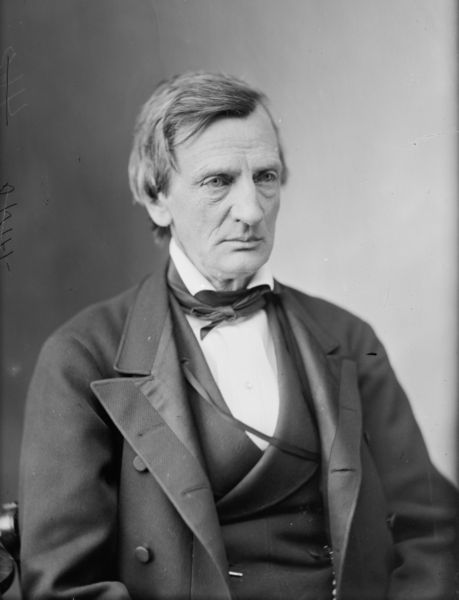
William M. Evarts, 1818-1901

William M. Evarts, 1818-1901

Earlier in the week an obituary for a William M. Evarts Jr. caught my eye. For those who may not know–and it is entirely understandable why one would not–the “original” William M. Evarts was an attorney and political figure from the nineteenth century. Among other things, he was part of Andrew Johnson’s defense team during the president’s impeachment trial. Evarts also represented the United States in its lawsuit against Great Britain when the U.S. was seeking damages over the Alabama incident during the Civil War. Theodore Roosevelt’s uncle, James Bulloch, had been one of the Confederate agents conspiring with the British. Later, Evarts represented Rutherford B. Hayes during the electoral dispute that followed the 1876 presidential race. Hayes would later appoint him Secretary of State. So, you could imagine my surprise when I was that a William M. Evarts Jr. died this week.

A cursory search revealed that this was not the statesman’s son. Evarts died in 1901; Evarts Jr. was born in the 1920s. My curiosity piqued, I went to Ancestry to see what I might find. I do not know how the “Junior” thing works. Maybe you are not a junior if you share your father’s first, but not middle, name? It turns out the man who passed on this week was the great-grandson of the statesman mentioned above. There was the original William Evarts, whose son was Prescott. Next, in the 1880s, came the second William Evarts, who evevtually begat William Maxwell Evarts, Junior.

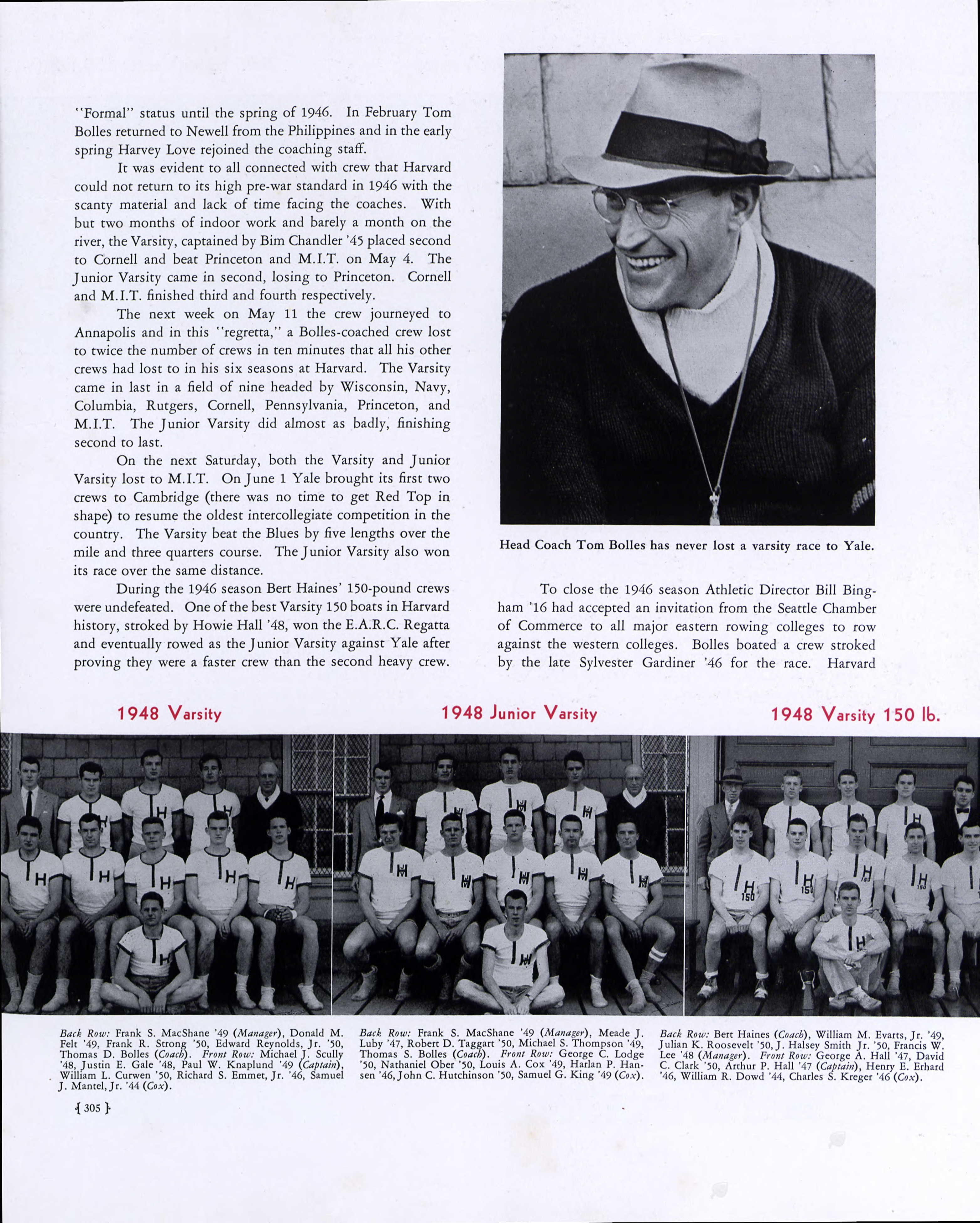
It seems Evarts led a full and productive life of fun and service. Here he is in the Harvard yearbook, standing next to a Julian K. Roosevelt no less.

William M. Evarts Jr. and Julian K. Roosevelt, Harvard crew team, 1948 Varsity 150 pounds

William M. Evarts Jr. and Julian K. Roosevelt: Harvard crew team, 1948 Varsity 150 pounds

Evarts played hockey as well.

Harvard hockey team, 1946-1947

Harvard hockey team, 1946-1947

Evarts Jr. was married to his wife for sixty-five years.

Jefferson Davis's Beauvoir

Jefferson Davis’s Beauvoir

It is hard to believe it is now 2 1/2 years ago, but at the start of the sesquicentennial there was a great piece in the USA Today about the descendants of various Civil War protagonists. If memory serves, they spoke to the relatives of Frederick Douglass, Jeb Stuart, and a few others asking them about their ancestors and what the Civil War means to them today. Last week Ulysses Grant Dietz and Bertram Hayes-Davis met at a professional gathering in Mississippi. Yes, as you may have figured, these are the great, great grandsons of U.S. Grant and Jeff Davis. Dietz is a curator at the Newark Museum of Art in New Jersey, one of the great cultural institutions in the Northeast. Hayes-Davis is the executive director of Beauvoir, the Confederate president’s estate near Biloxi. Apparently the two men are talking loosely of collaborating to whatever degree in the future, which would make sense given their shared histories and professions.

(image/Jeffrey Reed)