• About

The Strawfoot

~ a New Yorker's American History blog

The Strawfoot

Category Archives: Libraries

Adopting the 27th Division

17 Saturday Jun 2017

Posted by Keith Muchowski in 23rd (106th) New York State National Guard Regiment, 27th (New York) Division, Great War centennial, Libraries

≈ 6 Comments

I mentioned to someone connected to the WW1 Centennial Commission last week of my intention to “adopt” the 27th Division during the Great War 100th anniversary. I intend to blog about the division, especially its 23rd (106th) Infantry Regiment, a great deal over the next two years, from its basic training in Spartanburg, South Carolina through its coming home after the Armistice. The 27th is a natural choice for me; it was the only division sent to France comprised of units from only one state, New York. Its 23rd Regiment was from Brooklyn and its armory is today on the National Register of Historic Places. The 23rd served on the Texas border during the Punitive Expedition in 1916. Its unit chaplain was the Reverend S. Parkes Cadman. When the regiment was called into federal service during the Great War it became the 106th. There were so many men, regiments, and divisions that fought in the war that it seems the best way to tell a doughboy story is by finding the general in the particular. That’s why I selected the 27th. Plus, they fought with the British, which gives me a chance to better explore the international aspects of the war.

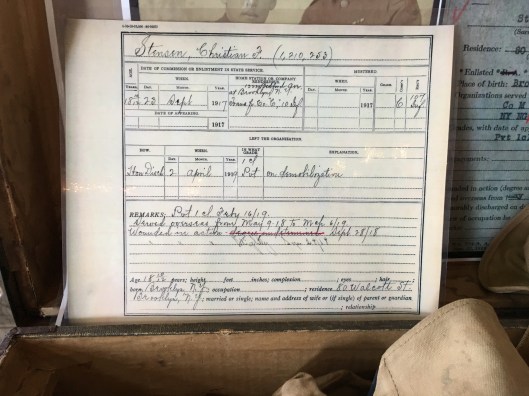
Yesterday when we were at the Library of Congress I saw a man standing in front of a wooden trunk outside the exhibit hall. As it turned out, he was a volunteer and the trunk held the accoutrements of a Brooklyn doughboy named Christian F. Stensen, a private in the 23rd. I had an interesting conversation with the man from the Library of Congress, who graciously showed me Private Stensen’s belongings. We did not know for sure, but we were speculating that the Indian was adopted as a logo because the division’s Orion symbol looks something like a tomahawk. I’ll have more on the Orion symbol itself in a future post. You never know what you will see if you get out there. Whether it is the Park Service, the Library of Congress, or some other institution, yesterday’s experience was testimony to the special role that volunteers play in the telling of our history.

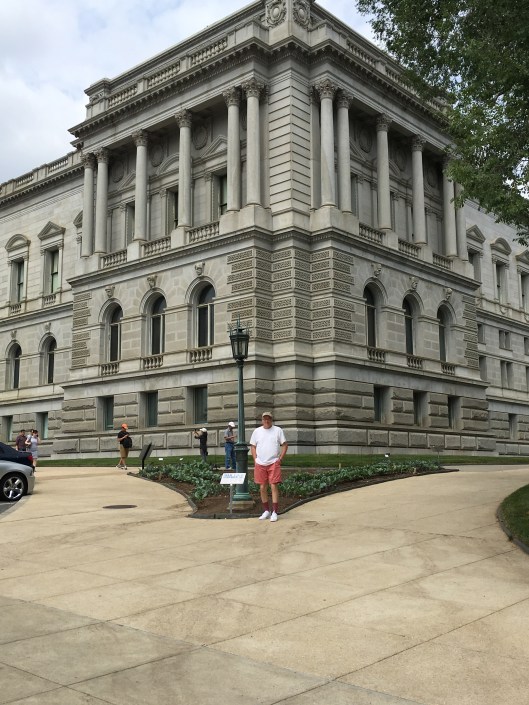
An afternoon at the Library of Congress

16 Friday Jun 2017

Posted by Keith Muchowski in Dwight D. Eisenhower, Great War centennial, Libraries, World War One Centennial Committee for New York City, WW2

≈ Comments Off on An afternoon at the Library of Congress

I was having a conversation with someone last night who noted how many of the images I have used recently on the blog have come from the Library of Congress. I try to mix up the sources, but indeed most of the best photographs for recent posts have come from the LOC’s extensive collections. As a librarian myself, I understand how valuable these resources are to our nation. Not only have I used the library’s image collections, I have utilized the Library of Congress manuscript collections for my book projects as well. And the best thing is, with the internet at our fingertips many of these resources are available to us regardless of where we live or work. They do such a great job, we almost–almost–take it all for granted. Well today I had the good fortune to go with the Hayfoot to the Jefferson Building to see Echoes of the Great War: American Experiences of World War I. The curators did a fine job not just discussing the battles, but the economic, political, and social consequences of the war as well. With our country facing so many issues and uncertainties in our own historical moment, it is comforting to know that we as a nation have weathered times of uncertainty in the past. The challenges vary only in the details.

It is hard to believe the the World War I Centennial Commission Trade Show was three years ago this week, and right here in Washington D.C. no less. Approaching others is not something that comes easily to me, but I made certain at that event to talk to the representatives at every table. I remember having discussions with staff from various museums and cultural institutions, including some people from the Library of Congress’s Veterans History Project of the American Folklife Center. The friend with whom I was speaking last night lost his father, a veteran, not long ago. His father was buried in a military cemetery in a Southern state. I was telling my friend that waiting for my bus in Manhattan yesterday morning I struck up a conversation with a man wearing a WW2 cap. He too was waiting for the bus and was headed to Bethesda to see his daughter and her family, presumably for Father’s Day Weekend. Over our coffees I asked him if he had fought in Europe or the Pacific and he said Europe. He said he was nineteen when he entered the war, which would put him now in his early 90s. He looked more like seventy-five at the oldest. I told him I wrote my master thesis on Dwight Eisenhower and he told me he met the general one time. Eisenhower had come to speak to his unit of about 100 men to explain in person why their transport ship home would be delayed for a week. I know my WW2 well enough to know that troop transport delays homeward immediately after V-E Day were a major snag, though I didn’t say that to the veteran that at the coffee shop. Hearing the man tell the story was an incredible experience I will never forget.

I say all this because I noticed in the outstanding exhibit today that the curators incorporated a good deal of material from the Veterans History Project into Echoes of the Great War. Frank Buckles was the last of the American WW1 veterans, and he himself died over six years ago. If you have a chance, make sure to check out the Library of Congress’s outstanding Echoes of the Great War, which runs through January 2019.

Digitizing FDR

05 Tuesday Jan 2016

Posted by Keith Muchowski in Franklin Delano Roosevelt, Libraries

≈ 1 Comment

Roosevelt (in white pants at center right) and James M. Cox arrive at the White House with reporters in tow prior to their meeting with President Wilson, July 1920. Cox, with FDR as his running mate, lost his presidential bid that year. Roosevelt was assistant secretary of the navy at the time.

Roosevelt (in white pants at center right) and James M. Cox arrive at the White House with reporters in tow prior to their meeting with President Wilson, July 1920. Cox, with FDR as his running mate, lost his presidential bid that year. Roosevelt was assistant secretary of the navy at the time.

There was big news out of Poughkeepsie last month when Marist College, the Roosevelt Institute and the Franklin D. Roosevelt Presidential Library and Museum announced the completion of their effort to digitize FDR’s Master Speech File. The collection contains over 46,000 items spanning the thirty-second president’s long career. It is often lost on us how hard politicians work and the stamina they need to communicate their message to the people. His frenetic pace in advocacy of the Versailles Treaty is what led to Woodrow Wilson’s stroke; we tend to see FDR as being older when he was when he died, and yet he was only sixty-three. At Yalta he looked twenty years older than that. The collection contains not only the audio recordings themselves but the drafts and final texts of Roosevelt’s words. This is a treasure trove for historians, interpreters, and anyone interested in the history of the first half of the twentieth century, especially the World Wars.

(image/Library of Congress)

TRA Boston

01 Thursday Oct 2015

Posted by Keith Muchowski in Libraries, Theodore Roosevelt Birthplace (NPS)

≈ Comments Off on TRA Boston

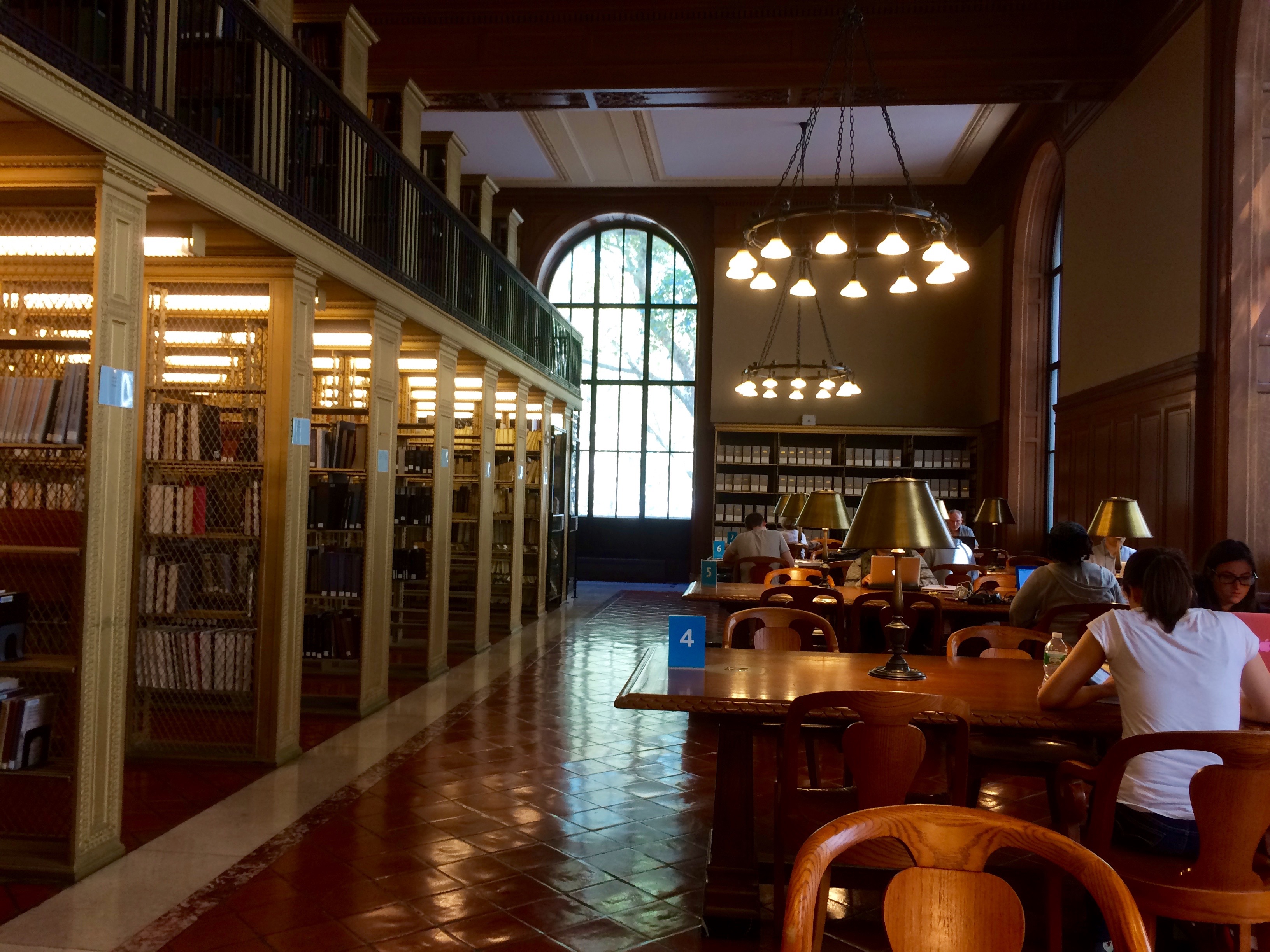
Nora Cordingley worked here at the NYPL in the early 1920s before taking a position at Roosevelt House in 1923.

Nora Cordingley worked here at the NYPL in the early 1920s before taking a position at Roosevelt House in 1923 and then moving to Massachusetts twenty years later.

The Theodore Roosevelt Association’s annual conference is this weekend in Boston. Alas I will not be attending this year. I was talking to a friend the other day, an individual who is quite knowledgeable about Roosevelt, and mentioned to her that Boston is an ideal place to discuss TR and his legacy. Harvard, Alice Hathaway Lee, and Henry Cabot Lodge are all big parts of Theodore Roosevelt’s story with their roots in The Hub. Working on the article I submitted last week, I came across an individual I had never heard of previously: Nora E. Cordingley.

Ms. Cordingley was a Canadian-American who ended up working at the New York Public Library in the early 1900s. In 1923 she took a job at Roosevelt House working under director Hermann Hagedorn. She was there for two full decades; when the Roosevelt Collection moved from East 20th Street to Harvard University in 1943 she moved to Cambridge along with the collection. I was at NYPL a few weeks ago and asked the reference librarian if she had ever heard of Cordingley. She had not. The ref librarian added that NYPL had a training course in the early 1900s–this presumably in the years prior to one’s receiving an MLS from an ALA-accredited school–and that Cordingley may have been here in New York to receive this education. Then, if this is indeed the narrative, after her education and training she moved on to the Roosevelt collection that the RMA was building on East 20th Street.

Cordingley was dedicated to her job. Sadly she died in the Widener Library of a heart attack in March 1951 while editing Roosevelt’s letters. These were the letters that were published in eight volumes in the 1950s under the direction of Elting Morison. Cordingley’s is a moving story that I now think about each time I look up a Roosevelt missive in the set.

A signed Roosevelt Memorial edition

19 Saturday Sep 2015

Posted by Keith Muchowski in Libraries, Theodore Roosevelt Birthplace (NPS), Theodore Roosevelt Jr (President)

≈ 2 Comments

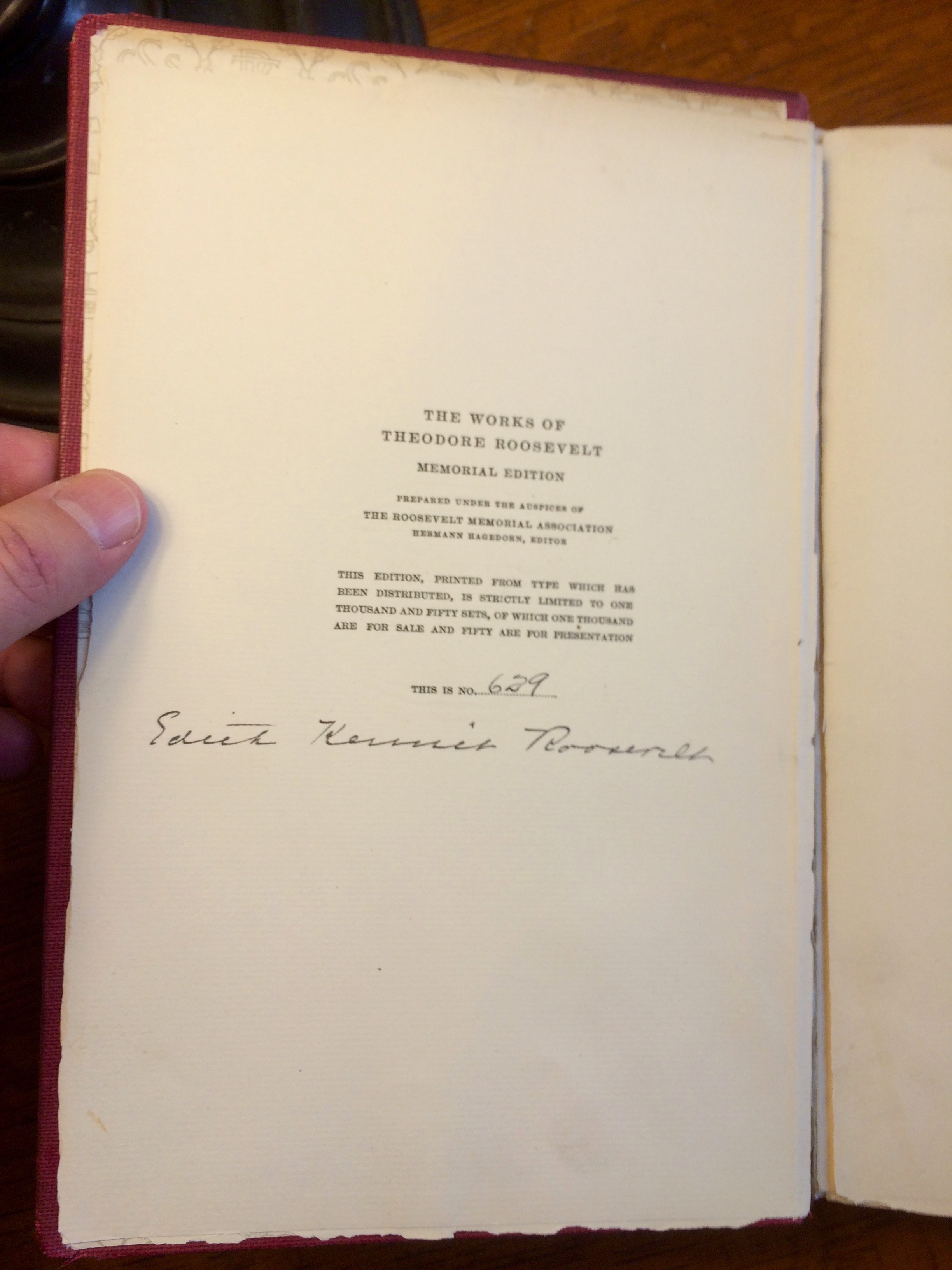
IMG_2700Here is something you don’t see every day. I was at the New York Public Library today doing some research. The book I am holding here is volume 1 of the Memorial Edition of Theodore Roosevelt’s collected works. For those who may not know their TR, Colonel Roosevelt authored over thirty books in his lifetime. I wrote a Facebook post for the TRB page about a year ago. Hermann Hagedorn edited Roosevelt’s books in the mid-1920s. The collected works were then published in two versions, a limited-run Memorial Edition and a larger National Edition for the general public.

There were 1050 sets of the Memorial Edition. This is 629. What really drew my attention is that it is signed by Edith Roosevelt, Theodore’s wife. This thing has been part of the NYPL collection for 90+ years now. It’s amazing to hold such a thing in your hands.

Quentin Roosevelt lantern slides

15 Wednesday Jul 2015

Posted by Keith Muchowski in Film, Sound, & Photography, Libraries

≈ 2 Comments

One of my favorite things in the Theodore Roosevelt Birthplace is the stereoscope in the family library. Stereography was a major medium until moving imagery rendered it obsolete in the early twentieth century. An even earlier method for conveying imagery was the magic lantern. Magic lanterns date back to the seventeenth century and could even depict the illusion of movement by projecting images drawn on glass slides on to a screen via candle light. When daguerreotypes and film came along in the nineteenth century magic lanterns adapted and thrived. Enthusiasts still practice the craft in its many forms today in the digital age.

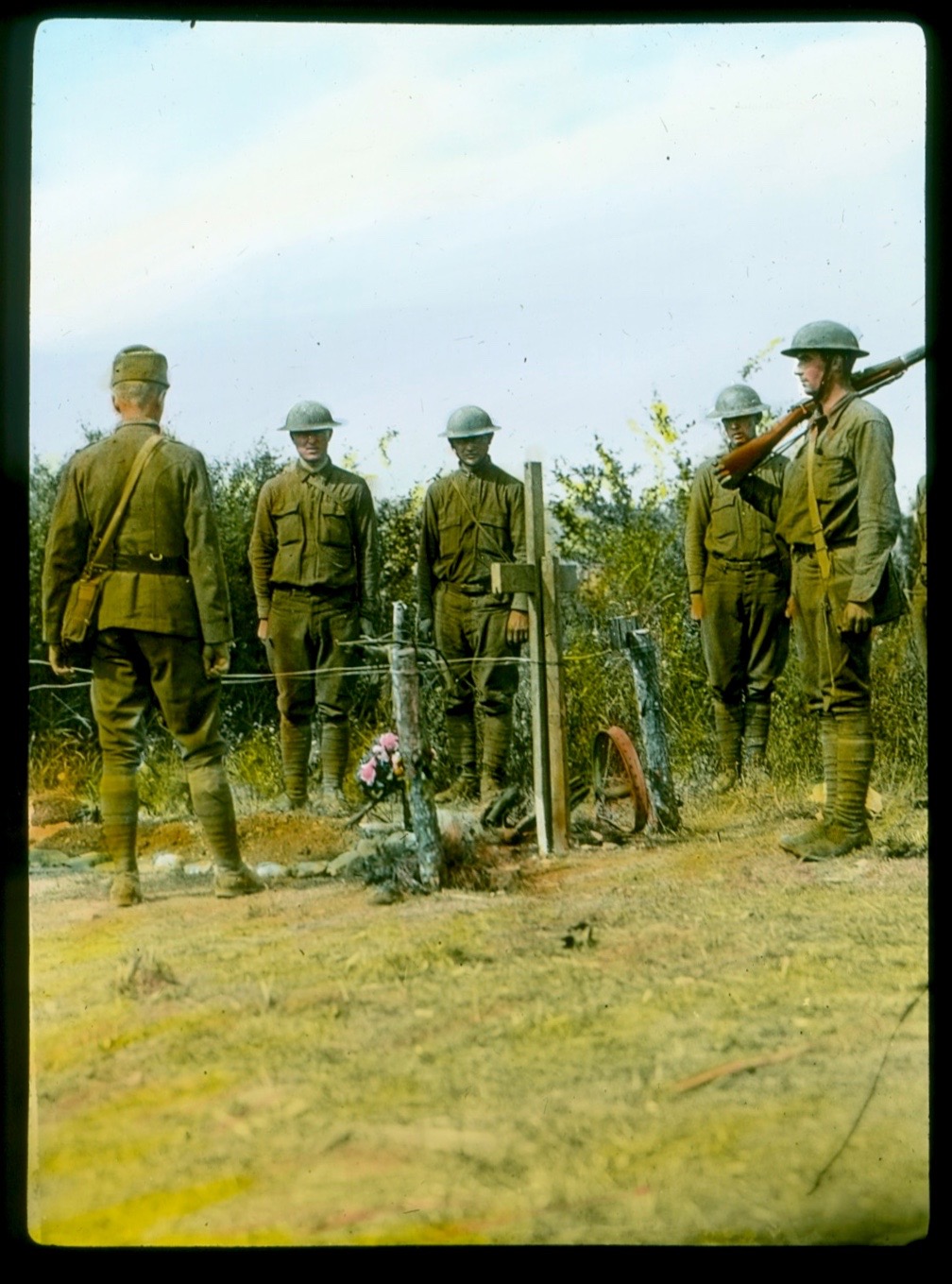
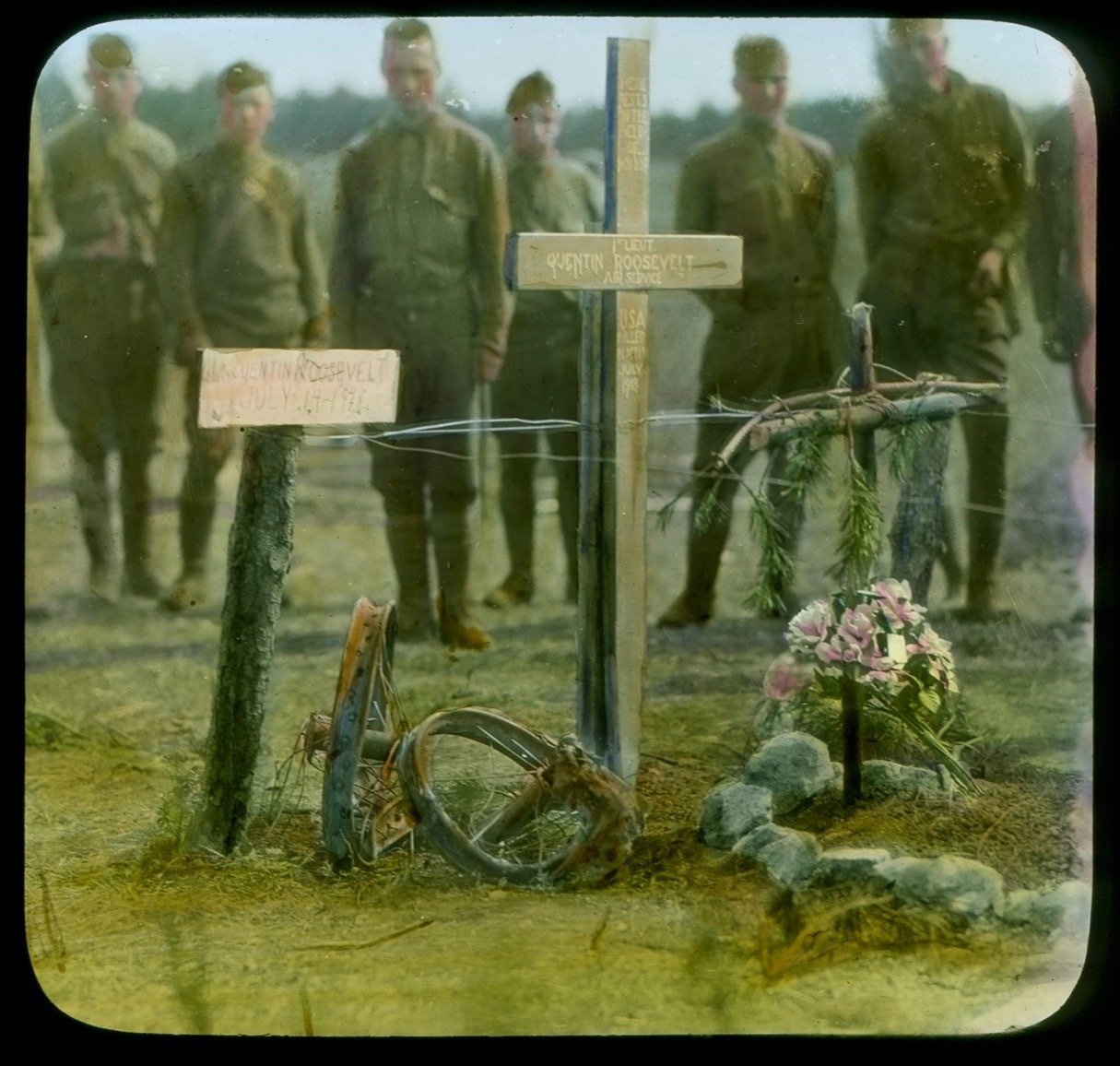
I say all this because, in response to a post on the WW1 Centennial Commission Facebook page, Susan Mitchem of the The Salvation Army National Archives in Virginia noted that her repository holds several lantern slides of Quentin Roosevelt’s original resting place in Chambray, France. You may know that Lieutenant Roosevelt was shot down of Bastille Day 1918, the anniversary of which was yesterday. (In the 1950s Quentin was reinterred in Normandy American Cemetery next to his older brother Ted. Quentin Roosevelt is the only soldier of the Great War to be buried in this cemetery overlooking Omaha Beach.)

Ms. Mitchem said she would be interested in sharing the slides and so I contacted her seeking permission to show them here on The Strawfoot. And so, here you go: two lantern slides of Quentin Roosevelt’s original resting place. The Germans buried him with full military honors and, when the Allies re-took this area shortly thereafter, this site became something of a shrine for soldiers and civilians alike. Pilgrimages such as you see here were quite common.

lantern 3

lantern 1

(images courtesy of The Salvation Army Archives)

The Lost Sketchbooks interview, part 2

17 Friday Apr 2015

Posted by Keith Muchowski in Interviews, Libraries, Media and Web 2.0

≈ 2 Comments

Here is the second and concluding part of the Rex Passion interview. Yesterday’s installment brought Edward Shenton up to the Armistice.

#122 Germans at  Haumont

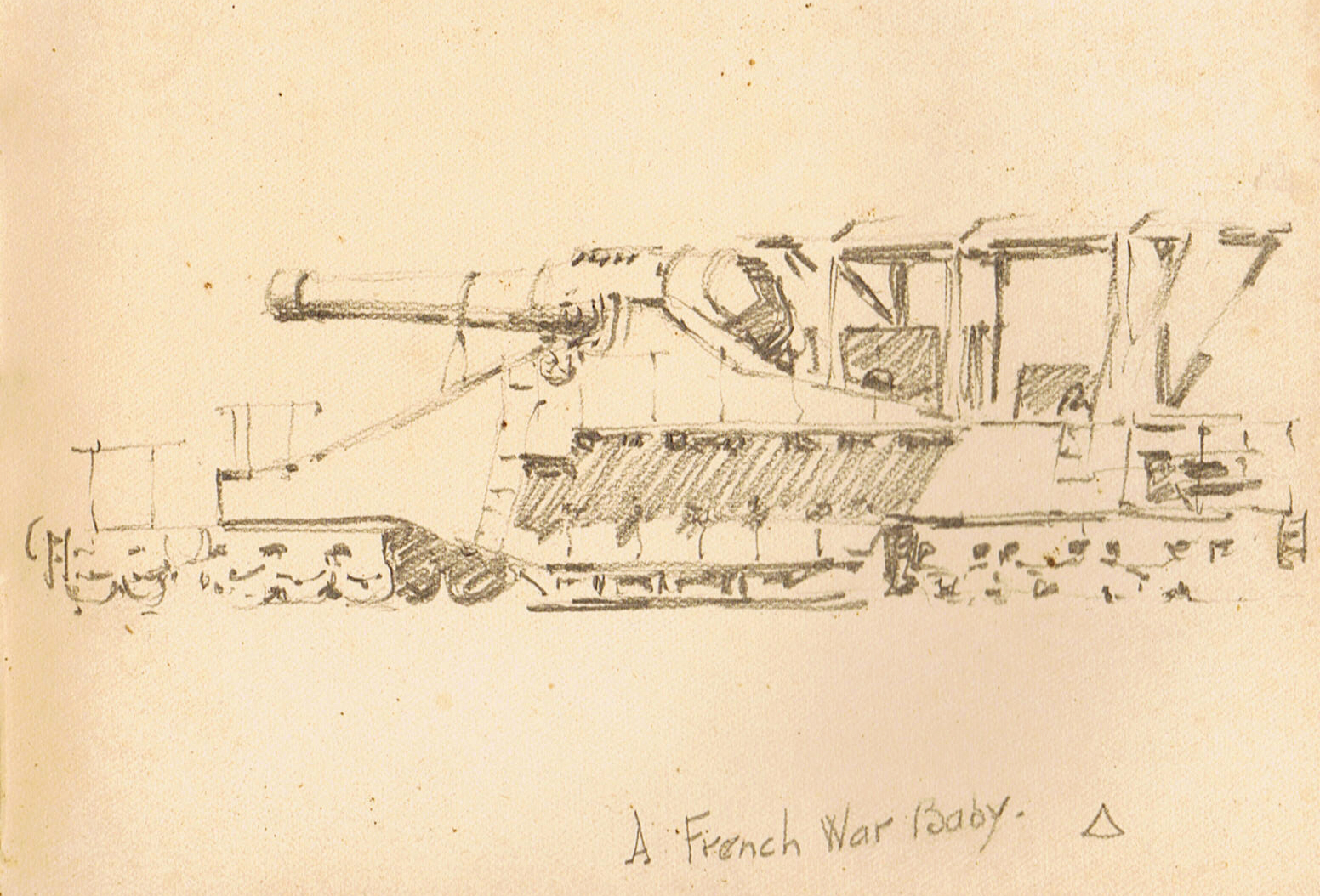
The 28th Division remained in France for six months and as the weeks passed, there was less and less for the soldiers to do and more and more time for Ed to draw. He was in the villages of Vignuelles, Uruffe, Colombey-les-Belles and Le Mans sketching everything he saw before he finally boarded the ship for home.

#134 Railway Gun

#144 Side Show#143 Hospital Train Attendant


On April 20, 1919 the engineers of Company B boarded the SS Finland and sailed back home They marched in a parade down the streets of Philadelphia and celebrated a job well done.

#150 Comin Home

The Strawfoot: What were the conditions under which he made the sketches?

Rex Passion: Before he left for training camp, Ed bought several canvas-bound sketchbooks from Wanamaker’s department store in Philadelphia, along with pencils, graphite sticks and a water color set. In both Camp Meade and Camp Hancock evenings and Sundays were his own and he had a good deal of time to draw. He was able to store his art supplies in a foot locker so he could use the larger (9” x 10 ¾”) sketchbooks and he could also paint with watercolors. All this changed when he shipped overseas.

#22 Meade Sketchbook Cover

#67 Mostly Billets Sketchbook

Once he landed in Calais, he was ordered to store his personal effects and limit his kit to what he could carry on his back. One of the things Ed did was to cut his 6” x 9” sketchbooks in half. I suspect this was to be able to keep them inside his helmet where they would be protected from the weather and especially the mud. The first two drawings in this sketchbook were cut when the book was cut, the others were drawn to fit the smaller pages.

Some of Ed’s wartime sketchbooks were mailed home to his father in Philadelphia and have his address on the cover. Some of the drawings in these books have place names obscured by the sensor
Many of the images from Ed’s time in combat are drawn on larger sheets of loose paper (13 ½” x 9 ¼”). The captions are carefully drawn in ink, but the drawings are done in pencil. There are a couple of instances where sketches in a cut-down sketchbook are very similar to those on a larger sheet. It appears that the sketchbook images were re-drawn at a later date on larger sheets. Perhaps this was even done once Ed was back home.

There are, however, many images on larger sheets for which there is not a corresponding one in a canvas-bound sketchbook. Also, there are no drawings from his trip from the US to France in 1918; all the sea drawings were done on the return trip. Ed would have had a great deal of time to draw on the boat trip over, and many new things to see. Are these sketchbooks still missing? Continue reading →

The Lost Sketchbooks interview, part 1

16 Thursday Apr 2015

Posted by Keith Muchowski in Interviews, Libraries, Media and Web 2.0

≈ Comments Off on The Lost Sketchbooks interview, part 1

Recently I posted about Rex Passion’s new book The Lost Sketchbooks: A Young Artist in the Great War. Rex has performed a labor of love in preserving the voluminous corpus of work Shenton left behind. A few weeks back I sent Rex the link to an article about The Sketchbook Project, a Brooklyn-based library of 33,000+ sketchbooks from around the world. I believe Rex sent them a copy of his new book for their collection. The visual history of the Civil War–Winslow Homer, Alfred Waud, and their contemporaries–has been so well documented. It seems we don’t fully appreciate the visual culture of the First World War to anywhere near the same degree. I am hoping that changes during the Great War Centennial. The public needs to know of the work of such solider/artists as Ed Shenton, John W. Thomason and their counterparts from across the globe who lived and fought in the trenches of 1914-18.

The Strawfoot: Tell us about Edward Shenton and his experience in the First World War.

Rex Passion: At the time the U.S. declared war on Germany, Edward Shenton was in his second year as a full-time art student at the Pennsylvania Museum and School of Industrial Art in Philadelphia. He had just gotten through a very trying and depressing winter and the decision to join the army seems to have cleared away some of the dark clouds.

#20 Mug Wamp

#21 Mugwamp goes to war

Ed and fifteen of his high-school friends joined the Pennsylvania National Guard at the armory in Philadelphia and Ed was assigned to Company apt, 103rd Engineers, which was later attached to the 28 Division. After several weeks of drill and training at the armory, Company B moved to Camp Meade between Baltimore and Washington. The land for the camp had been purchased by the government only weeks before so Ed was present with his sketchbooks as the camp was being built. He kept up his art school habit of drawing what he saw every day.

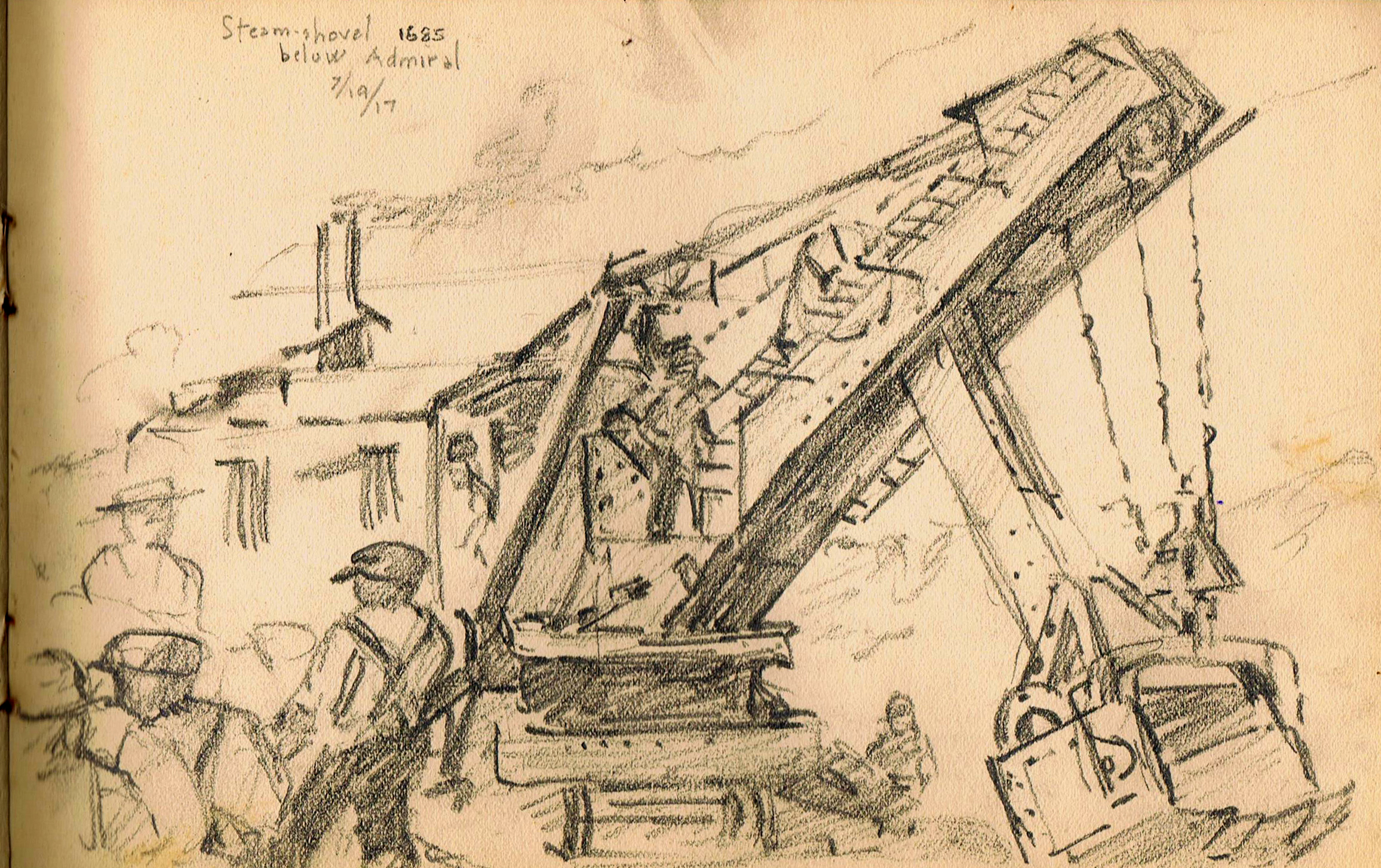
12.14 shovel

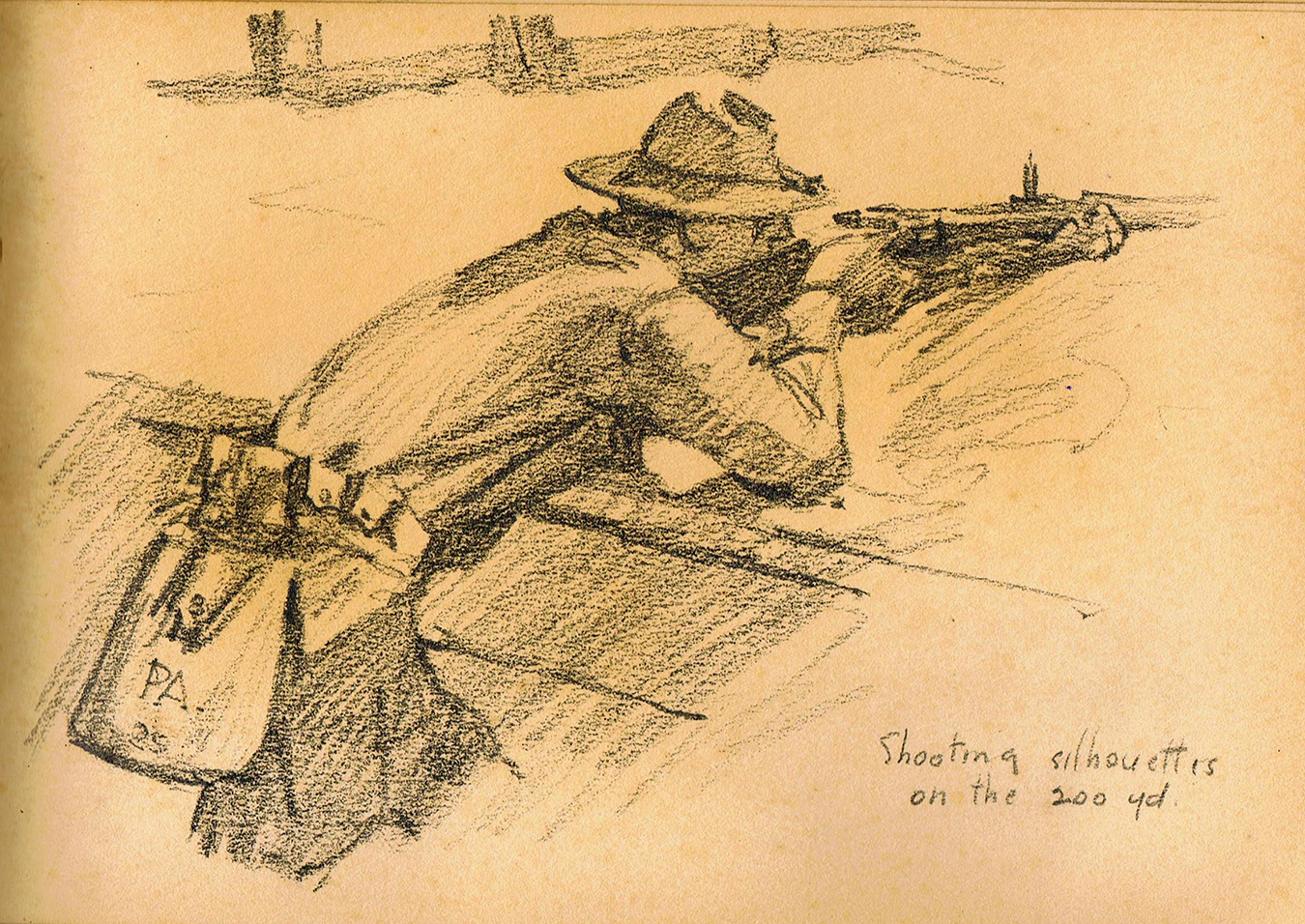
The new recruits spent the spring at Camp Meade then moved to Camp Hancock near Augusta, Georgia where their training intensified. They learned the building and demolition techniques of a combat engineer, but also the craft of an infantry soldier.

#30 pick and shovel gang

#40 Shooting Silhouettes

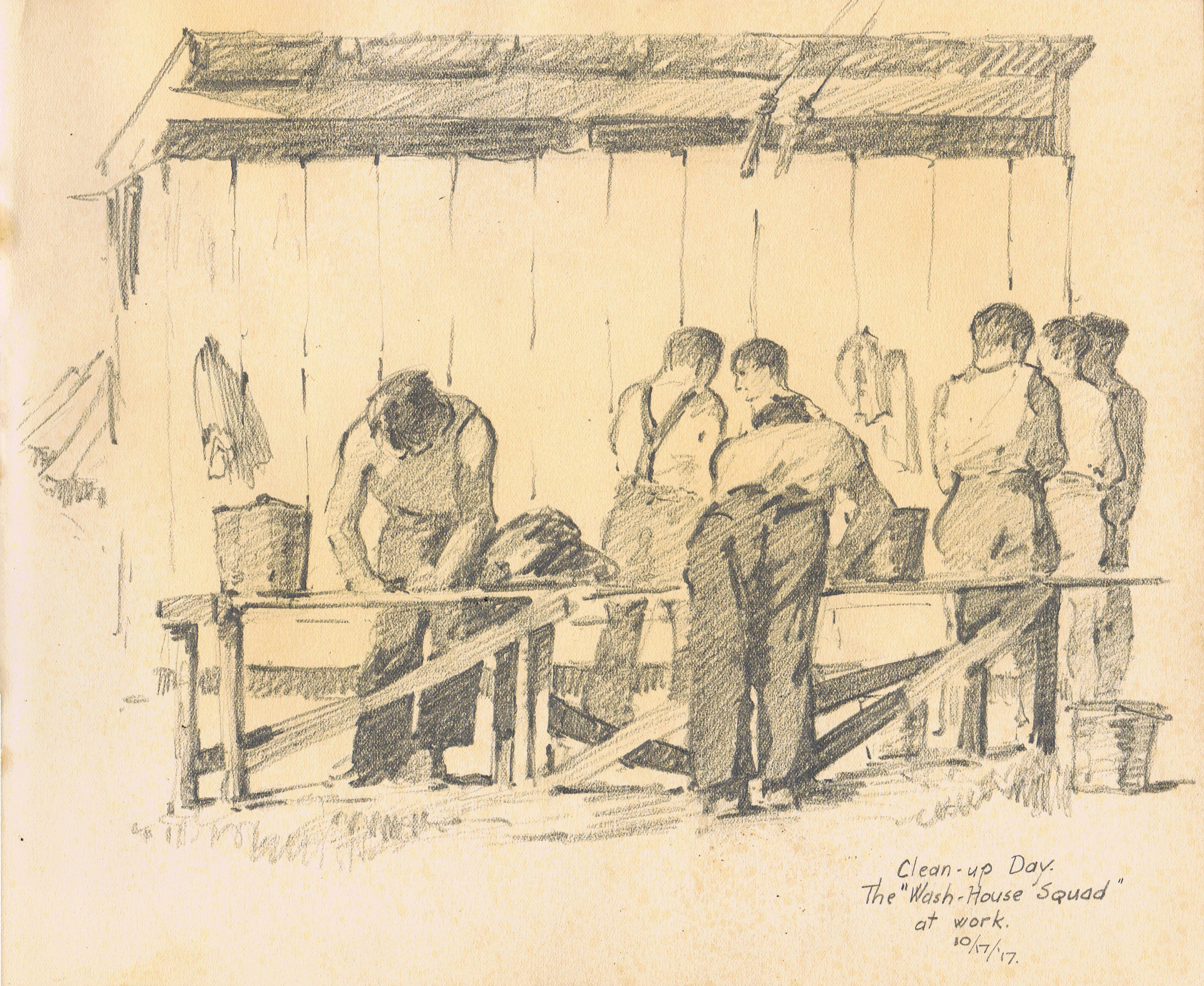
In addition to the soldiers’ training the men of Company B had various camp chores but still found time for a bit of rest and recreation.

2.6

#31 the gamblers

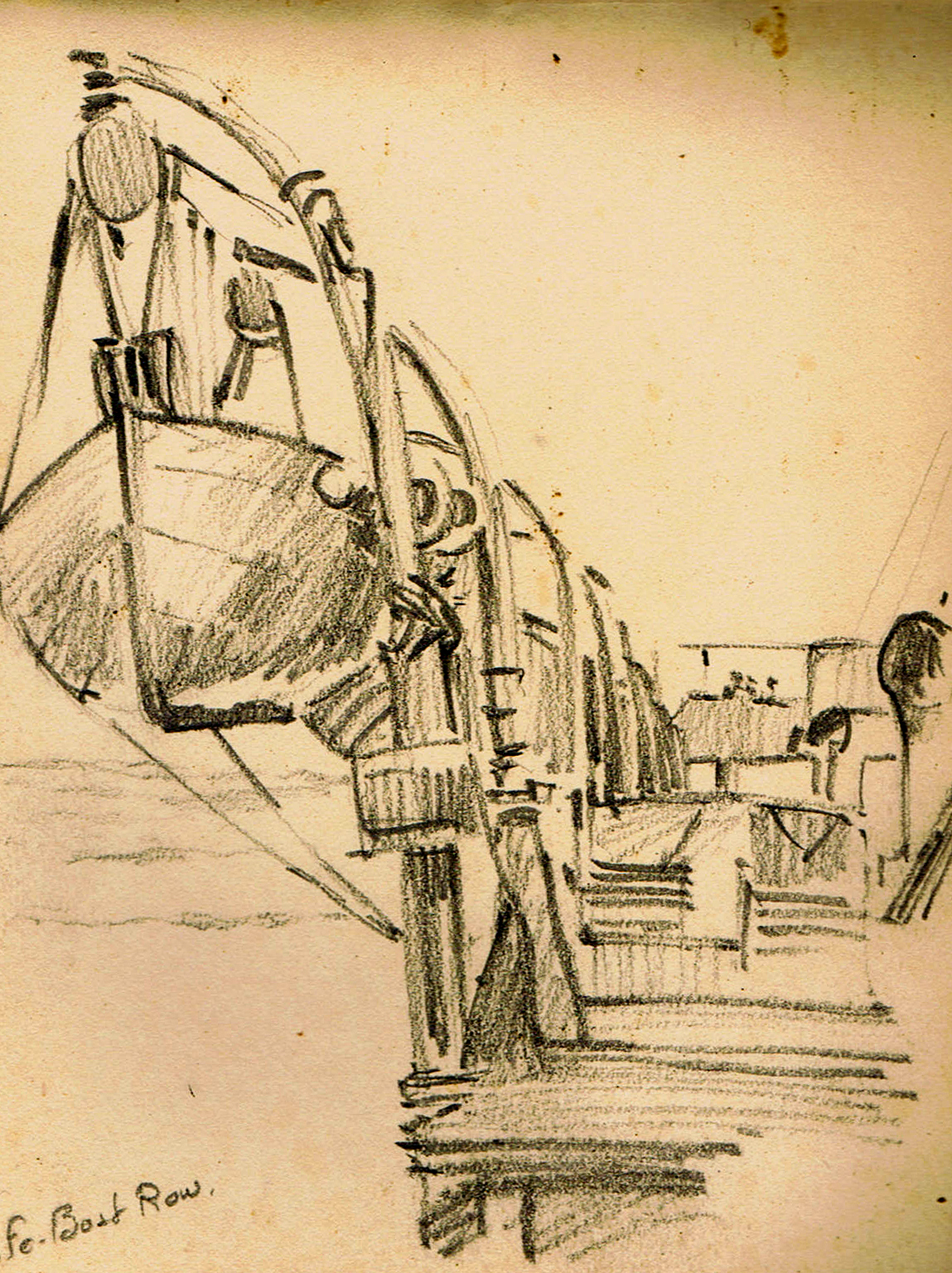
Finally, after nearly a year of training, Ed Shenton and his friends embarked for France and the war.

4.12 life boat row

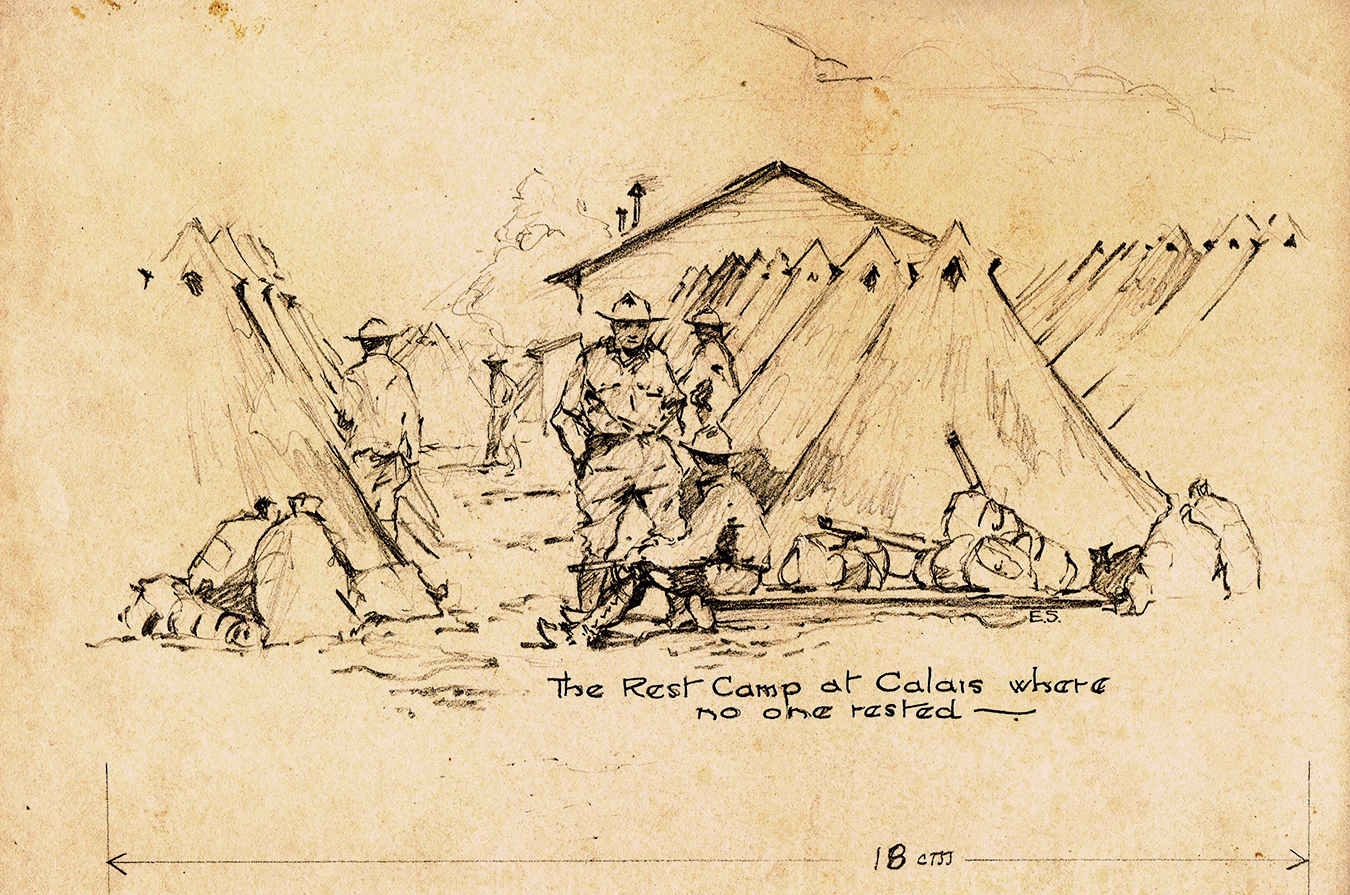
On the first of June they arrived in Calais and after an additional three weeks of training moved toward the front.

#66 Calais Rest Camp

The engineers’ first taste of combat was near the town of Charly-sur-Marne. They lived at a chateau near the river and marched to and from a place called la Canarderie (the duck farm) amid cannon fire and aerial combat. During this period Ed was building trenches all day and only had time to draw after a long days’ work.

#75 The Third Billet, an Old Chateau

On July 14, the engineers were hastily withdrawn from Charly-sur-Marne and redeployed to the east near the town of Condé-en-Brie. On the night of the 15th they marched to a hillside above the town of St. Agnan and the next morning relieved the 109th Infantry, which had been decimated by the advancing Prussian Guard.

#81 Engineers in the Front Line, St. Agnan About noon the advancing Germans started shooting at the Americans and the engineers returned their fire. An hour or two later the Germans started shelling the shallow trench where Ed and his fellows were crouched. Many were wounded and some killed and Ed Shenton had his baptism of fire. Continue reading →

Digitizing the Harlem Hellfighters

30 Sunday Nov 2014

Posted by Keith Muchowski in Genealogy, Libraries

≈ Comments Off on Digitizing the Harlem Hellfighters

index.php

Earlier in the week I finished Richard Slotkin’s Lost Battalions: The Great War and the Crisis of American Nationality. It is a dual history of the 369th Infantry Regiment and the 77th Division. Those looking for a triumphalist account of the war should look elsewhere. Slotkin tells a sobering tale of how and why men joined the Harlem Hellfighters and Melting Pot Division and what they hoped to get out of it. Briefly put, men joined for many reasons. The most important, though, was the idea that they were helping their people by by making this sacrifice. And understand, many of them made the ultimate sacrifice. The hope of the Armistice soon led to disillusionment with the failures of the League of Nations, the social and racial unrest, and the economic difficulties in the 1920s and 1930s.

The 369th was comprised of African Americans from many neighborhoods; the 77th was primarily immigrants who were new to the country. Fittingly Slotkin does not end the story on Armistice Day but takes the story all the way to the mid twentieth century. It was only then, after the Second World War, that social gains began to be made in any meaningful way.

The New York State Military Museum has begun digitizing the military records of the men of the 369th. So far staff and volunteers have digitized 2,500 of the 10,ooo documents. They can be viewed online. Reading them is addictive. The cards go all the way to 1949 and should be invaluable source for both military and social historians. Genealogists will find them useful as well.

(image/NYPL Schomburg Center for Research in Black Culture)

We interrupt this weekend . . .

13 Monday Oct 2014

Posted by Keith Muchowski in Jazz, Libraries

≈ Comments Off on We interrupt this weekend . . .

. . . to note that Coleman Hawkins’s rendition of “Body and Soul” turned seventy-five this week.

The Hawk’s version of the song was not the first, but it was the one that literally became the standard. Ten years ago the National Recording Preservation Board of the Library of Congress added “Body and Soul” to the National Recording Registry. Other entrants that year included Hoagy Carmichael’s “Stardust,” Woodrow Wilson’s Armistice Day 1918 broadcast, and Alexander Scourby’s reading of the King James Bible.

No one–not even the Duke himself–was cooler than Bean. Enjoy.


← Older posts
Newer posts →

Enter your email address to subscribe to this blog and receive notifications of new posts by email.

Join 258 other subscribers

Categories

Archives

  • November 2023 (1)
  • October 2023 (3)
  • September 2023 (3)
  • August 2023 (4)
  • July 2023 (7)
  • June 2023 (10)
  • May 2023 (8)
  • April 2023 (6)
  • March 2023 (5)
  • February 2023 (4)
  • January 2023 (4)
  • December 2022 (4)
  • November 2022 (8)
  • October 2022 (2)
  • September 2022 (4)
  • June 2022 (1)
  • May 2022 (1)
  • April 2022 (13)
  • January 2022 (1)
  • December 2021 (2)
  • November 2021 (1)
  • October 2021 (3)
  • September 2021 (3)
  • August 2021 (5)
  • July 2021 (1)
  • June 2021 (1)
  • May 2021 (4)
  • April 2021 (3)
  • March 2021 (4)
  • February 2021 (7)
  • January 2021 (4)
  • December 2020 (4)
  • November 2020 (3)
  • October 2020 (4)
  • September 2020 (7)
  • August 2020 (5)
  • July 2020 (7)
  • June 2020 (11)
  • May 2020 (7)
  • April 2020 (9)
  • March 2020 (9)
  • February 2020 (7)
  • January 2020 (6)
  • December 2019 (7)
  • November 2019 (9)
  • October 2019 (4)
  • September 2019 (6)
  • August 2019 (10)
  • July 2019 (8)
  • June 2019 (6)
  • May 2019 (9)
  • April 2019 (8)
  • March 2019 (6)
  • February 2019 (8)
  • January 2019 (5)
  • December 2018 (10)
  • November 2018 (6)
  • October 2018 (9)
  • September 2018 (11)
  • August 2018 (11)
  • July 2018 (17)
  • June 2018 (10)
  • May 2018 (8)
  • April 2018 (9)
  • March 2018 (8)
  • February 2018 (5)
  • January 2018 (7)
  • December 2017 (11)
  • November 2017 (8)
  • October 2017 (9)
  • September 2017 (11)
  • August 2017 (12)
  • July 2017 (14)
  • June 2017 (18)
  • May 2017 (11)
  • April 2017 (10)
  • March 2017 (9)
  • February 2017 (11)
  • January 2017 (14)
  • December 2016 (7)
  • November 2016 (8)
  • October 2016 (8)
  • September 2016 (9)
  • August 2016 (6)
  • July 2016 (12)
  • June 2016 (8)
  • May 2016 (9)
  • April 2016 (6)
  • March 2016 (12)
  • February 2016 (10)
  • January 2016 (9)
  • December 2015 (9)
  • November 2015 (11)
  • October 2015 (8)
  • September 2015 (9)
  • August 2015 (13)
  • July 2015 (14)
  • June 2015 (11)
  • May 2015 (11)
  • April 2015 (18)
  • March 2015 (10)
  • February 2015 (8)
  • January 2015 (8)
  • December 2014 (12)
  • November 2014 (13)
  • October 2014 (16)
  • September 2014 (11)
  • August 2014 (16)
  • July 2014 (12)
  • June 2014 (13)
  • May 2014 (10)
  • April 2014 (10)
  • March 2014 (11)
  • February 2014 (12)
  • January 2014 (10)
  • December 2013 (11)
  • November 2013 (14)
  • October 2013 (14)
  • September 2013 (14)
  • August 2013 (13)
  • July 2013 (17)
  • June 2013 (9)
  • May 2013 (13)
  • April 2013 (13)
  • March 2013 (16)
  • February 2013 (15)
  • January 2013 (15)
  • December 2012 (18)
  • November 2012 (18)
  • October 2012 (21)
  • September 2012 (14)
  • August 2012 (16)
  • July 2012 (21)
  • June 2012 (22)
  • May 2012 (24)
  • April 2012 (20)
  • March 2012 (23)
  • February 2012 (22)
  • January 2012 (15)
  • December 2011 (23)
  • November 2011 (22)
  • October 2011 (23)
  • September 2011 (18)
  • August 2011 (19)
  • July 2011 (20)
  • June 2011 (29)
  • May 2011 (25)
  • April 2011 (18)
  • March 2011 (21)
  • February 2011 (11)

Meta

  • Create account
  • Log in
  • Entries feed
  • Comments feed
  • WordPress.com
Creative Commons License
This work is licensed under a Creative Commons Attribution-NonCommercial-ShareAlike 4.0 International License.

Enter your email address to subscribe to this blog and receive notifications of new posts by email.

Join 258 other subscribers

Categories

Archives

  • November 2023 (1)
  • October 2023 (3)
  • September 2023 (3)
  • August 2023 (4)
  • July 2023 (7)
  • June 2023 (10)
  • May 2023 (8)
  • April 2023 (6)
  • March 2023 (5)
  • February 2023 (4)
  • January 2023 (4)
  • December 2022 (4)
  • November 2022 (8)
  • October 2022 (2)
  • September 2022 (4)
  • June 2022 (1)
  • May 2022 (1)
  • April 2022 (13)
  • January 2022 (1)
  • December 2021 (2)
  • November 2021 (1)
  • October 2021 (3)
  • September 2021 (3)
  • August 2021 (5)
  • July 2021 (1)
  • June 2021 (1)
  • May 2021 (4)
  • April 2021 (3)
  • March 2021 (4)
  • February 2021 (7)
  • January 2021 (4)
  • December 2020 (4)
  • November 2020 (3)
  • October 2020 (4)
  • September 2020 (7)
  • August 2020 (5)
  • July 2020 (7)
  • June 2020 (11)
  • May 2020 (7)
  • April 2020 (9)
  • March 2020 (9)
  • February 2020 (7)
  • January 2020 (6)
  • December 2019 (7)
  • November 2019 (9)
  • October 2019 (4)
  • September 2019 (6)
  • August 2019 (10)
  • July 2019 (8)
  • June 2019 (6)
  • May 2019 (9)
  • April 2019 (8)
  • March 2019 (6)
  • February 2019 (8)
  • January 2019 (5)
  • December 2018 (10)
  • November 2018 (6)
  • October 2018 (9)
  • September 2018 (11)
  • August 2018 (11)
  • July 2018 (17)
  • June 2018 (10)
  • May 2018 (8)
  • April 2018 (9)
  • March 2018 (8)
  • February 2018 (5)
  • January 2018 (7)
  • December 2017 (11)
  • November 2017 (8)
  • October 2017 (9)
  • September 2017 (11)
  • August 2017 (12)
  • July 2017 (14)
  • June 2017 (18)
  • May 2017 (11)
  • April 2017 (10)
  • March 2017 (9)
  • February 2017 (11)
  • January 2017 (14)
  • December 2016 (7)
  • November 2016 (8)
  • October 2016 (8)
  • September 2016 (9)
  • August 2016 (6)
  • July 2016 (12)
  • June 2016 (8)
  • May 2016 (9)
  • April 2016 (6)
  • March 2016 (12)
  • February 2016 (10)
  • January 2016 (9)
  • December 2015 (9)
  • November 2015 (11)
  • October 2015 (8)
  • September 2015 (9)
  • August 2015 (13)
  • July 2015 (14)
  • June 2015 (11)
  • May 2015 (11)
  • April 2015 (18)
  • March 2015 (10)
  • February 2015 (8)
  • January 2015 (8)
  • December 2014 (12)
  • November 2014 (13)
  • October 2014 (16)
  • September 2014 (11)
  • August 2014 (16)
  • July 2014 (12)
  • June 2014 (13)
  • May 2014 (10)
  • April 2014 (10)
  • March 2014 (11)
  • February 2014 (12)
  • January 2014 (10)
  • December 2013 (11)
  • November 2013 (14)
  • October 2013 (14)
  • September 2013 (14)
  • August 2013 (13)
  • July 2013 (17)
  • June 2013 (9)
  • May 2013 (13)
  • April 2013 (13)
  • March 2013 (16)
  • February 2013 (15)
  • January 2013 (15)
  • December 2012 (18)
  • November 2012 (18)
  • October 2012 (21)
  • September 2012 (14)
  • August 2012 (16)
  • July 2012 (21)
  • June 2012 (22)
  • May 2012 (24)
  • April 2012 (20)
  • March 2012 (23)
  • February 2012 (22)
  • January 2012 (15)
  • December 2011 (23)
  • November 2011 (22)
  • October 2011 (23)
  • September 2011 (18)
  • August 2011 (19)
  • July 2011 (20)
  • June 2011 (29)
  • May 2011 (25)
  • April 2011 (18)
  • March 2011 (21)
  • February 2011 (11)

Meta

  • Create account
  • Log in
  • Entries feed
  • Comments feed
  • WordPress.com
Creative Commons License
This work is licensed under a Creative Commons Attribution-NonCommercial-ShareAlike 4.0 International License.

Enter your email address to subscribe to this blog and receive notifications of new posts by email.

Join 258 other subscribers

Categories

Archives

  • November 2023 (1)
  • October 2023 (3)
  • September 2023 (3)
  • August 2023 (4)
  • July 2023 (7)
  • June 2023 (10)
  • May 2023 (8)
  • April 2023 (6)
  • March 2023 (5)
  • February 2023 (4)
  • January 2023 (4)
  • December 2022 (4)
  • November 2022 (8)
  • October 2022 (2)
  • September 2022 (4)
  • June 2022 (1)
  • May 2022 (1)
  • April 2022 (13)
  • January 2022 (1)
  • December 2021 (2)
  • November 2021 (1)
  • October 2021 (3)
  • September 2021 (3)
  • August 2021 (5)
  • July 2021 (1)
  • June 2021 (1)
  • May 2021 (4)
  • April 2021 (3)
  • March 2021 (4)
  • February 2021 (7)
  • January 2021 (4)
  • December 2020 (4)
  • November 2020 (3)
  • October 2020 (4)
  • September 2020 (7)
  • August 2020 (5)
  • July 2020 (7)
  • June 2020 (11)
  • May 2020 (7)
  • April 2020 (9)
  • March 2020 (9)
  • February 2020 (7)
  • January 2020 (6)
  • December 2019 (7)
  • November 2019 (9)
  • October 2019 (4)
  • September 2019 (6)
  • August 2019 (10)
  • July 2019 (8)
  • June 2019 (6)
  • May 2019 (9)
  • April 2019 (8)
  • March 2019 (6)
  • February 2019 (8)
  • January 2019 (5)
  • December 2018 (10)
  • November 2018 (6)
  • October 2018 (9)
  • September 2018 (11)
  • August 2018 (11)
  • July 2018 (17)
  • June 2018 (10)
  • May 2018 (8)
  • April 2018 (9)
  • March 2018 (8)
  • February 2018 (5)
  • January 2018 (7)
  • December 2017 (11)
  • November 2017 (8)
  • October 2017 (9)
  • September 2017 (11)
  • August 2017 (12)
  • July 2017 (14)
  • June 2017 (18)
  • May 2017 (11)
  • April 2017 (10)
  • March 2017 (9)
  • February 2017 (11)
  • January 2017 (14)
  • December 2016 (7)
  • November 2016 (8)
  • October 2016 (8)
  • September 2016 (9)
  • August 2016 (6)
  • July 2016 (12)
  • June 2016 (8)
  • May 2016 (9)
  • April 2016 (6)
  • March 2016 (12)
  • February 2016 (10)
  • January 2016 (9)
  • December 2015 (9)
  • November 2015 (11)
  • October 2015 (8)
  • September 2015 (9)
  • August 2015 (13)
  • July 2015 (14)
  • June 2015 (11)
  • May 2015 (11)
  • April 2015 (18)
  • March 2015 (10)
  • February 2015 (8)
  • January 2015 (8)
  • December 2014 (12)
  • November 2014 (13)
  • October 2014 (16)
  • September 2014 (11)
  • August 2014 (16)
  • July 2014 (12)
  • June 2014 (13)
  • May 2014 (10)
  • April 2014 (10)
  • March 2014 (11)
  • February 2014 (12)
  • January 2014 (10)
  • December 2013 (11)
  • November 2013 (14)
  • October 2013 (14)
  • September 2013 (14)
  • August 2013 (13)
  • July 2013 (17)
  • June 2013 (9)
  • May 2013 (13)
  • April 2013 (13)
  • March 2013 (16)
  • February 2013 (15)
  • January 2013 (15)
  • December 2012 (18)
  • November 2012 (18)
  • October 2012 (21)
  • September 2012 (14)
  • August 2012 (16)
  • July 2012 (21)
  • June 2012 (22)
  • May 2012 (24)
  • April 2012 (20)
  • March 2012 (23)
  • February 2012 (22)
  • January 2012 (15)
  • December 2011 (23)
  • November 2011 (22)
  • October 2011 (23)
  • September 2011 (18)
  • August 2011 (19)
  • July 2011 (20)
  • June 2011 (29)
  • May 2011 (25)
  • April 2011 (18)
  • March 2011 (21)
  • February 2011 (11)

Meta

  • Create account
  • Log in
  • Entries feed
  • Comments feed
  • WordPress.com
Creative Commons License
This work is licensed under a Creative Commons Attribution-NonCommercial-ShareAlike 4.0 International License.

Blog at WordPress.com.

  • Subscribe Subscribed
    • The Strawfoot
    • Join 229 other subscribers
    • Already have a WordPress.com account? Log in now.
    • The Strawfoot
    • Subscribe Subscribed
    • Sign up
    • Log in
    • Report this content
    • View site in Reader
    • Manage subscriptions
    • Collapse this bar
 

Loading Comments...