• About

The Strawfoot

~ a New Yorker's American History blog

The Strawfoot

Category Archives: Memory

9/11 plus fifteen years

11 Sunday Sep 2016

Posted by Keith Muchowski in Governors Island, Lusitania, Memory, Monuments and Statuary, New York City

≈ 2 Comments

Freedom Tower at 8:30 this morning

Freedom Tower from Manhattan’s Lower Battery at 8:30 this morning

There were definitely more people on the Battery this morning than on a usual Sunday morning. As you might guess most of them were headed for the ceremony at Ground Zero. I had never thought about it this way before, but I found the many other war/conflict monuments in the Battery comforting on this anniversary of the Trade Center attacks. This is where we had the commemoration of the sinking of the Lusitania a year ago this past May.

img_3494

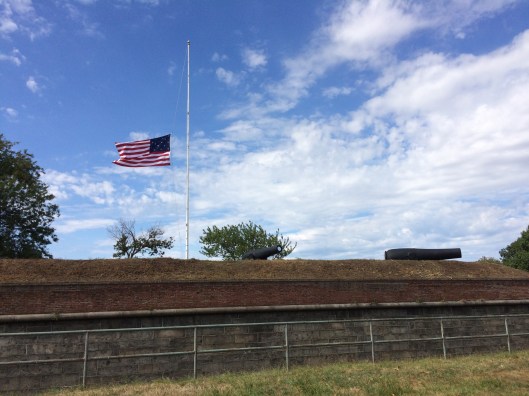
The flag–the Star Spangled Banner, if I noted correctly–was flying at half staff atop Fort Jay. On my way to Castle William for the 11:30 am tour I had to stop and take this picture (below) of these two apartment buildings. Coast Guard personnel who lived on the island in the late 1960s and early 70s have told me that from their living room and bed room windows they saw the Twin Towers go up incrementally over the years. I could not help but think of that this morning.

From these apartment building on the northern tip of Governors Island Coast Guard residents watched the Twin Towers rise nearly five decades ago.

From these apartment buildings on the northern tip of Governors Island Coast Guard residents watched the Twin Towers rise nearly five decades ago. The Freedom Tower is plainly visible.

William Patton Griffith, Patriotic Instructor

01 Thursday Sep 2016

Posted by Keith Muchowski in Memory

≈ Comments Off on William Patton Griffith, Patriotic Instructor

Griffith_William_Patton_1_FrontAfter class today I was following up on some leads that will hopefully carry over into the next few class meetings. I was searching the Brooklyn Daily Eagle database when I came across an article about one William Patton Griffith. This led me to a search engine to find out more about the man. And that is where, among other things, I came across the photo you see here. It is the front and back of the same image. Griffith fought in the Civil War and was in his 90s when he finally died in the 1930s. Like many veterans he was actively engaged in veteran and civic affairs throughout his adult life; in his final years he was brought out for public engagements, one of those aged Civil War veteran whose symbolic power at Decoration Days and Fourths of July rested in that he survived anachronistically into the mid twentieth century. How in the 1920s or 1930s, in the wake of the Great War, the Roaring Twenties and Great Depression, could one not have been moved to meet a survivor of Gettysburg, Pea Ridge, or the Peninsula Campaign?

Patriot instructorIt is a striking images. He exudes the appearance of a man nearing the end of his life seemingly content that he has accomplished what had set out to achieve. What struck me too was his job title: patriotic instructor. Some very rudimentary digging indicated that this was a formal position within the Grand Army of the Republic, of which Griffith was a long and active member. It is tempting to scoff at such a thing, but as the saying goes the past is a foreign country and they do things differently there. I intend to talk more about Griffith in class next Tuesday.

(images/New York State Archives, Grand Army of the Republic records)

The passing of the armies

30 Tuesday Aug 2016

Posted by Keith Muchowski in Memory

≈ Comments Off on The passing of the armies

Veterans_of_World_War_I_MemorialI had the opportunity this past weekend to spend some time with the official historian of a particular American military unit. This is an outfit that stretches back to the mid-nineteenth century and has fought in most of America’s engagements since that time. No longer active duty, this individual traces his time with the outfit back to the early 1970s. During our conversation he mentioned the unit’s annual dinners, which he has attended going back to his days as a young, active duty officer. I asked him if at these annual gatherings he ever had the opportunity to meet and talk with any of the Great War veterans who had worn the regiment’s insignia in 1917-18. He lit up when I asked and said that indeed he had. These WW1 veterans would have been in their mid 70s at the time.

The historian filled in a few anecdotes before noting ruefully that while he had indeed made these men’s acquaintance, he did not engage with them as extensively as would have liked today. Now those doughboys are all gone. Of course he was not the unit historian at that time, but a young, Vietnam-era officer with much on his mind. Today as the unit historian he has made certain to record and preserve all he can about the rapidly fading WW2 veterans. In just a few years they too will be all gone.

(image/Visitor7 via Wikimedia Commons)

The Golden Flyer

06 Wednesday Apr 2016

Posted by Keith Muchowski in Memory

≈ Comments Off on The Golden Flyer

21391r

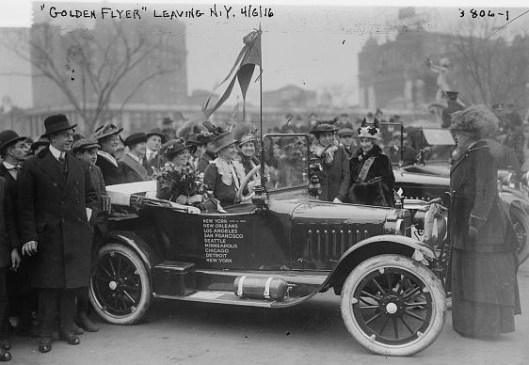
The social changes that the Great War wrought are sometimes overlooked. Certain issues, most notably the Civil Rights Movement here in America and independence for Europe’s colonies–showed some progress in the 1920s and 30s but did not come to fruition until after the Second World War. Two that did succeed were Prohibition and Suffragism. It was not coincidental that the 18th and 19th amendments passed just after the war’s end. Calls for Prohibition and women’s right to vote went back decades prior to American involvement in the war. In 1916 proponents of both did all they could to influence that November’s presidential election, and state and local elections too of course.

3b10974r

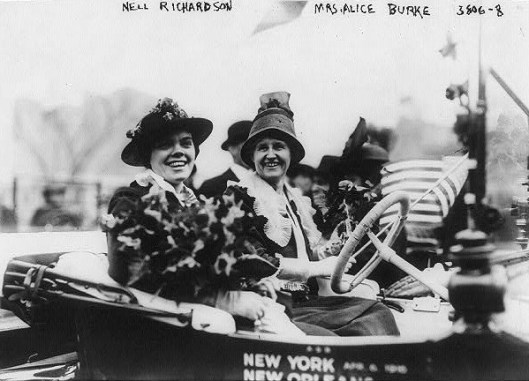
On the early spring day of April 6, 1916 suffragists Alice Burke and Nell Richardson left New York in their Golden Flyer for the West Coast. Their objective was to raise awareness and interest in the female vote. They visited forty-two states, by-passing New England, and drove over 10,000 miles in the April-October excursion to California and back. Keep in mind that there were no highways at this time. It was even three years prior to the Army’s 1919 Motor Transport Corps convoy in which Dwight Eisenhower participated. And that one only went 3000 miles.

It is somewhat surprising that the Burke/Richardson is not better known than it is. I’m guessing that a reason might be that we already have a standard narrative of the Women’s Rights Movement and this doesn’t fit the formula. Of course that is a problem regarding the Civil War and pretty much every historical subject. The heroes and villains get set and that’s it, at least for many people. Whatever the reason for so little interest in this event, it is an amazing story that deserves more attention than it has received.

(images/Library of Congress)

Signifying Presidents Day

15 Monday Feb 2016

Posted by Keith Muchowski in Memory, Theodore Roosevelt Jr (President)

≈ Comments Off on Signifying Presidents Day

Speaking softlyA friend sent me this image over the weekend. It is an ad for a clothing company’s Presidents Day Weekend sale. He made the interesting observation that former presidents seem to be used more and more often in today’s society to signify something to an intended audience. One sees this invoked in shows like Mad Men all the time. We reflexively use “Eisenhower” as short-hand for the repressiveness of the 1950s without even thinking about it. Juxtapose that with how we invoke “John F. Kennedy” as shorthand for the country’s “innocence” in those years just prior to the escalation in Vietnam, racial unrest, college protests, and assassinations that came in the wake of the young president’s own shooting. Invoking JFK just begs one to think of what might have happened had he not gone to Dallas. We have seen this in a slightly different way these past few months with calls to remove Woodrow Wilson’s name and likeness on the campus of Princeton University in response to his segregationist and other race-based policies.

I know that companies had to pay the Lincoln family to use the 16th president’s name and likeness in the decades after his death. It would be interesting to know more about the hows and whys of using presidents’ images for commercial and other purposes. That said, I have no doubt TR is now safely in the public domain. The purpose of the image above seems to be more mundane than segregation, Vietnam, or misconceptions about 1950s’s America; it’s an ad for a Presidents Day sale. As I mentioned to my friend, I’ll take a stab at this one. The retailer seems to be saying that one should should be reserved (“speak softly”) but also be a little bold (hence the red hat).

(Hat-tip Darrow Wood)

Sunday morning coffee

24 Sunday Jan 2016

Posted by Keith Muchowski in Memory, Monuments and Statuary, New York City

≈ Comments Off on Sunday morning coffee

IMG_2888I hope everyone is safe after the Great Blizzard of 2016. I have not been out since Friday evening and so have not yet seen it, but we got dumped with about three feet here in New York City. I took advantage of the weather yesterday by preparing the syllabus for the class I will be co-teaching this semester. It’s about 30% done. There are some holes to fill but it’s coming along. As I said the other day, I’m nervous and excited in equal measure. There’s that feeling of working without a net.

The other day I posted about the obscure Lincoln tablet affixed to the north face of Borough Hall. That same day I took this image of the World War II memorial in Cadman Plaza. Ironically, despite its size many people miss this one too because it is in a seldom-visited part of the plaza. The reason why it is so seldom-visited is something out students will learn and write about over the term. The way I understand it Robert Moses constructed this memorial in the early 1950s in response to what he saw as the excessive number of World War I memorials that sprung up throughout the city in the wake of the Great War. As Mark Levitch, the founder of the World War I Memorial Inventory Project notes, there are something like 10,000 Great War monuments of all types and sizes across the country. Every park in the five boroughs seems to have its doughboy and Moses was apparently determined that this not repeat itself after VE and VJ days. There is so much history surrounding us as we go about our daily lives. I will be writing more about the WW2 memorial as the semester goes along. The snow will hopefully have disappeared by then too!

“Pearl Harbor? Who’s she?”

07 Monday Dec 2015

Posted by Keith Muchowski in Memory, WW2

≈ 2 Comments

Pearl Harbor 2011

Longtime readers may remember this post from 2011. It’s hard to believe this was four years ago. As time goes by I cannot help but wonder who will be the Frank Buckles of the Second World War. We’ll find out in 10-15 years. I suppose we will see a big Pearl Harbor observation next year, as 2016 will mark the 75th anniversary of the attack. Until then, here is this from 2011…

A few years ago the father of a good friend of mine happened to be in the food court of a shopping mall on Memorial Day. This is a man, now in his eighties, who served in the Air Force and later played semi-professional football. He still has his leather cleats. Lou is the essence of Old School. Like shopping mall food courts throughout the country, this one was full of teenagers. Striking up a conversation with the 4-5 at the neighboring table he asked them if they knew what Memorial Day was. After the blank stares, one offered that it was a day off from school. My friend’s dad was not impressed.

When I was in school in the seventies and eighties a visit from a World War 2 vet was a HUGE deal, even in the most cynical of times just after Vietnam. (I graduated high school just a decade after the Fall of Saigon.) One vet recounted today that during a recent school visit a girl asked who Pearl Harbor was and why he was there to talk about her.

I offer these stories not to blame our country’s historical amnesia on young people, but to emphasize the educational crisis we face.

I have written about the significance to me of D-Day and aging veterans before. Personally, Pearl Harbor Day 2011 is the end of something tangible, akin to the 75th anniversary of Gettysburg in July 1938 when aged veterans turned out for one final gathering. President Roosevelt was in attendance; three years after dedicating the Eternal Peace Light Memorial in front of the 1,800 veterans and 150,000 citizens that summer day he would tell the country that December 7 would forever live in infamy. Today in Hawaii the Pearl Harbor Survivors Association held its final gathering. There are just too few Pearl Harbor survivors left seventy years later to justify a seventy-first. There will be more World War 2 anniversaries between today and the commemoration of V-J Day in 2015, but for me they will no longer seem the same. By 2015 there will be fewer WW2 veterans, and those remaining will likely be too infirm to participate in any meaningful fashion. Time moves on. It was ever thus.

(image/U.S. Navy)

What did WW1 veterans think of their service?

01 Saturday Aug 2015

Posted by Keith Muchowski in Memory

≈ 3 Comments

Sergeant York was one of the tens of thousands of doughboys who filled out an MSR reflecting on his experience in the Great War.

Sergeant York was one of the tens of thousands of doughboys who filled out an MSR reflecting on his experience in the Great War.

Last night I finished Edward Gutiérrez’ Doughboys on the Great War. In 2000 Dr. Gutiérrez, now a lecturer at the University of Hartford, began analyzing the Military Service Records (MSRs) that American fighting men filled out upon returning from France. Several dozen states had some version of these questionnaires, though the length and thoroughness of the questioning fluctuated wildly from state to state. Some states had index cards asking for such basic information as name, age, rank, unit, length of service, and current address. Four states–Connecticut, Minnesota, Utah, Virginia–went much further and created a several-page document in which soldiers and marines could discourse more fully on their experience. Many veterans did just that, sharing their impressions of their training, the competence of their officers, their fighting experience, and whatever else they chose to share. According to Gutiérrez–and I see no reason to doubt him–these sources had been sitting pretty much untouched for nearly a century before he began reading them.

Studying the lives of returning soldiers has become a cottage industry over the past few years. Brian Matthew Jordan’s Marching Home: Union Veterans and Their Unending Civil War is one example. This trend should not be surprising given that we have had so many veterans returning from combat in our own time. This is a welcome addition to the scholarship. The crux of Gutiérrez argument is that, while some had difficulty adjusting, for the most part doughboys returned to society quickly and seamlessly. This runs contrary to the narrative articulated by such Lost Generation writers as Hemingway, Fitzgerald and even Faulkner in the 1920s.

Some states followed up in the 1960s and 70s, by which time the veterans were well into middle age. These later accounts differ in that they lack the immediacy of the questionnaires the veterans filled out immediately upon their return from the war. A sourness set in for many in the 1930s, climaxing in the Bonus Army march in Washington. In the 1940s Doughboys noted ruefully that there was no GI Bill for them as there was now for the soldiers returning from the Second World War.

Gutiérrez has written an important book laying out some of the issues faced by the doughboys during and after their service. Hopefully during the centennial additional scholars will explore this topic.

(image/Library of Congress, http://www.loc.gov/pictures/item/ggb2006004542/)

Sunday morning coffee

26 Sunday Jul 2015

Posted by Keith Muchowski in Memory

≈ 3 Comments

Hey all, it is another early Sunday morning. I am off to Governors Island in a bit.

Today is the final stage of the Tour de France. I liked the way the Tour incorporated elements of WW1 commemoration into some of the racing stages. I hope this continues through 2018. It seems there is so much they could do without impeding on the integrity of the  race itself. One thing that is unique about the Tour is that its course changes year-by-year. It seems that for one thing they could alter the course here and there to visit battlefield sights. This seems to have already happened to a certain extent.

This all got me thinking to past tours, including one that took place at one of the most unique moments in pre-war history: the 1910 funeral of King Edward VII. As you can from the image, most of the European crowned heads-of-state turned out. I once wrote something on the TRB Facebook page about how former president Theodore Roosevelt represented the United States and had a good laugh at the pomposity on display. Still, he did get along with many of these people, including Kaiser Wilhelm II.

These nine rulers are just some of the European royalty who showed up for the funeral of King Edward VII on May 20, 1910. Their striking resemblance is not coincidental; many were related to one another. Less than five years later they would be at war.

These nine rulers are just some of the European royalty who showed up for the funeral of King Edward VII on May 20, 1910. Their striking resemblance is not coincidental; many were related to one another. Less than five years later they would be at war.

It is hard to imagine how Europe would have turned out had the Great War not taken place and many of these monarchs not been deposed.

The Tour de France took place two months later and the winner was Frenchman  Octave Lapize. When the Great War came Lapize became a pilot in the French Army. He was killed on Bastille Day 1917.

July 31, 1910: an exhausted Lapize wins the Tour de France. Note the flowers.

July 31, 1910: an exhausted Lapize wins the Tour de France two months later. Note the flowers.

(Funeral image photographed by W. & D. Downey and Lapize image by Agence Roi from Bibliothèque Nationale de France; both via Wikimedia Commons)


Battling for Lincoln

24 Friday Jul 2015

Posted by Keith Muchowski in Memory

≈ Comments Off on Battling for Lincoln

JJohn Nicolay (seated) and John Hay (right) were best friends who worked selflessly for President Lincoln. After the war they toiled equally hard to craft his image and defend the Unionist perspective of the war.

John Nicolay (seated) and John Hay (right) were best friends who worked selflessly for Abraham Lincoln. After the war they toiled equally hard to craft his legacy and defend the Unionist perspective of the war.

Last night I finished Joshua Zeitz’s Lincoln’s Boys: John Hay, John Nicolay, and the War for Lincoln’s Image and gained a lot from reading it. Zeitz traces the relationship between the 16th president and his two assistants from the time they met prior the Civil War all the way through the early years of the twentieth century when Nicolay (1901) and Hay (1905) died. I have always known the general outline of the story of how the two wrote their mammoth ten-volume Lincoln biography in the 1880s. Zeitz does a good job of capturing the two competing and contradictory impulses at work in the decades immediately after the war. On one hand there was a tendency to deify the martyred president. Republicans couldn’t go wrong waving the bloody shirt. At the same time the Lost Cause narrative was gaining traction in these years, with such figures as Jubal Early laying the foundation for what would prove to be a remarkably resilient narrative about why the war was fought and how it was lost. We’ve seen the dying throes of this narrative play out in the headlines and cable news shows over the past several weeks.

Hay and Nicolay were very much writing against this narrative, though ironically the Lost Cause was being disseminated in the same place at the same time. While The Century was publishing excerpts from the highly anticipated biography, that magazine was also publishing pieces from Battles and Leaders of the Civil War. B&L was drum and bugle history and sought to give both equal time to the Union and the Confederacy, while strenuously avoiding the cause and consequences of the war. One can only imagine what people were thinking when they read these pieces juxtaposed next to one another, which they did for years. Sometimes Hay and Nicolay could be unfair, especially in their rough handling of General McClellan, who they disliked intensely and were determined to excoriate.

Nicolay and Hay both had long successful careers after the Civil War, including stints overseas in important diplomatic positions. Hay wound up U.S. ambassador to the United Kingdom, where he did so much to build the special relationship that served the U.S. and Britain so well during the First World War and then through the twentieth and early twenty first century. He was of course later Secretary of State in the McKinley and Theodore Roosevelt Administrations as well, where he continued his important work.

(image by Alexander Gardner taken in studio in Washington, D.C. on November 8, 1863, less than two weeks prior to the Gettysburg Address; Library of Congress.)

← Older posts
Newer posts →

Enter your email address to subscribe to this blog and receive notifications of new posts by email.

Join 258 other subscribers

Categories

Archives

  • November 2023 (1)
  • October 2023 (3)
  • September 2023 (3)
  • August 2023 (4)
  • July 2023 (7)
  • June 2023 (10)
  • May 2023 (8)
  • April 2023 (6)
  • March 2023 (5)
  • February 2023 (4)
  • January 2023 (4)
  • December 2022 (4)
  • November 2022 (8)
  • October 2022 (2)
  • September 2022 (4)
  • June 2022 (1)
  • May 2022 (1)
  • April 2022 (13)
  • January 2022 (1)
  • December 2021 (2)
  • November 2021 (1)
  • October 2021 (3)
  • September 2021 (3)
  • August 2021 (5)
  • July 2021 (1)
  • June 2021 (1)
  • May 2021 (4)
  • April 2021 (3)
  • March 2021 (4)
  • February 2021 (7)
  • January 2021 (4)
  • December 2020 (4)
  • November 2020 (3)
  • October 2020 (4)
  • September 2020 (7)
  • August 2020 (5)
  • July 2020 (7)
  • June 2020 (11)
  • May 2020 (7)
  • April 2020 (9)
  • March 2020 (9)
  • February 2020 (7)
  • January 2020 (6)
  • December 2019 (7)
  • November 2019 (9)
  • October 2019 (4)
  • September 2019 (6)
  • August 2019 (10)
  • July 2019 (8)
  • June 2019 (6)
  • May 2019 (9)
  • April 2019 (8)
  • March 2019 (6)
  • February 2019 (8)
  • January 2019 (5)
  • December 2018 (10)
  • November 2018 (6)
  • October 2018 (9)
  • September 2018 (11)
  • August 2018 (11)
  • July 2018 (17)
  • June 2018 (10)
  • May 2018 (8)
  • April 2018 (9)
  • March 2018 (8)
  • February 2018 (5)
  • January 2018 (7)
  • December 2017 (11)
  • November 2017 (8)
  • October 2017 (9)
  • September 2017 (11)
  • August 2017 (12)
  • July 2017 (14)
  • June 2017 (18)
  • May 2017 (11)
  • April 2017 (10)
  • March 2017 (9)
  • February 2017 (11)
  • January 2017 (14)
  • December 2016 (7)
  • November 2016 (8)
  • October 2016 (8)
  • September 2016 (9)
  • August 2016 (6)
  • July 2016 (12)
  • June 2016 (8)
  • May 2016 (9)
  • April 2016 (6)
  • March 2016 (12)
  • February 2016 (10)
  • January 2016 (9)
  • December 2015 (9)
  • November 2015 (11)
  • October 2015 (8)
  • September 2015 (9)
  • August 2015 (13)
  • July 2015 (14)
  • June 2015 (11)
  • May 2015 (11)
  • April 2015 (18)
  • March 2015 (10)
  • February 2015 (8)
  • January 2015 (8)
  • December 2014 (12)
  • November 2014 (13)
  • October 2014 (16)
  • September 2014 (11)
  • August 2014 (16)
  • July 2014 (12)
  • June 2014 (13)
  • May 2014 (10)
  • April 2014 (10)
  • March 2014 (11)
  • February 2014 (12)
  • January 2014 (10)
  • December 2013 (11)
  • November 2013 (14)
  • October 2013 (14)
  • September 2013 (14)
  • August 2013 (13)
  • July 2013 (17)
  • June 2013 (9)
  • May 2013 (13)
  • April 2013 (13)
  • March 2013 (16)
  • February 2013 (15)
  • January 2013 (15)
  • December 2012 (18)
  • November 2012 (18)
  • October 2012 (21)
  • September 2012 (14)
  • August 2012 (16)
  • July 2012 (21)
  • June 2012 (22)
  • May 2012 (24)
  • April 2012 (20)
  • March 2012 (23)
  • February 2012 (22)
  • January 2012 (15)
  • December 2011 (23)
  • November 2011 (22)
  • October 2011 (23)
  • September 2011 (18)
  • August 2011 (19)
  • July 2011 (20)
  • June 2011 (29)
  • May 2011 (25)
  • April 2011 (18)
  • March 2011 (21)
  • February 2011 (11)

Meta

  • Create account
  • Log in
  • Entries feed
  • Comments feed
  • WordPress.com
Creative Commons License
This work is licensed under a Creative Commons Attribution-NonCommercial-ShareAlike 4.0 International License.

Enter your email address to subscribe to this blog and receive notifications of new posts by email.

Join 258 other subscribers

Categories

Archives

  • November 2023 (1)
  • October 2023 (3)
  • September 2023 (3)
  • August 2023 (4)
  • July 2023 (7)
  • June 2023 (10)
  • May 2023 (8)
  • April 2023 (6)
  • March 2023 (5)
  • February 2023 (4)
  • January 2023 (4)
  • December 2022 (4)
  • November 2022 (8)
  • October 2022 (2)
  • September 2022 (4)
  • June 2022 (1)
  • May 2022 (1)
  • April 2022 (13)
  • January 2022 (1)
  • December 2021 (2)
  • November 2021 (1)
  • October 2021 (3)
  • September 2021 (3)
  • August 2021 (5)
  • July 2021 (1)
  • June 2021 (1)
  • May 2021 (4)
  • April 2021 (3)
  • March 2021 (4)
  • February 2021 (7)
  • January 2021 (4)
  • December 2020 (4)
  • November 2020 (3)
  • October 2020 (4)
  • September 2020 (7)
  • August 2020 (5)
  • July 2020 (7)
  • June 2020 (11)
  • May 2020 (7)
  • April 2020 (9)
  • March 2020 (9)
  • February 2020 (7)
  • January 2020 (6)
  • December 2019 (7)
  • November 2019 (9)
  • October 2019 (4)
  • September 2019 (6)
  • August 2019 (10)
  • July 2019 (8)
  • June 2019 (6)
  • May 2019 (9)
  • April 2019 (8)
  • March 2019 (6)
  • February 2019 (8)
  • January 2019 (5)
  • December 2018 (10)
  • November 2018 (6)
  • October 2018 (9)
  • September 2018 (11)
  • August 2018 (11)
  • July 2018 (17)
  • June 2018 (10)
  • May 2018 (8)
  • April 2018 (9)
  • March 2018 (8)
  • February 2018 (5)
  • January 2018 (7)
  • December 2017 (11)
  • November 2017 (8)
  • October 2017 (9)
  • September 2017 (11)
  • August 2017 (12)
  • July 2017 (14)
  • June 2017 (18)
  • May 2017 (11)
  • April 2017 (10)
  • March 2017 (9)
  • February 2017 (11)
  • January 2017 (14)
  • December 2016 (7)
  • November 2016 (8)
  • October 2016 (8)
  • September 2016 (9)
  • August 2016 (6)
  • July 2016 (12)
  • June 2016 (8)
  • May 2016 (9)
  • April 2016 (6)
  • March 2016 (12)
  • February 2016 (10)
  • January 2016 (9)
  • December 2015 (9)
  • November 2015 (11)
  • October 2015 (8)
  • September 2015 (9)
  • August 2015 (13)
  • July 2015 (14)
  • June 2015 (11)
  • May 2015 (11)
  • April 2015 (18)
  • March 2015 (10)
  • February 2015 (8)
  • January 2015 (8)
  • December 2014 (12)
  • November 2014 (13)
  • October 2014 (16)
  • September 2014 (11)
  • August 2014 (16)
  • July 2014 (12)
  • June 2014 (13)
  • May 2014 (10)
  • April 2014 (10)
  • March 2014 (11)
  • February 2014 (12)
  • January 2014 (10)
  • December 2013 (11)
  • November 2013 (14)
  • October 2013 (14)
  • September 2013 (14)
  • August 2013 (13)
  • July 2013 (17)
  • June 2013 (9)
  • May 2013 (13)
  • April 2013 (13)
  • March 2013 (16)
  • February 2013 (15)
  • January 2013 (15)
  • December 2012 (18)
  • November 2012 (18)
  • October 2012 (21)
  • September 2012 (14)
  • August 2012 (16)
  • July 2012 (21)
  • June 2012 (22)
  • May 2012 (24)
  • April 2012 (20)
  • March 2012 (23)
  • February 2012 (22)
  • January 2012 (15)
  • December 2011 (23)
  • November 2011 (22)
  • October 2011 (23)
  • September 2011 (18)
  • August 2011 (19)
  • July 2011 (20)
  • June 2011 (29)
  • May 2011 (25)
  • April 2011 (18)
  • March 2011 (21)
  • February 2011 (11)

Meta

  • Create account
  • Log in
  • Entries feed
  • Comments feed
  • WordPress.com
Creative Commons License
This work is licensed under a Creative Commons Attribution-NonCommercial-ShareAlike 4.0 International License.

Enter your email address to subscribe to this blog and receive notifications of new posts by email.

Join 258 other subscribers

Categories

Archives

  • November 2023 (1)
  • October 2023 (3)
  • September 2023 (3)
  • August 2023 (4)
  • July 2023 (7)
  • June 2023 (10)
  • May 2023 (8)
  • April 2023 (6)
  • March 2023 (5)
  • February 2023 (4)
  • January 2023 (4)
  • December 2022 (4)
  • November 2022 (8)
  • October 2022 (2)
  • September 2022 (4)
  • June 2022 (1)
  • May 2022 (1)
  • April 2022 (13)
  • January 2022 (1)
  • December 2021 (2)
  • November 2021 (1)
  • October 2021 (3)
  • September 2021 (3)
  • August 2021 (5)
  • July 2021 (1)
  • June 2021 (1)
  • May 2021 (4)
  • April 2021 (3)
  • March 2021 (4)
  • February 2021 (7)
  • January 2021 (4)
  • December 2020 (4)
  • November 2020 (3)
  • October 2020 (4)
  • September 2020 (7)
  • August 2020 (5)
  • July 2020 (7)
  • June 2020 (11)
  • May 2020 (7)
  • April 2020 (9)
  • March 2020 (9)
  • February 2020 (7)
  • January 2020 (6)
  • December 2019 (7)
  • November 2019 (9)
  • October 2019 (4)
  • September 2019 (6)
  • August 2019 (10)
  • July 2019 (8)
  • June 2019 (6)
  • May 2019 (9)
  • April 2019 (8)
  • March 2019 (6)
  • February 2019 (8)
  • January 2019 (5)
  • December 2018 (10)
  • November 2018 (6)
  • October 2018 (9)
  • September 2018 (11)
  • August 2018 (11)
  • July 2018 (17)
  • June 2018 (10)
  • May 2018 (8)
  • April 2018 (9)
  • March 2018 (8)
  • February 2018 (5)
  • January 2018 (7)
  • December 2017 (11)
  • November 2017 (8)
  • October 2017 (9)
  • September 2017 (11)
  • August 2017 (12)
  • July 2017 (14)
  • June 2017 (18)
  • May 2017 (11)
  • April 2017 (10)
  • March 2017 (9)
  • February 2017 (11)
  • January 2017 (14)
  • December 2016 (7)
  • November 2016 (8)
  • October 2016 (8)
  • September 2016 (9)
  • August 2016 (6)
  • July 2016 (12)
  • June 2016 (8)
  • May 2016 (9)
  • April 2016 (6)
  • March 2016 (12)
  • February 2016 (10)
  • January 2016 (9)
  • December 2015 (9)
  • November 2015 (11)
  • October 2015 (8)
  • September 2015 (9)
  • August 2015 (13)
  • July 2015 (14)
  • June 2015 (11)
  • May 2015 (11)
  • April 2015 (18)
  • March 2015 (10)
  • February 2015 (8)
  • January 2015 (8)
  • December 2014 (12)
  • November 2014 (13)
  • October 2014 (16)
  • September 2014 (11)
  • August 2014 (16)
  • July 2014 (12)
  • June 2014 (13)
  • May 2014 (10)
  • April 2014 (10)
  • March 2014 (11)
  • February 2014 (12)
  • January 2014 (10)
  • December 2013 (11)
  • November 2013 (14)
  • October 2013 (14)
  • September 2013 (14)
  • August 2013 (13)
  • July 2013 (17)
  • June 2013 (9)
  • May 2013 (13)
  • April 2013 (13)
  • March 2013 (16)
  • February 2013 (15)
  • January 2013 (15)
  • December 2012 (18)
  • November 2012 (18)
  • October 2012 (21)
  • September 2012 (14)
  • August 2012 (16)
  • July 2012 (21)
  • June 2012 (22)
  • May 2012 (24)
  • April 2012 (20)
  • March 2012 (23)
  • February 2012 (22)
  • January 2012 (15)
  • December 2011 (23)
  • November 2011 (22)
  • October 2011 (23)
  • September 2011 (18)
  • August 2011 (19)
  • July 2011 (20)
  • June 2011 (29)
  • May 2011 (25)
  • April 2011 (18)
  • March 2011 (21)
  • February 2011 (11)

Meta

  • Create account
  • Log in
  • Entries feed
  • Comments feed
  • WordPress.com
Creative Commons License
This work is licensed under a Creative Commons Attribution-NonCommercial-ShareAlike 4.0 International License.

Blog at WordPress.com.

  • Subscribe Subscribed
    • The Strawfoot
    • Join 229 other subscribers
    • Already have a WordPress.com account? Log in now.
    • The Strawfoot
    • Subscribe Subscribed
    • Sign up
    • Log in
    • Report this content
    • View site in Reader
    • Manage subscriptions
    • Collapse this bar
 

Loading Comments...