Henry Clay, 1777-1852

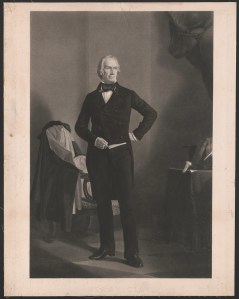
Henry Clay was one of the great American statesmen of the first half of the nineteenth century.

Here is a small story that, while I wouldn’t read too much into it, nonetheless offers a reminder of the importance of place. I was manning the information desk at Federal Hall this morning when a man came in with his two teenage sons. I asked if they were in town doing the tourist thing and the dad responded yes. The family was from Kentucky and the father was clearly an intelligent, aware fellow. It turns out he was a high school history teacher. I told him I’ve always wanted to visit Kentucky and tour Ashland, the historic home of Henry Clay. He responded that he had been there several times and that it is indeed beautiful. This led to a brief discussion about Henry Clay’s life and legacy, including his role in the struggle to save the Second Bank of the United States against the equal determination of President Andrew Jackson to quash it. Old Hickory won that struggle, and in the 1840s Martin Van Buren and James K. Polk created the Independent Sub-Treasury to carry on some of the functions of the now-gone national bank. What is now Federal Hall was the New York Sub-Treasury from 1863-1920.

An hour later I go into the room where the ranger’s desk is and ask the ranger on duty what he’s working on. He said he was writing a social media post about Henry Clay, who it turns out died on this day, June 29, in 1852. I naturally told him about the man and his family from earlier. This led to an interesting discussion on the importance of learning about and understanding the lives and legacies of the leaders who, for good and ill, gave us the nation we live in. Clay certainly fits that category.
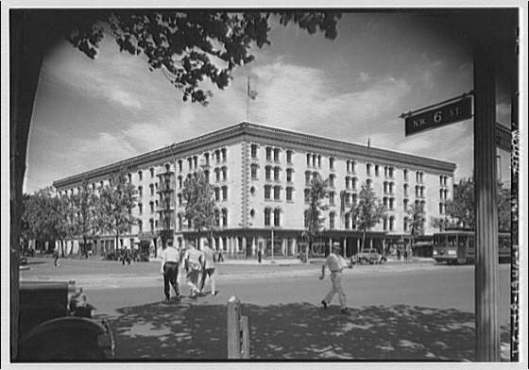
Clay died in the National Hotel on June 29, 1852, where he lived for decades when not in Kentucky. Seen here in the early twentieth century, the National closed in 1931 and was torn down in 1942.

Later in the afternoon a couple come in and ask me and the ranger about the other NPS sites in Manhattan. It turns out the couple were from Ft. Lauderdale and are currently on an extended sailing trip across the Eastern Seaboard. They had been at sea for several weeks and had docked their boat in New Jersey for the weekend while touring New York City. They wanted to know especially about Governors Island, and so I gave them the Cliff Notes version of the island’s history. Captain Ulysses S. Grant was stationed there briefly in 1852 before his regiment was slated to sail for California via the Isthmus of Panama. In June Grant went briefly to Washington D.C. on War Department business. It was Sam Grant’s first time in the District of Columbia and his trip there happened to coincide with the passing of . . . Henry Clay, who died of tuberculosis at the National Hotel when the young captain was in town.

Go where history was made. You never know what you’ll see or hear.

(image/Library of Congress)
Versailles

Summer has come full on. I was off today and had the windows open and fan on as I worked on an article I’m doing about Eleanor Roosevelt. I’ve got about 400 in the books and hope to write another 400 or so this evening before declaring victory. I would be remiss if I did not pause and note that today, June 28, 2019, is the 100th anniversary of the signing of the Treaty of Versailles in the Hall of Mirrors. I don’t intend to write too much about it right now because there is already so much good reading out there today. For now I though I would emphasize the quickness and degree to which resistance to the treaty, especially its covenant for a League of Nations, had manifested itself even before the ink had dried.

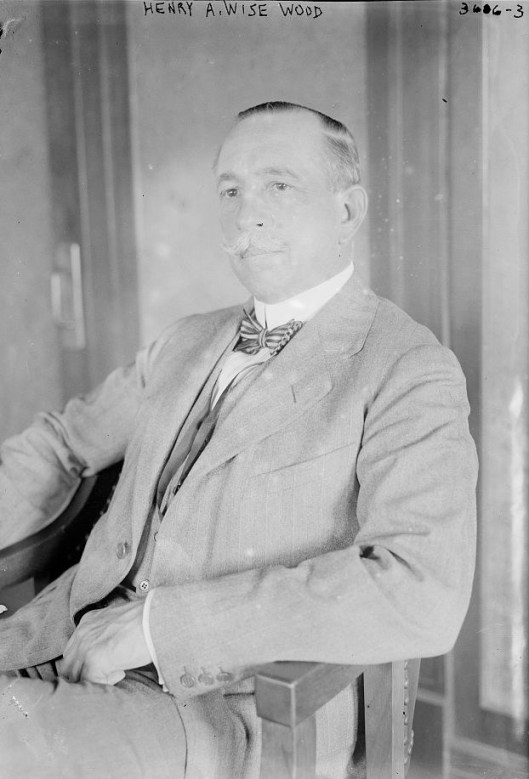
Henry A. Wise Wood, the son of Civil War Era New York City mayor Fernando Wood, led the campaign against the League of Nations the very day of the signing of the Treaty of Versailles.

One hundred years ago tonight the League for the Preservation of American Independence held a rally in New York City’s Carnegie Hall. One of the American Independence League’s leaders was Henry A. Wise Wood, an engineer and inventor who had been active in the Preparedness Movement with Theodore Roosevelt and others in the Great War’s early years before American entry into the conflict. Born in 1866, Wood was the son of three-time New York City mayor Fernando Wood. The League for the Preservation of American Independence enjoyed tremendous popularity and easily filled Carnegie Hall that night in protest against Wilson, the Versailles Treaty, and prospective League of Nations. A spinout crowd gathered outside on the sidewalk. Wood asked that the spirit of Theodore Roosevelt fill the hall.

TR had died almost six months previously but almost certainly would have opposed the League of Nations. One Roosevelt who did support it was Franklin, who when he ran for the vice-presidency in 1920 advocated for the League. FDR’s position may or may not have been opportunism based on loyalty to Wilson and the knowledge that, because he and running mate Jacob M. Cox would likely lose the election, he could take a position confident in never having to carry it out. Franklin D. Roosevelt did learn the lesson of the failures of Versailles however, and when he became commander-in-chief began pushing for what became the United Nations a quarter of a century later.

(image/Library of Congress)


Captain William Wheeler, 13th New York Independent Battery

Captain William Wheeler headstone, Brooklyn’s Green-Wood Cemetery

Captain William Wheeler as seen in an 1875 private printing of his letters

A friend took the image above on the Sunday of Memorial Day Weekend in Brooklyn’s Green-Wood Cemetery and I have been holding on to it until today. Captain William Wheeler of the 13th New York Independent Battery was killed 155 years ago today at the Battle of Kolb’s Farm in Georgia. Frederick Phisterer informs us in his essential history of New York State in the CIvil War that Wheeler was the only officer of the 13th New York Independent Battery to be killed in the American Civil War. That is saying something: among other places the 13th fought at Bull Run, Chancellorsville, Gettysburg, Missionary Ridge, Kennesaw Mountain, and elsewhere before Wheeler’s unfortunate death.

Wheeler was born in Manhattan in 1836, and his family moved to Brooklyn in 1847. He matriculated at Yale College in September 1851 and graduated in 1855. It must have been a heady time for an idealistic young man, what news about Bleeding Kansas, John Brown, and other outrages taking place almost daily in the lead-up to Fort Sumter. He enlisted immediately and lived to tell the story until Kolb’s Farm. By then a battle-hardened veteran at twenty-seven, Wheeler wrote to a friend from his unit’s camp in Cassville, Georgia on May 22, 1864 that “. . . to-day is a real ‘day of rest,’ unlike the last two Sundays, which were spent in fighting. . .” One month later to the day, he was killed. On July 17, Timothy Dwight V, a future president of Yale, delivered a sermon about Captain Wheeler at New Haven’s Third Congregational Church.

(bottom image/Letters of William Wheeler of the Class on 1855, Y.C.)

Juneteenth 2019

Citizens of Austin, TX observe Juneteenth, June 19, 1900. One would imagine these individuals remembered General Granger’s 1865 proclamation.

I was off today and spent a big chunk of the hours preparing for an event that will probably come to pass next month. If/when it does, I will write about it in this space. One of the best things about being off on a Wednesday is that this middle day of the work week is getaway day in Major League Baseball. What that means is that teams often play day games on this third day (Monday, Tuesday, Wednesday) of a series before quickly “getting away” to the next town for a weekend series. While working today I had the Astros/Reds game on. During the broadcast they mentioned that today is Juneteenth. I lived in Texas for many years and know what a big holiday this is in the Lone Star and neighboring states. Unfortunately it remained an exclusively regional affair for much of the next century; there is no mention of Juneteenth in the New York Times until 1933, and after that not until 1981. Over the past several decades Juneteenth has become more significant nationally. Awareness was aided by the 1999 publication of Ralph Ellison’s posthumous novel Juneteenth. Ellison was born in Oklahoma City, Oklahoma in 1914.

Gordon Granger, circa 1861-65

Juneteenth began in 1865 and marked the moment when on June 19th of that year Brevet Major General sailed into Galveston Bay and read his General Order #3, which began with the announcement that “The people are informed that in accordance with a Proclamation from the Executive of the United States, all slaves are free.” One must remember that Lincoln’s January 1, 1863 Emancipation Proclamation only applied to slaves within jurisdictions under Federal (Union) control. General Granger spent much of the next six weeks traveling within Texas to spread the news.

Holidays have a funny way of disappearing and coming back. Here in New York we used to have Evacuation Day every November 25. Evacuation Day marked the moment in 1783 when the British, acknowledging defeat, packed up and sailed from New York Harbor back to England. Evacuation Day petered out eventually, presumably because it fell so close to Thanksgiving. It was for Evacuation Day 1883 that they dedicated the John Quincy Adams Ward statue of George Washington on the steps of Federal Hall, then still the New York Sub-Treasury. I would argue that Juneteenth should become a national holiday, or at least a national observance. It is already officially commemorated in forty-five states.

(top image/Austin History Center and the Portal to Texas History; bottom/LOC)


Sunday morning coffee

New York City’s Federal Hall as it was around the time of Washington’s first inaugural. Even after the federal government moved to Philadelphia in 1790 this building and property would prove central local and national events.

I hope everyone’s summer is off to a good start. Happy Father’s Day to all dads out there. Posting will pick up here now that the summer days have settled into something of a pattern. With the academic year over I again began volunteering with the Park Service. This summer I am at Federal Hall. Though I never planned it this way, it has been something of a run through the various New York City sites. There is actually a great deal of overlap in the histories of these places, and Federal Hall has a unique story and provenance spanning many centuries. The site itself was placed under the auspices of the Park Service by the Franklin Roosevelt Administration, who did so eighty years ago in 1939 around the same time they quashed Robert Moses’s Brooklyn-Battery Bridge. The Early American Period is an era about which I know fairly little and I have thus spent much of my time since submitting grades Memorial Day Weekend engrossing myself in the literature. I find it comforting on a number of levels, not least as I try to understand our own troubling and disturbing times. The Founding Father have so much to teach us.

The site upon which stood Federal Hall has been many things over time. It was where the First Congress met and where George Washington was sworn in as our first president. The original building was torn down in 1812 and a customs house built on the choice Wall Street property in 1842. During the Civil War it became the New York Sub-Treasury, and would remain so until just after the First World War. A great deal of all this also ties in to my book manuscript, which really excites me. I am already up-and-running, writing some bits for the social media and giving tours. I’m looking forward to telling more stories and jumping in.

(image/Robert Shaw sketch via NYPL)


D-Day plus seventy-five years

Rally in New York City’s Madison Square on D-Day, June 6, 1944

Good morning, everyone. I could not let the 75th anniversary of the Normandy Invasion go unnoticed. Anniversaries such as this are an opportunity to pause and reflect on what we have gained and stand to lose in our current troubled times. Coalitions are difficult to build and easy to destroy. We would do well to remember the lessons taught to us by Franklin Roosevelt, Dwight Eisenhower, George Marshall, Harry Truman, and the many others who helped create the world we cavalierly take for granted today.

Last night one person did mention to me the 75th anniversary of D-Day. We’ll see how many, if at all, do today. Here is a post I wrote in 2011. The major D-Day anniversaries have followed me over the course of my adult life.

There are many striking images of New York City taken on June 6, 1944. People obviously had a need to be out publicly, anxious as they were for news from England and France. D-Day was a lonely time for Eisenhower himself, who by that time had done all he could and thus spent his hours chain-smoking and waiting for news at his headquarters in England. Here in the States, ball games were cancelled, shops closed, and things in general came to a halt as the fate of the war hung in the balance.

(image/photographed by Howard Hollem, Edward Meyer or MacLaugharie for the Office of War Information; Library of Congress)

Whitman at 200

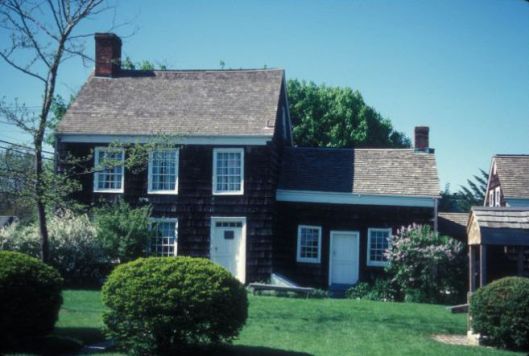
Walt Whitman was born in this farmhouse in 1819. The family moved to Brooklyn four years.

Walt Whitman was born in the farming community of Huntington, Long Island on May 31, 1819, two hundred years ago today. He was the second of what would eventually be nine children, one of whom died in infancy. Whitman had a strong sense of history and always believed he was taking part in a large historical narrative, probably because he was. Whitman and his family feature prominently in my book manuscript “Incorporating New York,” and I just may write a fair bit about the Whitmans over the summer. A friend and I intend to see the exhibit at the Grolier Club in the coming weeks or months. He also lived across the street from where I work, which has always made him seem that much more immediate to me. The Brooklyn printing house where he set the type for the first edition of Leaves of Grass was torn down in the early 1960s to make way for a Robert Moses project. Whitman and his siblings gloried in listening to stories of how their Long Island elders tricked the Redcoats during the British occupation in Revolutionary War.

By the time Walt Whitman was born the second round against the British—the War of 1812—had been over for nearly half a decade. During this Era of Good Feelings there was a feeling of optimism in the young republic, that the country held great possibility. A sense of history was clearly not lost on the parents; three of Walt’s brothers were named George Washington Whitman, Thomas Jefferson Whitman, and Andrew Jackson Whitman. George Whitman became an officer in the 51st New York Volunteers during the American Civil War, serving in the Army of the Potomac. It was after hearing of George’s wounding at the Battle of Fredericksburg that Walt rushed down South. His brother was okay, but what Walt saw in the hospitals horrified him. It was then that he became a nurse in the wards.

The Whitmans’ story is nothing less than the story of nineteenth century America. In addition to the Grolier exhibit I mentioned, there will be a number of other events in New York and elsewhere for those inclined.

(image/Jerrye & Roy Klotz MD via Wikimedia Commons)

Remembering Edmund Morris and Tony Horwitz

I learned yesterday of the recent deaths of both Edmund Morris and Tony Horwitz. It is difficult to process the loss of not just one but two important writers at the same time. Morris’s greatest legacy of course was his three-volume biography of Theodore Roosevelt, which will stand for some time as the source for those seeking a deep dive on the twenty-sixth president. To many people though he is best known as the author of Dutch: A Memoir of Ronald Reagan. For those who may not remember, Dutch was an authorized biography for which Morris had unfettered access to Reagan’s inner circle during the president’s second term. These were monumental years that today seem so far away, when the Cold War was winding down and so much seemed possible. As he did to most others however, Reagan proved inscrutable to Morris and the biographer ended up writing a semi-fictional account of Reagan’s life in which the author inserted himself into the text. That’s the “memoir” part of the title. Needless to say, there was great piling on when the book came out in 1999–twenty years ago. I always try to be charitable, and instead of joining the dog-pile have always regarded Dutch as an experiment gone wrong. For a good take on the thing, read Andrew Ferguson’s piece in The Atlantic.

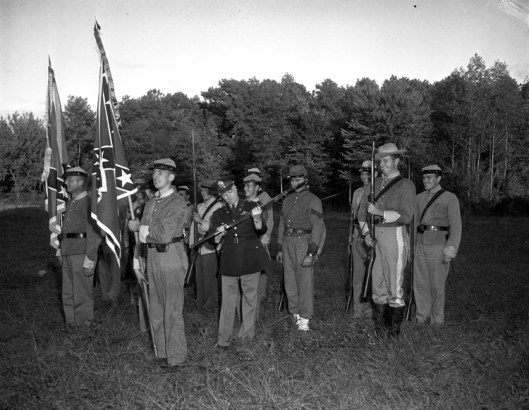
North-South Shoot, Civil War reenactment, October 14, 1951. Tony Horwitz wrote of the evolution of Civil War culture in Confederates in the Attic.

Horwitz was only sixty years old when he collapsed the other day near his home in Chevy Chase, Maryland. Horwitz was a journalist and historian who often worked in the vein of travel writer, visiting people and places and then telling his readers how the weather was. His most famous work was Confederates in the Attic, his account of Civil War culture as it stood in the mid-1990s. The book can still be read today with great profit.

As I have written before, many people’s takeaway from this book was Horwitz’s accounts of reenactors and their quest to achieve a “period rush” when out in the field camping and marching in period garb. My own biggest takeaway was the need to examine Civil War historiography in greater depth. Reading Confederates in 1998 also led me to take my first trip to Shiloh that summer. I went again the following year and alas have not been back since. With my father now gone, there hasn’t been much opportunity to get down to the region. I do hope to take the Hayfoot on a Civil War journey sometime in the next few summers, starting at the Lincoln presidential library in Illinois, the Grant home in St. Louis, Forts Henry and Donelson, and then Shiloh.

(image by Adolph B. Rice Studio via The Library of Virginia)


Green-Wood’s Harper Brothers

I hope everyone is enjoying their three-day weekend. Whatever one does today, please remember the true spirit and meaning of Decoration/Memorial Day.

Harper Brothers headstone, Green-Wood Cemetery. James Harper, the oldest of the four, died as the result of a carriage accident in Central Park.

My friend and I had a good time in Green-Wood yesterday. While I don’t want to give away too much right now, we came up with what might be an interesting small summertime project. Over the course of the day, which we split in half with lunch to replenish ourselves and get out of the heat for a bit, we came across this headstone here. I found it striking and could not help but notice that the individual died in 1869, one hundred and fifty years ago. So, we stopped and took the pic you see here. It turns out that James Harper is none other than the oldest of the Harper Brothers, the siblings who two centuries ago founded the publishing empire that still exists today. Their father came to New York from Philadelphia around 1790 and opened a grocery store on Maiden Lane, which means he most certainly knew the Roosevelts, whose hardware concern was on that same Lower Manhattan street. Young James worked with Thurlow Weed for a time before founding J & J Harper in 1817 with his brother John. They brought younger siblings Joseph and Fletcher into the publishing business in the 1820s and eventually named the company Harper & Brothers. All are buried in this Green-Wood plot. Indeed, the other brothers are represented on the other three sides of this monument.

Brothers Fletcher, James (standing), John, and Joseph Harper founded the publishing empire that still bears their name. All are interred today on a quiet hill in Brooklyn’s Green-Wood Cemetery.

James Harper was a notorious anti-Catholic who in 1844 successfully ran for New York City mayor on the nativist American Republican ticket. He served one term. His administration is noted for something that did not happen within Manhattan itself. In 1844 nativist riots, sometimes called the Bible or Prayer Riots, took place in Philadelphia ninety miles away. Closer to home there was anti-Catholic in Brooklyn just across the water as well. The fighting there was especially intense, with pitched clashes between nativists and Irishmen. Brooklyn however was still an independent city, and thus beyond Mayor Harper’s jurisdiction. The Nativist Riots caused great concern. Thankfully the violence did not spread to Manhattan, in part because of the vigilance of Archbishop “Dagger John” Hughes. The pugnacious cleric met Mayor Harper and warned him in stiff language of potential consequences should goons attack people or churches. James wisely left politics after his one term in office and focused again on the family publishing business, which only grew in the ensuing decades. The brothers’ most important vehicle was of course Harper’s Weekly, which made its debut in 1857.

(bottom image/Library of Congress)


Fiorello La Guardia’s Memorial Days

I hope everyone’s Memorial Day Weekend is going well. I’m meeting someone on the far end of Green-Wood Cemetery in about an hour. We’re going to explore the cemetery and then get lunch before the true heat of late spring kicks in. We submitted final grades the other day but there is still some detail work and mopping up in the coming days as we cap off the academic year. I started John Strausbaugh’s Victory City: A History of New York and New Yorkers During World War II. Last year after completing the manuscript for Incorporating New York I read his 2016 book about Civil War New York. I intentionally held off on reading it until finishing the draft of INY because I wanted to follow my own vision for the narrative and did not want others’ ideas seeping in.

I am profiting greatly from reading Victory City, which voters many of the themes my colleague and I covered with our class this just-concluded semesterOne of the major figures–how could he not be?-of the book is Fiorello La Guardia. I know so much more about La Guardia than I did at the beginning of the calendar year. I thought in recognition of Memorial Day Weekend I would re-up this post from last year.

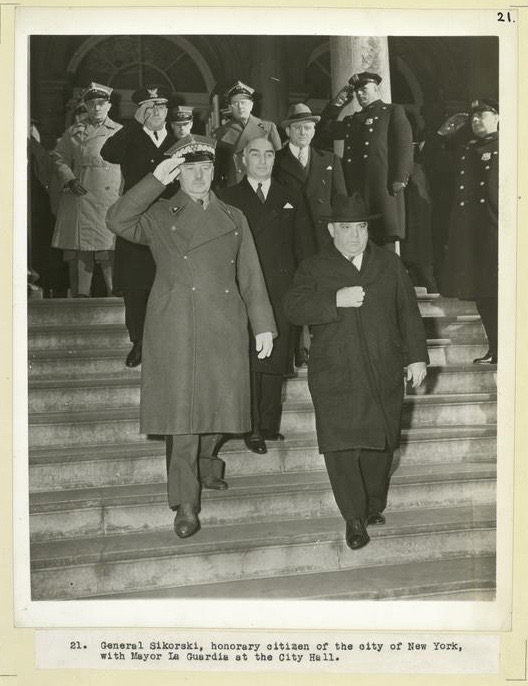
General Wladyslaw Sikorski (saluting) with Mayor Fiorello La Guardia (right) at New York City Hall, 1942

John Purroy Mitchel, New York’s boy mayor, died 100 years ago this coming July. Mitchel was in office from 1914-17, thus overlapping almost entirely with the early years of the Great War. Mitchel was a proponent of Preparedness and as such became a natural ally of Theodore Roosevelt, Leonard Wood, and others advocating for American readiness to join the fight. After Mitchel left office he joined the Army Air Service and was killed in Lake Charles, Louisiana when he fell out of an airplane during a training exercise in July 1918. Friends dedicated a memorial to him in Central Park near 90th Street and Fifth Avenue in November 1928. For years, especially throughout the 1930s and 1940s, the Mitchel monument was a focal point of Memorial Day commemorations in New York City. One regular attendee was Fiorello La Guardia, who over the course of his tenure in office from 1934-45 observed at least nine of twelve Memorial Days at the monument to his mayoral forerunner, Fusion Party associate, and fellow World War 1 aviator.

New York Times, May 31, 1934: La Guardia is second from the right.

The photograph above shows La Guardia at the Mitchel monument on Memorial Day 1934. This would have been just over a year into the FDR Administration and with the Great Depression in full effect. This was also La Guardia’s first Memorial Day as mayor. There were still Civil War veterans marching in New York City’s Memorial Day parades in these years, about 25 this year. In the years after this their numbers dwindled into the single digits.

New York Times, May 31, 1944: La Guardia was pressing for full Axis surrender in the tense days before the Normandy Invasion.

The headline here in which La Guardia advocates for an “aviator’s peace” comes from the 1944 Memorial Day observation. While obviously the public did not know the exact day that the offensive to liberate France would begin, Memorial Day 1944 took place one week before D-Day. Thus we see La Guardia pressing for all out victory. Poignantly, 1944 also happened to be the first year that a Civil War veterans did not participate in Manhattan’s Memorial Day observation. Brooklyn and Queens each had one G.A.R. veteran in the ranks. Spanish-American War veterans, doughboys from the First World War now well into middle age, and active duty servicepersons including WACS, WAVES, and SPARS were all represented.

La Guardia was on hand again at the Mitchel memorial on Memorial Day 1945. He had gotten his “aviator’s peace,” at least in Europe. By Memorial Day 1945 V-E Day had passed and everyone was waiting anxiously to see what would happen in the Pacific.

(top image/NYPL)