This weekend: the 99th TRA Conference

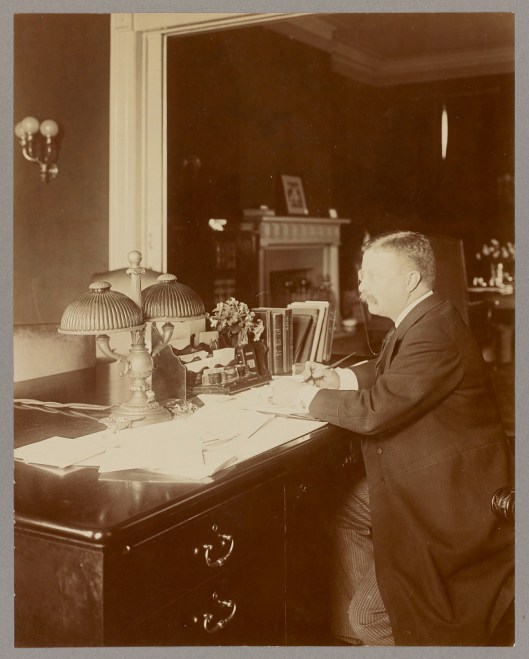
Theodore Roosevelt writing at his desk, circa 1905

This weekend here in New York City is the 99th annual Theodore Roosevelt Association conference. I am not attending any of the events today but will be at the Harvard Club tomorrow for the symposium. While I have irons in many fires, at the end of the day the Roosevelts are my primary intellectual interest. What I find fascinating about them is that one can interpret pretty much any aspect of American, and often even international history, through the prism of the Roosevelt clan. One hundred years ago right now Theodore Roosevelt’s health was in rapid decline. In 1917 he seemingly sensed that the end was near and began sending his papers to the Library of Congress for posterity. It was a burdensome time, with his health in decline and five of his children in danger serving in the Great War. Quentin of course would be killed on Bastille Day 1918, and the other boys would be gassed and/or wounded before it was all done. Ethel and her surgeon husband Richard Derby were in Paris dealing with the wounded.

Roosevelt was writing his weekly newspaper column well into the later months of 1918 but eventually stopped as he reached his final illness. When he finally died in January 1919 the output from his brief sixty-year life was incredible: 100,000+ letters, 30+ books, reams of journalism, and so much more. The Library of Congress this week, coincidentally or not in time to commemorate Roosevelt’s 160th birthday, has made digitally available a significant portion of that life’s work. They have done us a yeoman’s service.

(image/Library of Congress)

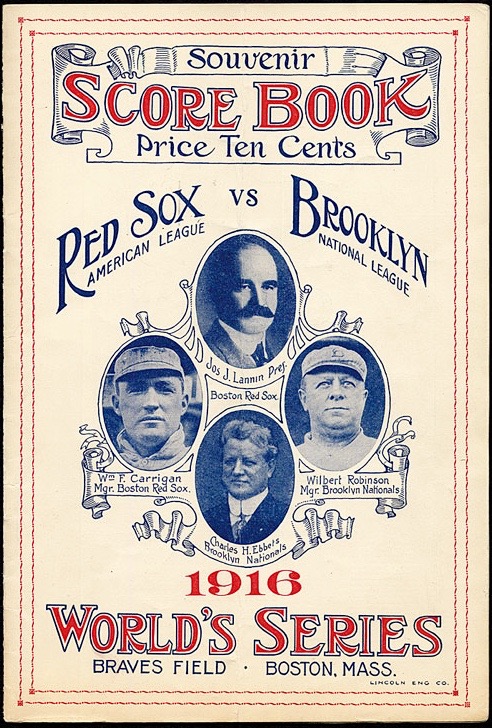
Brooklyn vs Boston, 1916

Note that it was called the “World’s Series” when Brooklyn and Boston squared off in 1916. The American League games were held in the more spacious Boston Braves ballpark to sell more tickets than possible in the much smaller Fenway Park.

I was having a conversation with some students yesterday explaining that the name of the National League team currently playing in the World Series took its name from the period during which the team played in Brooklyn. Fans had to dodge the streetcars to get to the ballpark and thus became known as trolley dodgers. In 1916 however that was still a little ways in the future; the Brooklyn team that played the Red Sox in that year’s World Series was known as the Robins. Charles Ebbets was already the owner by this time. Later in the day I was speaking to someone whose daughter lives in Boston but whose family roots are in Los Angeles. We got into a discussion about how some of those great Dodger players of the 1970s and early 1980s will hopefully be in attendance over the coming week, throwing out first pitches and whatnot. Red Sox Hall of Famer Carl Yastrzemski threw out the opening pitch in game one last night.

The last time the team that is now the Dodgers played the Red Sox in the World Series was 1916. Seasons ended earlier in those years, with the final game usually taking place around Columbus Day. In October 1916 the Battles of Verdun and the Somme were grinding to their awful conclusions. It was the final weeks of the presidential campaign and the incumbent Woodrow Wilson was running against challenger Charles Evans Hughes on the slogan “He Kept Us Out of War.” Fenway Park was in its fifth season in 1916, but if you look at the score book above you will see that the games in Boston were played not in Fenway but at Braves Field. I was wondering about this when I saw the score card. During the game last night the Red Sox radio announcers eventually spoke about it, noting that the games were moved to the more spacious ballpark to see more tickets. Let that be a lesson to anyone who thinks organized baseball was once only a game and not a business. I say that with no cynicism.

Babe Ruth, Casey Stengel, Fred Merkle and Tris Speaker were just some of the players who squared off in the World Series 102 years ago. Lincoln Logs were invented that year, presumably due to interest in the 16th president just a few years after the centenary of his birth and in the wake of the 50th anniversary of the American Civil War. It was the final season before America joined the Great War. While Europe burned Americans took in the World Series to forget the world’s troubles as best they could.

(image/Lincoln Eng. Co., via Wikimedia Commons)


Twain, Stowe, & Hawley

Mark Twain house, Hartford

I hope everyone had a good weekend. I’m sorry about the lack of posts recently but with the semester in full swing things have been busy. This past Saturday I was up and out of the house at 6:00 am to meet a friend at Grand Central, from where we took the train to Hartford. There we were met by a friend who was our guide for the day. We visited the Mark Twain house and adjacent Harriet Beecher Stowe Center. Literally they are right next each other. Both tours were distinctly different but uniformly excellent. I love to watch interpreters perform their craft. Twain’s house was obviously an anchor for a man who traveled so extensively, both as a younger man finding his way and later as a famous writer supplementing his income on the lecture circuit. Twain often lived out of a suitcase and the house there in Hartford was the place to which he and his family, who often accompanied him abroad, could return. He did most of his writing on the third floor. While up there I mentioned his publishing Ulysses S. Grant’s Memoirs. The guide turned to his immediate left and pointed out a beautiful bust of Grant on the mantel. I so wanted to take a picture but photography was not permitted in the house.

I had never been to either site before. The one that seems to have undergone the most change in recent years has been the Stowe Center. They used to give a more conventional overview of the house itself and Stowe’s time there later in her life. This is what friends of mine and I call a “furniture tour,” in which a guide focuses more on the make and model of a home’s accoutrements instead of the historical figures who lived there. The Stowe Center, thankfully, has changed its interpretive model to discuss not only Stowe’s life and times but the social and cultural issues that faced our nation then and now. We were even told beforehand when buying out tickets that it would be such. Apparently people have gotten angry during tours in the past.

Joseph Roswell Hawley headstone, Cedar Hill Cemetery

Our guide was so generous. I had mentioned a few days earlier that perhaps we might go to Cedar Hill Cemetery, to which none of us had ever been before. It is one of the old garden cemeteries and among other Connecticut luminaries is the final resting place of Joseph Roswell Hawley. We got there late in the day, as dusk was about to settle in. We had a great time driving and taking in the scenery. We had some difficulty finding Hawley however but as you can see here we eventually found him. With the Roosevelt Sr. manuscript complete I intend to spend the rest of this year and probably all of 2019 engaged in the Joseph Hawley project. It was so great to see his headstone and gives me the impetus to return to this fascinating topic.

I had not been to Hartford in several decades, when I was a very young child and my father would occasionally take us in on a Saturday to see the phone company building with its big computers and switchboards where he worked. Being there this Saturday was almost like coming home in a way. Here is to good friends who through their kindness and generosity help make our lives more meaningful.

The 1902 Rochambeau Delegation

One of the most famous moments in American diplomatic history was the Viviani-Joffre Mission to the United States in April-May 1917. This was when the French politician René Viviani and Field Marshal Joseph Joffre, among others, came to America to discuss military and diplomatic details after the United States declared war on Germany that spring. Viviani, Joffre and officials from other Allied governments toured the entire United States for several weeks to meet the American people, many of whom, especially in the South and Midwest, were suspicious of European leaders’ intentions. Fifteen years earlier there was a lesser known diplomatic mission: the 1902 Rochambeau Delegation.
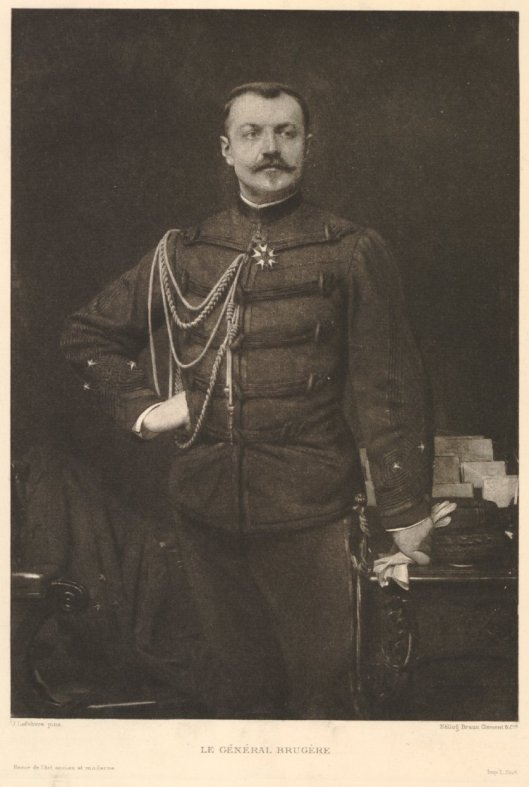
The British Museum acquired this painting of General Joseph Brugère in 1902, the same year this French military leader led a goodwill tour to the United States solidifying Franco-American relations. Many of the individuals involved would go on tour serve in the Great War.

The event was so-called because the central moment of the mission was the May 24, 1902 dedication in Washington D.C.’s Lafayette Park of a memorial to Jean-Baptiste-Donatien de Vimeur, Comte de Rochambeau, the French military leader who had fought with George Washington during the American Revolution. The early 1900s were an interesting moment in diplomatic relations. The United States had recently won the Spanish-American War and was becoming a true world power; the brutal Philippine Insurrection, the final phase in the Spanish-American War, ended on June 2, 1902. One month earlier, on May 6, General Joseph Brugère boarded Vice Admiral Ernest François Fournier’s Gaulois in Toulon and sailed for Washington. One of the driving forces of this mission was Horace Porter, the United States ambassador to France.

Porter had served under Ulysses S. Grant during the American Civil War and went on to serve in various capacities over the next several decades. He was the driving force to fund and build Grant’s Tomb, which finally came to fruition on April 27, 1897 when William McKinley dedicated his predecessor’s final resting place. Several weeks after that dedication Porter was off to Paris, where he would be President McKinley’s representative to France. Civil War veterans were still very much running American life; the president himself had been in the Battle of Antietam; his Secretary of State, John Hay, had been one of Lincoln’s personal secretaries; and right then in 1902 Secretary of War Elihu Root was putting Ambassador Porter in for the Congressional Medial of Honor for his actions at the Battle of Chickamauga.

Brugère, Fournier and a sizable contingent visited George Washington’s resting place at Mount Vernon on the afternoon of May 22 and were hosted that evening by Theodore Roosevelt at the White House. The big event came two days later when Ambassador Porter, President Roosevelt, General Brugère, Vice Admiral Fournier, scores of dignitaries, and thousands of others turned out at Lafayette Square Park for the Rochambeau statue dedication. Henry Cabot Lodge was the featured speaker. It was all a huge success.

A few days later the Brugère/Fournier contingent would be fêted across New York City. Among other things they got a look at the Brooklyn Navy Yard, dined with mayor Seth Low, and received a tour of Columbia University from college president Nicholas Murray Butler. Columbia is conveniently located next to Grant’s Tomb and on May 28 Ambassador Porter took Brugère, Fournier and the rest of the French delegates to the mausoleum that he had done so much to build. At the time the general public could not walk down to the sarcophagi as one can today. As leader of the Grant Monument Association however Porter was naturally able to take the Rochambeau delegates down the marble steps, where they all stood in hushed stillness for ten minutes. (At the time it was still only Ulysses; Julia passed away seven months later in December 1902.) After the visit, the delegation walked north of the tomb to the Claremont Inn, where several dozen people had a sumptuous meal.

(image/The British Museum)


A World War One era Steinway

Now here is something you don’t see everyday, let alone in a thrift store: a 1917/1918 Steinway & Sons grand piano. I saw this in the city yesterday on 23rd Street. I was a little confused at the 1917/1918 designation. I would have thought it fairly easy to trace the provenance of such a thing; as I understand it Steinways come with serial numbers and other identifying information to track their provenance. Or, maybe due to the war they were producing models on something other than an annual basis? Whatever the reasons, one can’t blame the people in the thrift store for not knowing.

This century-old 1917/1918 Model M Steinway & Son piano is currently in a thrift store on Manhattan’s 23rd Street.

Whenever I see something like this, I wonder how it got there. Was it in someone’s New York City apartment for decades until said person either passed on or moved in to a smaller place? Did the family donate the thing to a thrift store during a house cleaning? What famous pianist might have played it along the way over the past century? There is no way to know. That is the wonderful mystery of such things.

I have passed the Steinway crypt in Green-Wood Cemetery dozens of times over the years. A Wikipedia search informs us that the company was founded by Heinrich Engelhard Steinweg in New York City in 1853. Steinweg had emigrated from Lower Saxony and come to the United States with his sons after the failed revolutions of 1848. It was a wise move; the family avoided much of the tumult of the next 75 years. Steinway the Elder died in 1871 in the middle of the Franco-Prussian War. By the time of the Great War the Steinways were part of the fabric of New York City life and it does not seem they suffered from the anti-German sentiments so common during the Great War. Steinweg himself had anglicized the family name when first coming to the New Country. Perhaps the less overtly Germanic “Steinway” saved the family such grief.

Steinway pianos then and now were made in Queens. During the war the city was building a Steinway tunnel to connect Queens to Manhattan via a new subway line. Frederick Loeser & Co., a Brooklyn-based department store, was one place to buy a Steinway, among dozens of other piano makes and models. Loeser newspaper ads from 1917 and 1918, the period in which the Model M we see above was manufactured, list the original price of a Steinway grand piano at around $1000, just over $18,600 in today’s currency. Loeser’s however was selling them at a steep discount. It would be interesting to know if such discounts were customary or due to the war.


Geoff Emerick, 1945-2018

I learned yesterday of the passing this past Tuesday of Geoff Emerick, who engineered the Beatles’s catalog from Revolver onward. If the name does not ring any bells that is not entirely accidental: producer George Martin was fiercely territorial of his relationship with the Beatles in the recording studio and did not want others getting credit for what he saw as his domain. Emerick complained justifiably in his memoir Here, There, and Everywhere of him and others being minimized cavalierly as merely “the staff” despite their important contributions. Martin’s accomplishments were of course significant but one can state with strong accuracy that had Emerick not been there in the Abbey Road studios that Revolver and Sgt. Pepper in particular would not have been the albums that we have now been listening to for half a century.

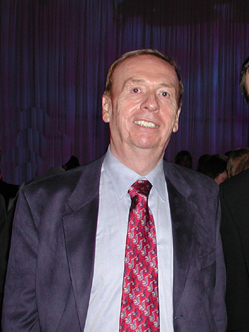
Geoff Emerick in 2003

Emerick worked in a supportive role on Beatle recordings from virtually the outset in 1962 and became their chief engineer in April 1966 when Norman Smith left to produce Pink Floyd. The first song Emerick engineered was “Tomorrow Never Knows.” He was all of twenty years old. The Beatles went on the road that summer for what would be their final tour. When they regrouped in London later that year they began the Pepper sessions, beginning with the double-A side single of “Strawberry Fields Forever” and “Penny Lane.” The pressure was truly on Geoff Emerick at this time because the Beatles had made clear to him that they would no longer be touring and that the studio releases were the band’s authoritative communications. It was his job to take their ideas and and find a way to get them on tape. That was no small task in the days before digitization.

It was a seminal year in British history; 1966 came fifty years after the battles of the Verdun and the Somme, nearly twenty years after V-E Day, and a decade after Suez. England defeated West Germany in the Word Cup that summer. Austerity Britain was giving way to Swinging London. Drab greys were giving way to the technicolor uniforms the Beatles would wear in 1967, the style inspired by the nostalgia for neo-militaria that was common in Britain in those years immediately after the Empire’s collapse. So much of that seems dated and overdone today, a relic of a time gone by. I suppose none of that really matters anyway. All that is left of true importance is the magic of what happened in those studios, in which Geoff Emerick played such an important part.

(image/Clusternote via Wikimedia Commons)

Brooklyn, circa 1950

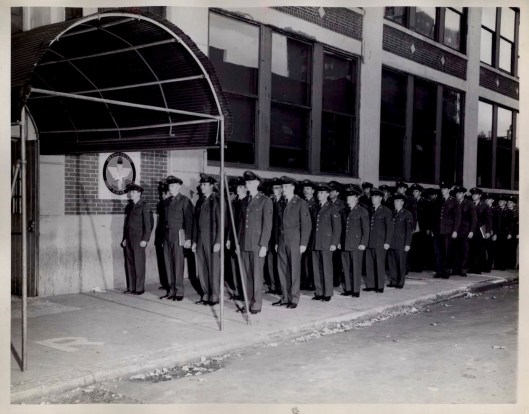
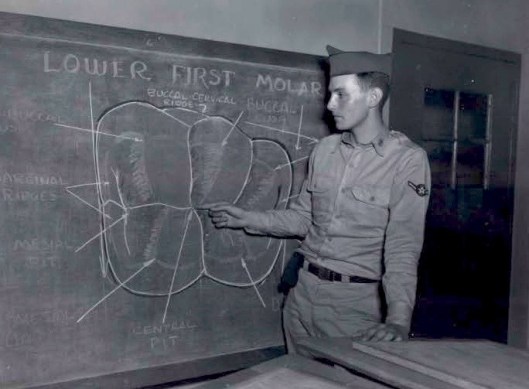
Yesterday morning at work I was going through some boxes of archival images for a presentation tomorrow when I came across these two. These are students at what is now New York City College of Technology in about 1950, when the institution was still known by its original name, the New York State Institute of Applied Arts and Sciences. There was–and still is–a strong veteran presence on campus because we began as a GI Bill school just after the Second World War. This fall I intend to get back to a project about the early years of our college, with a special emphasis on our founder: Benjamin Harrison Namm. I had intended to do it over the summer but the revisions on the latest draft of my Civil War manuscript took longer than I expected.

Namm had been a major in the First World War and returned to run the department store his father founded in Downtown Brooklyn, which he took to new heights. When the Second World War was winding down Namm understood that returning GIs needed the educational benefits and other services not afforded the doughboys of 1917-18 and became determined to do something about it. There was to be no Bonus Army this time around. I’ll leave it at that for now. The dental image is notable because the United States Air Force was one of the leaders in Restorative Dentistry. It was City Tech’s founding provenance that presumably led to the program landing at the school in the late 1940s and early 1950s. And so it remains today. I’ll have more to say on this in the coming weeks.

(images/Urulsa C. Schwerin Library Archives)

Geoffrey C. Ward: “The fun is in the chase.”

I was bemoaning the recent fallowness of the blog to a friend earlier this week. With the semester in full swing I haven’t had the time over the past ten days or so. Last night however a friend and I ventured up to the CUNY Graduate Center to watch Geoffrey C. Ward give the annual keynote for the Leon Levy Center for Biography. The Levy Center was founded by David Nasaw in 2007. While attending the Graduate Center in 2005 I took a class on the Gilded Age with Professor Nasaw in which I learned a great deal. At the time he was just about to release his biography of Andrew Carnegie. I can’t say I really know Professor Nasaw and I doubt he would remember me–I haven’t spoken with him in thirteen years for one thing–but as I understand it he founded the Levy Center because he believed that academics were not receiving professional credit for writing biographies. If that is indeed the case, and I suspect it is, I imagine it’s because tenure and promotion boards see biography as esoteric, which is misguided and unfortunate.

Geoffrey C. Ward, September 2018

Ward is the author or co-author of sixteen books but focused his keynote on his two-volume biography of FDR and his exposé of his great-grandfather Ferdinand Ward. This was of course the swindler who cheated Ulysses S. Grant and so many others in the ponzi scheme that took down Grant & Ward in 1884. Geoffrey Ward told the audience that while working on the book he concluded that his ancestor literally had no conscience and was probably a sociopath. Franklin Roosevelt however proved more inscrutable. Ward explained that when he began researching Roosevelt he wanted to know if the polio that touched Ward’s own life had taken away any of FDR’s optimism or indomitable spirit. Ward never found the answer during his research and writing but the answer may have appeared, he explained, in the diaries and letters of Margaret Suckley that turned up after her death in 1991 at the age of 99. In those pages Roosevelt confessed to his friend and confidante the depression and frustration to which he occasionally succumbed due to his physical impairment.

Ward gave a thoughtful presentation and had the audience’s attention. On the way out of the auditorium we ran into a mutual friend and the three of us talked on the Fifth Avenue sidewalk about the talk. I mentioned FDR’s public persona and compared it to the presentation of self of none other than Duke Ellington My friend look quizzical and so I repeated it. Strange as the comparison may seem, Roosevelt and Ellington in their individual ways presented impenetrable public versions of themselves. Of course everyone does this, especially public figures, but few are able to hold the visage together as tightly and for as long as Roosevelt and Ellington. Many people in their inner circles thought they understood the two men, when in reality the president and jazzman rarely gave all of themselves to any one individual. They both were, and to an extent still are, enigmas wrapped in puzzles. Geoffrey Ward collaborated with Ken Burns on the Jazz documentary twenty years ago and spoke of Ellington’s public countenance. This is entirely speculation on my part but I strongly suspect that when Ward was discussing Ellington he was comparing him to Franklin Roosevelt.

Mayors Mitchel and McClellan

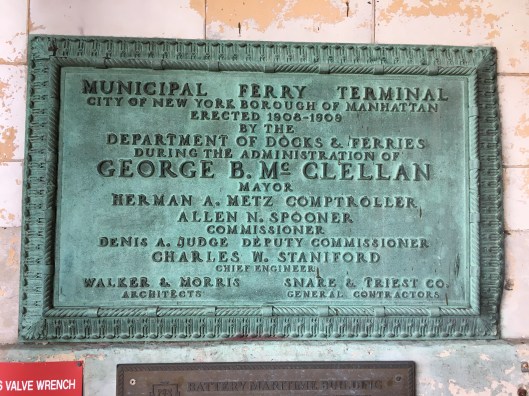
George B. McClellan Jr. tablet, Battery Maritime Building. The son of the Civil War general was one of the most important mayors in the history of New York City and later served in the Great War.

What a great weekend it was for Camp Doughboy on Governors Island. I had not been on the island all summer, working as I have in northern Manhattan at Grant’s Tomb since early June. It was so good to see and catch up with many of the rangers and volunteers I have known for almost . . . nine years . . . now. It is the people you meet and get to know who make it all worthwhile.

I had a good conversation with a friend on the ferry boat over about John Purroy Mitchel, the subject of my talk later in the morning. In the late 1900s, before himself becoming the city’s chief administrator, Mitchel worked with Mayor George B. McClellan Jr. to clean up the city, with a special focus on Tammany Hall. In a small bit of serendipity we noted that the Battery Maritime Building from which the ferry had taken off was itself built by Mayor McClellan in 1908-09, a few years after his split from Tammany. The thousands of people who cross the harbor every week pass the tablet you see above without giving it a second thought. Mitchel was a natural ally for Mac in the endeavor to take down Tammany, and while the two were not wholly successful in taming the Tiger they did put a serious dent in its power and influence. Both former mayors joined the armed services when the United States joined the fight, with Major Mitchel killed stateside in a flight accident and Lieutenant Colonel McClellan going to France.

Rutherford B. Hayes at South Mountain

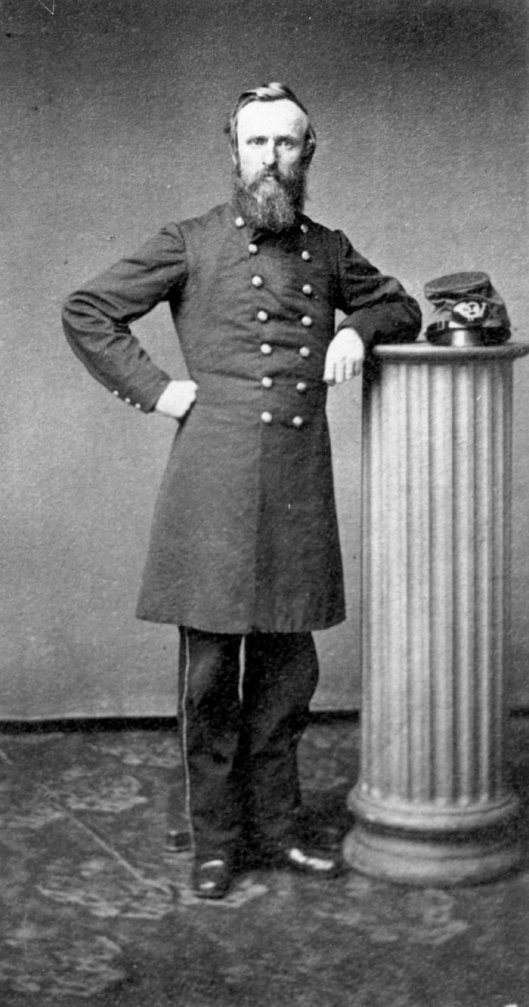
Rutherford B. Hayes was wounded at the Battle of South Mountain on this date in 1862. South Mountain is not as well known as it should be because it took place three days prior to the Battle of Antietam. Historians, accurately or not, usually interpret it not as its own set piece but as the prelude to the bloody day at Sharpsburg. That is entirely understandable but has also lessened the focus on the events of September 14. Hayes at the time was an officer in the 23rd Ohio. He and his men were eager to avenge the loss at Second Bull Run and were spoiling for a fight. They found it at Fox’s Gap, where Hayes received his wounds early in the morning. Of course he eventually recovered fully and became a general before entering the world of politics after the war.

Rutherford B. Hayes, seen here as a major in 1861, was wounded at the Battle of South Mountain on September 14, 1862.

In August 1885 now former president Rutherford B. Hayes attended Ulysses. S. Grant’s funeral. There too among the many other dignitaries was President Cleveland and former president Chester A. Arthur. I came across an interesting old newspaper article the other day that claimed that Arthur and Hayes were not selected as honorary pallbearers to avoid Hayes’s involvement in such a capacity. I have no idea if that is conjecture or if the writer of that piece in the 1880s had more information to go on. The standard narrative of the funeral is that former high-ranking officers were selected from the North and South as a reconciliationist gesture to aid in the reuniting of the country. Of course Arthur and Hayes had both been Civil War generals in their own right, so that theory would not necessarily preclude them from participating in such a capacity.

Arthur would have been a good fit for honorary pallbearer. he had been a long time Grant supporter, an ally and protégé of Grant ally Roscoe Conkling, and the first leader of the Grant Monument Association. Hayes’s involvement would have been a little more complicated. He had tried remove Arthur as Collector of the Port of New York in 1877 and replace him with Theodore Roosevelt Sr. That did not come to pass, in large part because of the political machinations of Senator Conkling. If the idea was to keep Hayes out then the idea of excluding Arthur would make sense: to ask one ex-president to be honorary pallbearer would mean having to ask the other. Arthur himself was a forgiving sort who rarely held grudges for long. A good illustration of that is that he attended Theodore Roosevelt Sr.’s funeral in February 1878 just weeks after the Collector controversy. So if a decision was made on Hayes it was probably made by someone else. Both former presidents did participate in the funeral, riding in carriages in the procession. The decision-making in how to incorporate Arthur and Hayes into Grant’s funeral is a rabbit hole worth going down. I am sure the answer is out there somewhere in the literature on the Gilded Age.

(image/Rutherford B. Hayes Presidential Center)