Remembering Franklin Pettit Updike

I wrote this four years ago and am re-posting it today, the 100th anniversary of the death of Private Franklin P. Updike in the Great War.IMG_1108I was in Green-Wood Cemetery on Sunday when I came across the headstone of Franklin P. Updike. These WW1 headstones are much rarer than the ubiquitous Civil War markers one sees so often in old garden cemeteries. For one thing, there were fewer American deaths in the First World War than there were during the Rebellion. what’s more, a significant portion of doughboys were interred overseas where they were killed.

Updike, I later learned, lived in Brooklyn Heights and enlisted in the Army a month after the U.S. entered the Great War.

Updike death copy

Updike is somewhat unusual in that he died during the war and was brought home. Note that the headstone was ordered in April 1942, just as the U.S. was entering the Second World War.

Updike grave marker copy

The young private was a wagoner, that is he tended horses and carts. This was a dangerous task; the enemy understood the importance of the enemy’s transport and so did everything to neutralize–kill–it. In his Memoirs George Marshall wrote of the wagoners in his division that at certain periods “the most dangerous duty probably fell to the Quartermaster Sergeants and teamsters who went forward each night.”

The people of St. Ann’s Church held a service for Updike at Thanksgiving 1918. The war had been over for two weeks by this time. This announcement and the one below are from the Brooklyn Daily Eagle.

Updike St Ann's announcement copy

This afternoon on my lunch break I went to the Heights and took this photo of St. Ann’s as it is today.

IMG_1110

The people of Brooklyn did not forget Updike. Alas I don’t believe it still exists today but they named the local American Legion Post after him. This was in January 1924, ninety year ago this year.
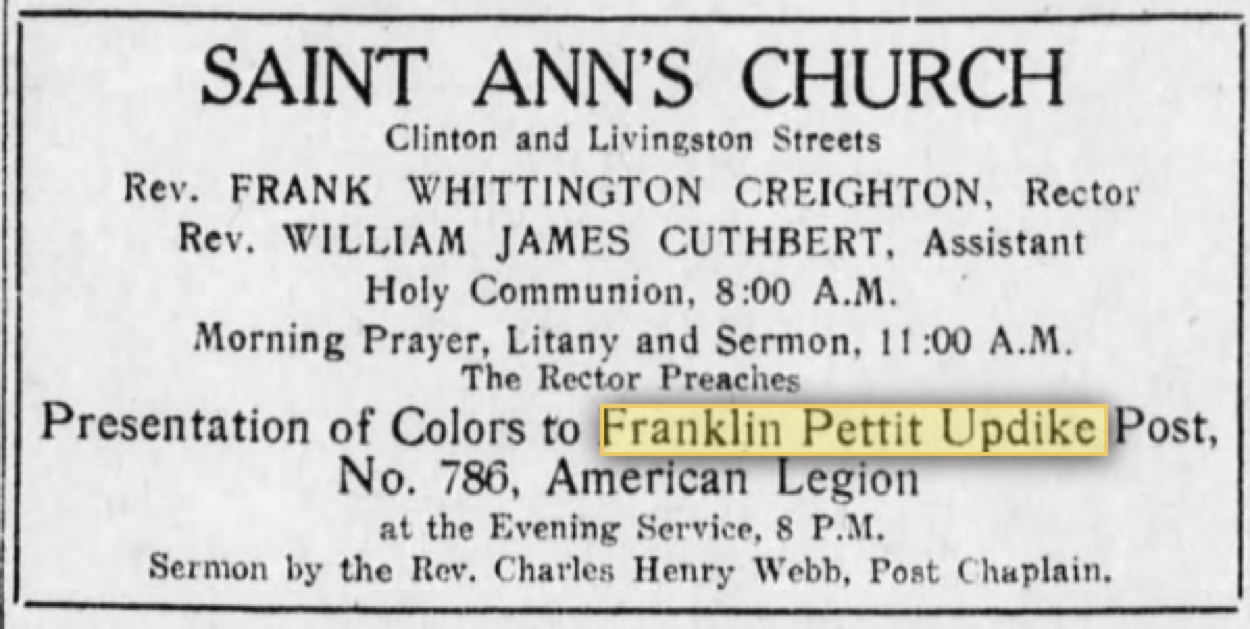
Updike color presentation copy

Three quick stories from one Sunday at Grant’s Tomb

“Grant from West Point to Appomattox,” 1885 engraving

It always pays to engage the pubic when one works or volunteers at a National Park Service site. Here are three amazing vignettes that happened just today at Grant’s Tomb:

A woman, clearly nostalgic, comes in today and says she lived in the neighborhood a long time ago and was back for the weekend. I told her that a few weeks a man came in and said the last time he had been in the Tomb was sixty-one years ago when he was a cadet at West Point and he and his classmates were there for a ceremony. “Oh, I can do better than that,” she laughs before continuing, “I grew up in an apartment building further down Riverside Drive and when I was a little girl way back when my friends and I would roller skate up here.” She then begins discussing the notion of free-range children, the freedom kids once had to explore the world around them on their own and figure things out for themselves.

A little while later a man comes in wearing a bright yellow shirt upon which are printed multiple images of Ulysses S. Grant. His daughter, a woman in her thirties, is with him. When I strike up a conversation he explains that they are on their way back to Ohio after attending the 137th annual Sons of Union Veterans encampment held this weekend in Framingham, Massachusetts. I had to tell them that the Grand Army of the Republic oversaw the Decoration Day observations at Grant’s Tomb from 1886 until 1929, when they turned those duties over to the Sons of Union Veterans. Father and daughter are duly impressed.

A little while after that a man comes in and says he lives in the Midwest and has not been here in some years. I mention to him the story of the West Point cadet coming back after sixty-one years and he too laughs. He himself turns out to be a United States Military Academy graduate, attending in the late 1970s in those years immediately after Vietnam. After he mentions it, I cannot help but notice that he has that thing that all Service Academy graduates seem to possess: the obvious intelligence and awareness, the sense of presence and unfailing politeness, and the impression that they are giving you their undivided attention when you are speaking. He is in town because he is going to West Point tomorrow to participate in March Back from Camp Buckner.

Three amazing and very random stories one might hear visiting one’s national parks.

(Engraving by Thure de Thulstrup for L. Prang & Co., Boston via Library of Congress)


Sunday morning coffee

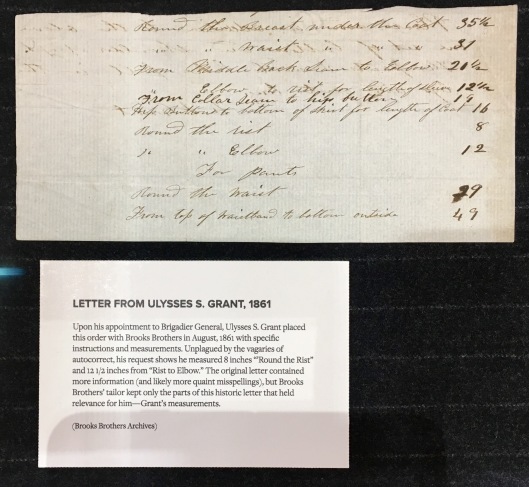
Ulyyses S. Grant sent his measurements to Brooks Brothers in August 1861 after being promoted to brigadier general. Oddly the tailors did not keep the entire note, instead only saving the portion describing the fit and proportions.

I’m listening to jazz and having my morning coffee before heading out the door for Grant’s Tomb. The sun seems to be shining. I thought we would stay with the Brooks Brothers theme one more day. What we see here is a letter in Ulysses S. Grant’s hand to Brooks Brothers giving his measurements. The letter is from August 1861 and is currently on display at the exhibition I mentioned yesterday at Grand Central Terminal. Grant learned of his promotion when he read about it in the St. Louis newspapers while stationed in the Western Theater. His rise had been meteoric. Grant left the Army in April 1854 and had seven full years in the wilderness before rejoining the military after the firing on Fort Sumter in April 1861. Now before the end of the summer he would be a brigadier general. Grant was never one for punctiliousness in military dress, he would famously wear an enlisted man’s blouse later in the war, but it must have been nice to order and put on this general’s uniform that we see here.

Enjoy your Sunday.

Grant rocks the ZZ Top beard wearing his new Brooks Brothers-tailored uniform, Cairo Illinois, September 1861.

Brooks Brothers, 1818-2018

I was in the city running a few errands and having a little fun yesterday, buying a chambray shirt, renewing my library card at NYPL, and taking in the Brooks Brothers exhibit on display through September 5 in Grand Central Terminal’s Vanderbilt Hall. Brooks Brothers began in 1818 on the more southern portion of Manhattan, where most New Yorkers still lived and worked. Grand Central opened in 1913 and Brooks Brothers opened its now-flagship store across the street at 346 Madison in 1915 to serve the commuting businessmen. It was fortunate for the Great War effort the the spacious train terminal was built when and where it was, accommodating as it did the mass influx of men and material on their way to France.

an October 24, 1861 letter from Assistant Quartermaster Chester A. Arthur letter to Brooks Brothers…

Taking in the Brooks Brothers exhibit was a journey in time and made me a little rueful at how far the once iconic temple of men’s style has fallen. Really it is not all Brooks’s fault; societal changes, many of them for the better, have rendered much of traditional men’s styling obsolete. That said, when they put me in charge of the world, jackets and repp ties will again be required for all men. There were many striking and iconic things to see but two that struck me the most were these. The first is a letter to Brooks Brothers from New York State Assistant Quartermaster Chester Alan Arthur requisitioning 300 overcoats. The letter is from October 24, 1861, three days after the Battle of Ball’s Bluff.

…and a contract signed by the four Brooks brothers and Governor Edwin D. Morgan on August 3, 1861, two weeks after First Bull Run. Note the fabric swabs in the upper right corner.

The second is a contract signed by Governor Edwin D. Morgan two month and a half months earlier. It is a mark of the great import of the transaction that all four actual Brooks brothers signed the document. This came at an important time in the war effort, just two after the fiasco at Bull Run. I write about this moment in the manuscript of Incorporating New York. By early August men like Morgan and Arthur were cleaning up the mess and preparing for what everyone now knew would be a long war. I know the images are not that great, having been taken through the glass in the display case, but note the red wax next to each signature marking it official. Governor Morgan’s is on top and then the four brother’s below. I don’t know for certain but my guess would be that the fabric swabs were included in the contract after earlier incidents of clothiers–including Brooks Brothers–providing the Army with inferior shoddy goods.

The 1865 Colfax Expedition

In late June 1864, with the country still reeling from Ulysses S. Grant’s bloody Overland Campaign, President Lincoln signed legislation granting Yosemite Valley and the Mariposa Big Tree Grove to the state of California. I speak in my manuscript about how forward-thinking many were even in the worst depths of the war about what might come afterward, hence the passage of the Pacific Railroad, Homestead, and Land-Grant College bills as early as 1862. The 1864 Yosemite Act was a part of that optimism. Eight years after this, President Grant put Yellowstone under federal control. In between, in the summer of 1865, Speaker of the House Schuyler Colfax led an expedition out west just after the Civil War to review the situation. Three years after all this Colfax became Grant’s running mate and then served four years as vice-president from 1869-73.

Frederick Law Olmsted (second from left front row) read his report on Yosemite and Mariposa Grove to House Speaker Schuyler Colfax and his entourage on 9 August 1865. Olmsted, his wife Mary (seated next to him), and the expedition then sat for this image. With the Civil War finally over, Americans were thinking of the possibilities for the future.

Frederick Law Olmsted left his position as secretary of the U.S. Sanitary Commission in mid-1863 and took a position in California managing the Mariposa mining estate. There he was horrified by the corruption and environmental depredations he saw. A bright spot was that he was eventually placed on a committee to examine how the state of California might preserve Yosemite and Mariposa. Back in Washington on 14 April 1865 Grant and Colfax both begged out of attending My American Cousin at Ford’s Theater with President and Mrs. Lincoln. That same day Lincoln spoke to Colfax excitedly about the Speaker’s upcoming trip out west. As Colfax remembered it, Lincoln told him, “Mr. Colfax, I want you to take a message from me to the miners whom you visit. I have very large ideas of the mineral wealth of our nation. I believe it practically inexhaustible. It abounds all over the Western country, from the Rocky Mountains to the Pacific, and its development has scarcely commenced.” Later that evening Booth shot Lincoln and the president died the next morning.

Colfax and his entourage headed west shortly after the president”s assassination and traveled many thousands of miles by various means, taking in what they saw and thinking optimistically about the possibilities for the reunified country. By early August they reached Yosemite and toured that beautiful valley along with the sequoias at Mariposa Grove. On 9 August 1865 Speaker of the House Colfax and others listened to Frederick Law Olmsted read his “Yosemite and the Mariposa Grove: A Preliminary Report,” the study that Olmsted and his team had written for state officials outlining how California might best preserve these sites. The state eventually did nt pursue many of the commission’s recommendations, deeming them too expensive and impractical. It was not a total loss. The Colfax Expedition helped lay the groundwork for President Grant’s signing in March 1872 of the Yellowstone National Park Protection Act. It was the start of the environmental movement here in the United States. Yosemite and the great sequoias too eventually came under the management of the National Park Service.

(image by Carleton Watkins; Courtesy Yosemite National Park Research Library)


August 8, 1918: the start of the Hundred Days Offensive

Battle of Amiens: German prisoners about to carry British wounded off on stretchers. Sailly-le-Sec, 8 August 1918.

In a vey real sense the beginning of the end of the First World War began one hundred years ago today; it was on August 8, 1918 that Supreme Allied Commander Ferdinand Foch began the counteroffensive that was itself a response to Ludendorff’s own Spring Offensive. This was hardly just a French military campaign; the British, Canadians, and Australians were also integral to the fighting against the Germans. The Americans played a supporting role as well. I saw on the news today that Prince William and others were on hand to mark the occasion. The Amiens Offensive lasted one week. The Allies suffered about 60,000 casualties and the Germans about 27,000 in addition to having almost 30,000 taken prisoner.

We are getting into the stage of the Great War centennial where events are going to move extremely quickly between now and the anniversary of the Armistice. Historians eventually called the period from August 8 to November 11 the Hundred Days Offensive. It was hard, full on fighting from here to the end. The Hundred Days Offensive was an extraordinary human drama. Men on all sides would be pushed to the limit, and the ambulance drivers, nurses and doctors who tried to put them back together faced extraordinary challenges. Every day had its own individual tragedies, multiplied thousands fold.

No one knew at the time when or how it would all end, but August 8, 1918 proved a crucial turning point in the Great War.

(image by Lieutenant John Warwick Brooke; Courtesy Imperial War Museum)

Margaret Suckley and the 27th Division

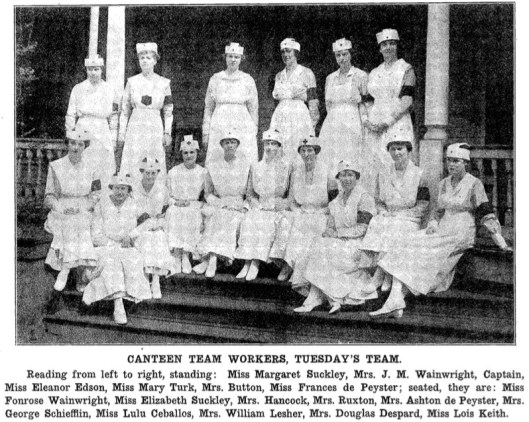
Yesterday a friend and I braved the heat and ventured to Roosevelt Island to visit Four Freedoms State Park, architect Louis Isadore Kahn’s tribute to our only four-term president and the man who gave the world so much of what many people sadly take for granted today. When I got home I finished Jean Edward Smith’s FDR, an outstanding biography I have been reading over the summer in addition to finishing my book manuscript and boning up on my U.S. Grant. (Last week I picked up a brand new hardcover copy of the same author’s Grant for $5 that I will get to in a few weeks.) This morning I have been going through copies of “Gas Attack,” the newspaper published by the 27th “New York” Division during the First World War. The men had published a previous newspaper called the “Rio Grande Rattler” when they were stationed on the Texas/Mexico border during the Punitive Expedition in 1916. The reason I say all this is because in pursuing “Gas Attack” I came across this extraordinary photography that includes Margaret L. Suckley.

Margaret Suckley was a volunteer with the 27th “New York” Division when the unit trained at Camp Wadsworth, South Carolina in 1918. She went on to be a friend and confidant of Franklin D. Roosevelt, whom she met a few years after the war. The Elizabeth Suckley pictured here is presumably a sister or cousin.

The image we see here is from the May 4, 1918 edition, published at Camp Wadsworth and the last installment of the paper before the division shipped out to France. Suckley (the first vowel in her name rhymes with book) was one of the two dozen or so canteen women who provided refreshments to the men of the 27th Division. Most of these women were married and had spouses within the unit. Suckley though was not one of these. In 1918 when this photograph was taken she was 26 and unmarried. A few years earlier she had been a student at Bryn Mawr but for whatever reason her mother forced her to drop out before getting a degree. Franklin Roosevelt was Assistant Secretary of the Navy at this time but he and Suckley did not yet know each other; they would not meet until 1922. In the 23 years after that, until FDR’s death in April 1945, they would be confidants and close friends. She was one of the few people unafraid to tell Franklin when he was wrong. Margaret was one of the women present in Warm Springs when Roosevelt died.

(image/Gas Attack of the New York Division)


Paying respects to Grant in Albany, August 1885

Stereoscopic view of General Grant’s Albany, NY funeral procession, August 4 or 5 1885

I spent a good portion of the day today telling visitors to Grant’s Tomb that this is the anniversary week of General Grants funeral. The famous procession attended by 1,000,000+ persons was held on August 8, 1885 in New York City. The Grant family held a private service at the Drexel house at Mt. McGregor on August 4, after which Winfield Scott Hancock and his staff from Governors Island brought Grant’s remains to Albany. There on August 4-5 some 80,000 people passed through the New York State Capitol to pay their respects. Not present was the Grant family, who had already gone on to New York City where they were staying at the Fifth Avenue Hotel on 23rd Street preparing for the event on the 8th. Widow Julia remained at Mt. McGregor, too distraught to take it all in. The Brooklyn Daily Eagle noted in its August 5 edition that “Albany did not go to bed last night.”

I wish the above stereoscopic image were clearer but this was the scene in Albany on either August 4 or 5 1885.

(image/NYPL)

Prospect Park, 1966

Prospect Park centennial invitation, June 1966

These past two Fridays I visited the Brooklyn Historical Society, last week the new satellite facility on the waterfront and yesterday the main site in the Heights. If you live in New York City I cannot recommend the BHS strongly enough. The DUMBO facility, situated in an old warehouse, is quite striking. Their inaugural exhibition is a long-running (four year) exhibit discussing the significance of the waterfront. I found the snippets of oral histories with Rosie the Riveters to be poignant. I ruefully texted a friend noting that the interviews were mostly from the 1980s and 1990s and that the subjects were probably deceased by this time. It saddens me to see the end of the World War 2 generation.

Yesterday at Pierrepont Street I took in a small exhibit about Prospect Park. Part of it dealt with the 1966 centennial observation of the Olmsted and Vaux masterpiece. The two won the commission for the Brooklyn park on May 29, 1866, about six months after Olmsted returned from California after the Civil War. I had never heard of the 1966 Prospect Park commemoration and so did a bit of digging. I noticed that May 29, 1966 fell on a Sunday and am therefore curious as to why they did not have the event on the anniversary itself. Perhaps Sunday blue laws were still stringent enough to move it to another day; or, maybe a weekday was better to accommodate school groups. I’ll never know.

There was an 8-10 minute film from the period produced by the Brooklyn Union Gas Company, today part of National Grid, with wonderful images. The signage next to the plasma screen noted that Brooklyn Union had placed the film in a time capsule to be opened for Prospect Park’s bicentennial in 2066. Apparently they made a few copies and gave one to the BHS. Civil War veterans were a frequent sight at events like this in Prospect Park well into the 1930s. That is why they changed the name of Prospect Park Plaza to Grand Army Plaza in 1926. By 1966 they were of course all gone. I was a little surprised however not to see any Great War veterans, who were still very much around in significant number, at this time.

To read the old New York Times articles about this event is to see a Brooklyn that is no more. The borough had not yet hit rock bottom but the post-industrial decline and white flight are there for the observant to notice. A May 30, 1966 headline reads “Centennial Celebration Will Open Thursday for City Oasis, Now in Decline Attendance Falling off.” Still, there were signs of hope. Mayor Lindsay and Robert Moses were both on hand and addressed the park’s issues. Federal and local funds had already been appropriated to renovate the boathouse and other venues. The park would fall much farther over the next three decades before turning around in the mid-1990s but is heartening to know that there were people, some prominent, others less so, studiously holding the line and doing what they could in what was a difficult situation.

Sunday morning coffee

Grant’s Tomb from Sakura Park, July 2018

I took this photo last Sunday and thought I would share. From the view from my window right now it looks like it should be a beautiful if warm day. Today marks the start of Harlem Week. Apparently this event is also called A Great Day in Harlem, after the Art Kane photograph taken sixty years ago this August. The photo is actually called Harlem 58. If you have never seen it take a look at this Daily News article from a few years back.

When this photo was taken the Harlem Renaissance was still within living memory. Many of the musicians profiled probably played in Paris in this years just after the Great War. By the late 1950s New York City was already beginning its post-industrial decline, even if that was not readily apparent at the time. From the Daily NewsThe world represented by those 57 men and women — a world of late-night clubs, of gents in suits and hats and ladies in gloves, of martinis and Lucky Strikes — was already vanishing in the rear-view mirror of popular culture.” It all sounds good to me, except for the martinis and Lucky Strikes. I remember when the documentary about the film shoot came out in the mid-1990s and even that seems like five eras ago. Many of the principals, like Dizzy Gillespie, were still alive to participate in the film. It is hard to believe Sonny Rollins and Benny Golson are the only two who remain.

Harlem Week began as Harlem Day in 1974. Someone was telling me that this event used to be more anarchic back in the wild years of the 1970s, 80s and early 90s, with people sleeping overnight on benches in Riverside Park and that type of thing. The beauty of this city is that it is constantly reinventing itself. Today Harlem Week stretches a month, through August 25 this year. Come to Harlem this Summer of 2018 and experience it for yourself.