JP Mitchel’s funeral, July 11, 1918

Here is some stunning footage of John Purroy Mitchell’s funeral at St. Patrick’s one hundred years ago today. Note Theodore Roosevelt and, I believe, Charles Evans Hughes, who ran against Wilson in 1916, walking behind the casket as the pallbearers take Mitchel into the cathedral.

John Purroy Mitchel, 1879-1918

Major John Purroy Mitchel in pilot gear, 1918

The have my article up and running over at Roads to the Great War about the life, times, and death of John Purroy Mitchel. New York City’s Boy Mayor was all of thirty-four when he became mayor in 1914. Initially he was an ally of Woodrow Wilson, who in 1913 had appointed him Collector of the Port of New York. Men like Chester Arthur had previously held the collectorship. Mitchel and Wilson soon had a falling out over what the mayor saw as the president’s poor leadership during the war. Soon, Mitchel was very publicly allying with friends like Theodore Roosevelt and Leonard Wood advocating for Preparedness. When he lost his re-election bid, Mitchel became a military aviator. He died in a flight exercise in Louisiana on July 6, 1918, one hundred years ago today.

(image/courtesy of Margaret Maloney via Wikimedia Commons)


New York City, July 1868

I would be remiss if I did not at least briefly mention that the Democratic National Convention began here in New York City 150 years ago today. This was the first presidential election since the end of the war, the assassination of Lincoln, and impeachment of Andrew Johnson. The Republicans had nominated Ulysses S. Grant in Chicago almost two months earlier. Grant would face the winner in the general election that fall. The Democratic field was wide open. President Johnson even sent a representative to take the pulse of the situation and see about maybe running. Few thought that Johnson would get the bid. Instead, George H. Pendleton of Ohio was the favorite coming in. Other leading prospects included Horatio Seymour of New York, Thomas A.Hendricks of Indiana, and Winfield Scott Hancock, one of the heroes of Gettysburg. The Democrats were meeting at Tammany Hall’s new wigwam on 14th Street that had been rushed into completion in time for the convention.

Very little actually happened at the wigwam on July 4, 1868. They did have a reading of the Declaration of Independence, which was a Tammany Fourth of July tradition. There was some talk about holding meetings that evening but that was quickly scuttled because of the holiday. This was all taking place five years after the victories at Gettysburg and Vicksburg. If you know your Gettysburg, you know that the Tammany regiment played a big role in that battle and has a prominent marker at the High Water Mark.

Most of the action that day took place a little farther south at the Cooper Institute. In a sort of shadow assembly, the Soldiers’ and sailors’ Convention was taking place there. Many former general were present including William B. Franklin and Henry Slocum. The preferred candidate here seemed to be Winfield S. Hancock. The South and West were widely represented at Cooper Union, just as they would be at the wigwam starting on July 5. In a precursor to the events that would transpire at the wigwam over the course of that hot week, Major General Ewing’s speech was a refutation of reconstruction.

In the next week I intend to go at least a little deeper into the convention held here in New York City 150 summer ago. Suffice it to say that the 1868 Democratic Convention was one of the most tragic and painful in American history. The only political gathering that may–may–have been worse in its ugliness was the convention in Chicago 100 years after it.

(top image/Library of Congress; bottom, title page of Ewing convention speech)

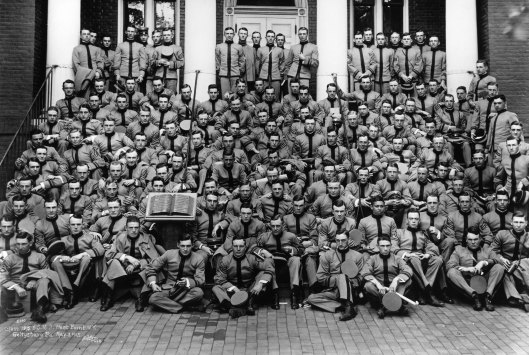
The Class the Stars Fell On at Gettysburg, 1915

The West Point Class of 1915–The Class the Stars Fell On–toured Gettysburg in early May 1915 a few days before the sinking of the Lusitania and graduated one month later. Two years after this many of these men would be lieutenants and captains serving in France.

We are going to continue with the Gettysburg theme this Fourth of July Week with this photograph of the West Point Class of 1915 posing on the steps of the Christ Lutheran Church on Chambersburg Street. This West Point cohort is called The Class the Stars Fell On because so many of the firsties we see here went on to become generals by the time of the Second World War. Somewhere in here are Dwight Eisenhower and Omar Bradley. They arrived in Gettysburg on 2 May and toured for several days under the supervision of Colonel Gustav J. Fiebeger, the legendary instructor who for more than a quarter of a century served as chair of the Academy’s Civil and Military Engineering Department. Among Fiebeger’s important works was “Campaign and Battle of Gettysburg,” which was studied by students at West Point. Remember that military parks like Gettysburg still fell under the auspices of the War Department in 1910s, not being turned over to the National Park Service until the Franklin D. Roosevelt Administration.

When these cadets graduated a month later on June 12 they were the largest West Point Class up until that time, comprising 164 second lieutenants. Secretary of War Lindley Garrison was the commencement speaker. This was the first United States Military Academy class to graduate since the outbreak of the Great War the previous year and everyone understood that these young men might eventually be leading men into battle. The Lusitania was sunk later the very week this photo was taken. A very short list of those in attendance when the West Point Class of 1915 graduated the following month included Major General and Chief of Staff Hugh L. Scott; Major General George W. Goethels, who built the Panama Canal during the Theodore Roosevelt Administration; a West Pointer from the Class of 1847 who went on to become a brigadier; and Horace Porter, another West Pointer, who was an important aid to General and President Ulysses S. Grant and who went on to build Grant’s Tomb and was managing the mausoleum up through this time.


Sunday morning coffee

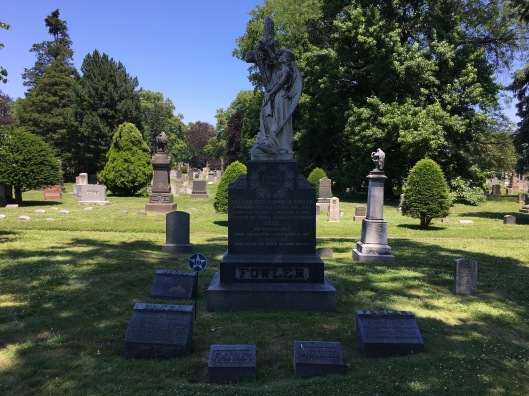
A colonel at the time of the Battle of Gettysburg, Edward B. Fowler led the 14th Brooklyn in Wadsworth’s division of Reynold’s I Corps at the railroad cut.

I am finishing up my coffee before I head out the door for Grant’s Tomb. It is going to be a warm one today, close to 100. I’m trying to embrace the heat to the extent I can. Today is the 155th anniversary of Day One of the Battle of Gettysburg. I was with a friend in Green-Wood Cemetery Friday and yesterday and, with a sense of longing for Adams County, was paying close attention for headstones of men who fought and/or were killed at Gettysburg. Yesterday I took this photograph of the Edward B. Fowler headstone. He and his men served under James Wadsworth in the Union I Corps. After the war he was a prominent figure in Brooklyn. When he died in 1896 he lay in state in Brooklyn’s City Hall and then had a full military burial in Green-Wood.

On Friday I finished re-reading David Blight’s Race and Reunion. While I don’t believe the work’s arguments were as groundbreaking as some would have us believe, R&R is no doubt an extraordinary work of scholarship. I gained a lot from going back to it. One of the things that most fascinates me about Grant’s Tomb, besides the life and times of the man resting there, is how the general’s death fit in to Americans’ memory and understanding of the war. Once I have my Grant history and historiography down a bit more, I intend to explore some of these things in a deeper way. I have already begun doing that. Grand Army Men were visiting the tomb for Decoration Days well into the 1920s. After the Armistice, they marched with men from the Spanish-American and the Great War.

Yosemite and the Civil War

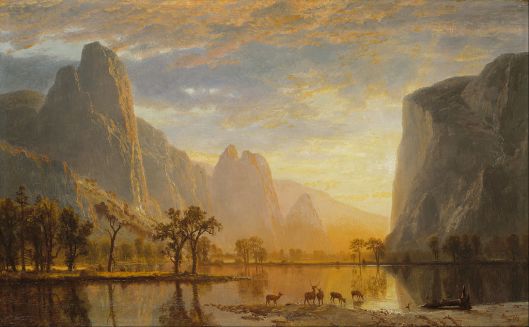
Albert Bierstadt began “Valley of the Yosemite” in 1863 and completed the small painting, less than 1′ x 2′, in early 1864. That spring it sold at the New York Sanitary Fair for $1600. In June Congress and Lincoln granted Yosemite and Big Tree Grove to California and Frederick Law Olmsted studied the area for the state over the next year. The painting today is in the collection of the Museum of Fine Arts Boston.

Abraham Lincoln signed the Yosemite Grant Act on this date in 1864. This legislation deeded Yosemite and the Mariposa Big Tree Grove to the state of California. It is interesting to note that Congress wrote and President Lincoln signed the measure in late June 1864, just days after the Overland Campaign in which so many men had been killed or wounded in ghastly ways. Even with the war far from decided people were looking ahead.

I tell the story a little bit in my book. The painting we see here was begun by Albert Bierstadt in 1863 and finished in 1864. While out west Bierstadt was also writing to his good friend John Hay, Lincoln’s secretary, back in Washington about the scenic beauty of California. It is not difficult to imagine Hay describing all this to his boss in the White House. As it happened, another man from back east was in California in 1863: Frederick Law Olmsted. He had resigned his position as secretary of the United States Sanitary Commission in September to take a job running a mine in Mariposa. Olmsted was burned out from his work with the Sanitary Commission and got as far away as he could by going out west. Soon after Lincoln signed the Yosemite legislation, Frederick Law Olmsted found himself part of a commission whose job it was to survey Yosemite and the Big Tree Grove and create for California officials a plan the state might use to make these protected parklands. Olmsted and his colleagues went about their task and submitted a report in August 1865. California officials ultimately tabled Olmsted’s report, deeming his provisions too expensive.

As for the painting we see above, it quickly ended up in New York City just after Albert Bierstadt completed it in early 1864. That spring officials of the Sanitary Commission sold the art work during the Metropolitan Sanitary Fair. The fair, like others held in various locales, raised funds for the Sanitary Commission to do its work tending the needs of soldiers out in the field. Albert Bierstadt’s “Valley of the Yosemite” sold for $1600, the highest sum for any artwork on sale for charity at the New York Sanitary Fair.

(image/Museum of Fine Arts Boston)

Life’s small pleasures

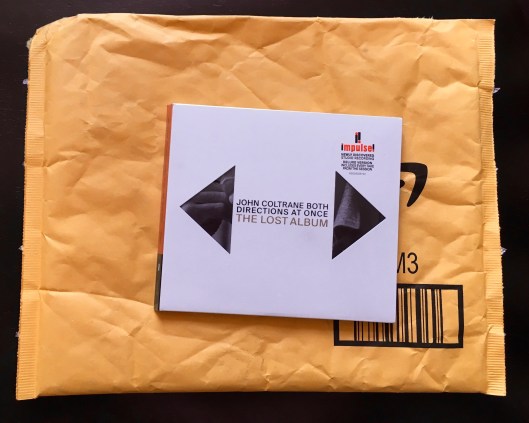
I spent a few hours walking Green-Wood Cemetery this morning with a friend. When I got home, there in the mailbox was the new John Coltrane cd waiting for me. I have it on right now. I love stories of “lost” audiotapes, manuscripts, archival photographs, and whatnot. It is easy to be cynical about these things–it is easy to be cynical about a lot of things–but this is no filler or outtakes that should have remained in the vaults. These lost tapes are the real thing, another tile in the mosaic to help us better understand Coltrane’s legacy. I have always believed that Coltrane’s output in the 1960s, when he began going more “out there,” has withstood the test of time when others’ has not is because his music is rooted in both blues and his time in a Navy band just after the Second World War. Whatever the era, military musicians usually bring a discipline to their work. They respect tradition. The Lost Album will take a while to fully absorb and I can already tell will be part of the soundtrack to the summer.

Grant at Gettysburg

Ulysses S. Grant arrived in Gettysburg on this date in 1867. Grant had been made lieutenant general the year before and, with Andrew Johnson’s presidency increasingly in jeopardy, it was becoming increasingly obvious that Grant might make a feasible run for the White House in 1868. David Wills invited Grant to visit Gettysburg to tour the battlefield and also meet the commissioners of the National Cemetery where Lincoln gave the Gettysburg Address four years earlier.

The photograph we see here was taken by Charles J. Tyson on June 21. Charles and sibling Isaac were the Tyson Brothers who took so many of the iconic images of the battlefield just after the fighting ended. This image was taken with the boys and girls at National Homestead orphanage for Union soldiers on Baltimore. The girls are on the left and the boys on the right. The photo was taken for charity, with proceeds going to fund the orphanage. The children seem to have been selected from many states to increase public interest in the photograph and thus the orphanage itself.

It is difficult to distinguish the four men but based on other versions of the photograph online that zoom more closely on the adults, Grant seems to be second from the right. Grant and his entourage toured the Gettysburg battlefield and cemetery that day. After that, the busy Grant was off to Harrisburg. In an interesting coda, when Grant indeed assumed the presidency two years later, Wills wrote to him asking to be made U.S. minister to Italy.

(image/Library of Congress)

Grant off to Mount McGregor

An afternoon paper, the Brooklyn Daily Eagle chronicled Grant’s June 16, 1885 journey to Mount McGregor almost in real time. New Hamburgh is a reference to one of the stops Grant’s entourage made along the way.

Like news outlets throughout the country the Brooklyn Daily Eagle was closely monitoring Ulysses S. Grant’s health and progress in the spring and summer of 1885. This is an excerpt from the June 16th edition of that Brooklyn newspaper. As we can see, it was 133 years ago today that Grant and his family traveled to Mount McGregor, outside Saratoga New York, to escape the heat here in the city. At Mount McGregor Grant would push himself to finish his Memoirs. Everyone knew that General Grant’s health was failing due to throat cancer and that it was a race against time.

William H. Vanderbilt, who had helped Grant financially after the collapse of the Grant and Ward investment firm the previous year, now put his personal railroad car at Grant’s disposal. Another Grant admirer, Joseph W. Drexel, was lending Grant and his entourage the use of a spacious cottage for the general to complete the draft in comfort and relative solitude. We stress “relative” solitude. Public interest in Grant was so ardent that a continuous stream of onlookers came out regularly to the mountain retreat to bear witness. From a respectful distance they might have seen Grant on the porch, hard at work with the writing and edits but looking up occasionally and waving in acknowledgment. On other days spectators might note the comings and goings of such dignitaries as Mark Twain or Simon Bolivar Buckner, Grant’s old West Point friend who went on to surrender to him at Fort Donelson during the Civil War. The ailing Grant and his editorial team worked diligently on the book over the next five weeks at the cottage. Grant died there on July 23rd, days after finishing the manuscript.