Sunday morning coffee

Good morning, all. I am sorry about the lack of posts this week. It has been a busy time at work with the new academic year underway. I wanted to remind everyone that Camp Doughboy is taking place next weekend, September 16-17, at Governors Island.  There is a lot to see and do. Author Kevin Fitzpatrick has been the great driving force behind the event and has done incredible work bringing it all together. You can check out the entire schedule here. Note that on Saturday at 1:30 a guy with my initials will be speaking about the Preparedness Movement. If you are in the Greater New York City area, try to come out for what should be an exciting two days with lots to see and do.

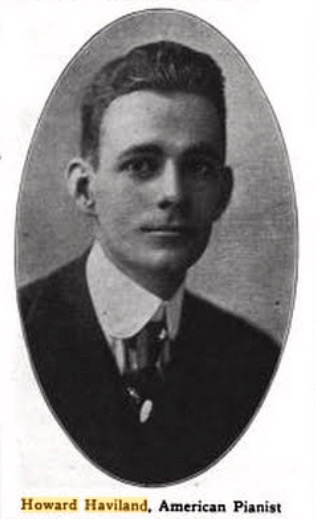
Howard R. Haviland plays

Howard R. Haviland of Brooklyn played and taught for the war effort.

Pianist Howard R. Haviland began a series of concerts one hundred years ago today at the Brooklyn Navy Yard. The show, put on for about 1200 workers and sailors, was the first in a series Haviland performed under the auspices of the YMCA’s National War Work Council. Haviland and the YMCA had set a high bar: to play at every camp in the United States over late summer and fall. Later that same week Haviland played at camps in Mineola and Hempstead, Long Island; Queens; and upstate at Plattsburg. Haviland was a Brooklynite who spent his summers playing in hotels in New Jersey. (Then and now New Yorkers got out of the Big City in July-August if they could.) Haviland had spent July playing at the Hotel Montclair, where he helped the Red Cross raise $100,000,000 for the war effort.

Haviland noted that “the boys” in the camps preferred lighter tunes to the classical stuff and wanted material with which they were familiar. His sets were heavy on light opera, which is a reminder that opera was not always Opera as we perceive it today: as a distant High Art, something for which you pay top dollar and put on a tuxedo to listen to. There was a time, not that long ago, when the genre was very much part of the popular vernacular. Think of the organ grinder and his monkey. Havilland’s tour was a smashing success. By early November he was back in Brooklyn at his parents house on Grand Avenue. Still he continued on with his war work. On behalf of the Red Cross he taught piano to advanced and beginning students alike to raise funds and awareness for the Allied war effort.

(image/Musical America)


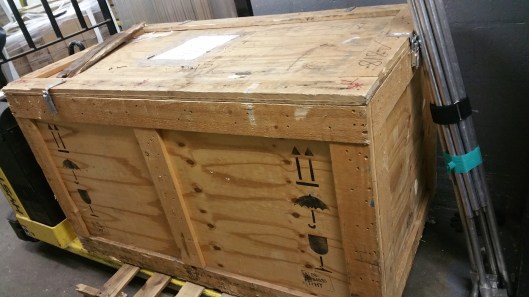
Opening the crate

My colleagues and I had too much fun unpacking this crate today. The container weighs over 400 pounds and contains an exhibit on loan to us from the Embassy of Belgium in Washington D.C. There are thirty panels, which will be on display in installments throughout September and October in the library where I work. I will have more details in the coming days about how one can see the exhibit. We are putting up the first of it tomorrow morning. Today we opened the box, sorted the tubes you see here, pulled out the first six panels for installation tomorrow, and put two of them together just to make sure we understood how to do it. The panels are beautiful and are a real contribution to the commemoration of the Great War Centennial. Details to come.

Sending off the 27th

The Biltmore as it was in 1917

As August 1917 wound down the officers and men of what was now the 27th Division prepared to leave for Spartanburg, South Carolina. They were supposed to go several weeks earlier but bureaucratic snafus in the War Department prevented that from happening. Things were now as in place as they were going to get. Before the division left, the people of New York prepared a three-day fête to see the men off. On Tuesday 28 August about 500 people showed up at the Biltmore Hotel to honor Major General John F. O’Ryan, the division’s commander. There seemed to be a conscious attempt to play up the Irish aspect of the evening. Mayor Mitchel was one of the organizers and T.P. O’Connor gave the keynote. Broadway turned silent film star William Courtleigh was the master of ceremonies. The evening was quite reserved and understated; organizers were trying to Hooverize–conserve in the name of the war effort–as much as they could.

It had been a hectic few days. Later the past week New York State’s attorney general had placed O’Ryan on the New York National Guard inactive list. This was because President Wilson and the Senate had appointed O’Ryan, and most all militia officers, in the National Army a few weeks back. That had put O’Ryan’s militia status somewhat in question. O’Ryan had spent much of this time visiting his regiments out in the field. Many of them were camped out in municipal parks. Brooklyn’s Twenty-Third Infantry Regiment for instance was training in Van Cortlandt Park in the Bronx. The time to move on was near and people were gathering. All of O’Ryan’s staff were on hand at the Biltmore dinner as well. The dinner was just the lead-up to what was to come over the following two days.


Reading Hackworth

The late Colonel David H. Hackworth, December 1995

Late last week I began Colonel David H. Hackworth’s About Face: The Odyssey of an American Warrior. For those who may not know Colonel Hackworth’s life story, I have gotten to the part where he has finished his post-WW2 service in Italy and has just begun his time in Korea. Hackworth was only fifteen when he joined the Army in May 1946, lying about his age to get in. He does a god job of explaining the starvation and chaos in postwar Europe and shows how the Second World War did not end as neatly as our general consensus has it. Events are always more complicated than we believe. There is a human need to find simplicity in things.

Hackworth was stationed in Trieste in the late 1940s, arriving as a private and leaving in 1950 as a sergeant. I have read a good deal about Hackworth online. Some commentators argue that he was too self-serving and held himself in too high regard in his memoirs. I suppose it amounts to a truism: memoir by definition is self-serving. The writer always sees himself as the center of events, just as we all see ourselves as the center of events as we go about our daily lives. The reader must be cognizant of this going in. Hackworth does a good job of explaining how hard his unit trained and how difficult it was. His premise is that TRUST was the last of the Old Army units and that training, expectations, and discipline were meted out in ways that would no longer be permissible even a few years later. The postwar drawdown in the late-1940s thinned the Army ranks back almost to their early-1920s size. The WW2 soldiers had returned home and were using the GI Bill and low-interest home loans to get on with their lives interrupted by the war. With those citizen-soldiers gone, there were still enough regulars left in the service to carry on in the old ways. Korea ended that.

Trieste itself was a complicated place. The city had been part of the Austro-Hungary Empire until the First World War and was given to Italy as a prize at Versailles for being on the winning side. Tito wanted it for Yugoslavia in those years just after World War 2. That is why there was such a strong Allied presence there in the late 1940s. All of this is preliminary to Hackworth’s expositions on Korea and Vietnam, and his public denunciations of the civilian and military leadership that led to his forced resignation from the Army in the early 1970s. I intend to have more to say on this in the coming weeks as I go deeper.

(image/Dale Cruse via Wikimedia Commons)

Remembering the Camp Logan riot

24th U.S. Infantry Regiment, Philippine Islands 1902

On the afternoon of Thursday 23 August 1917 Private Alonzo Edwards, Company L, Third Battalion, Twenty-Fourth Infantry Regiment, was arrested for interceding with two white police officers in the arrest of Houston resident Sara Travers. That incident triggered a series of events culminating in a night of spectacular violence that would leave almost twenty people dead and many more wounded, some of them mortally. It led to three trials over the next seven months that gripped Americans and challenged assumptions about race and Jim Crow segregation. It required the attention of local law enforcement officials, military authorities, the Secretary of War, and ultimately President Woodrow Wilson himself. Finally, it led to the hanging deaths of nineteen African-American soldiers and life sentences for scores of others. I wrote this piece in different form for a class almost fifteen years ago and wanted to share it on the anniversary of one of worst days in American history.

The Twenty-Fourth Infantry Regiment

The Twenty-Fourth’s baseball team in an undated photograph

The Twenty-Fourth Infantry Regiment had a long history of service. In the decades after the Civil War these Buffalo Soldiers protected communication and supply lines during the Indian Campaigns, and in 1898 went up San Juan Heights with Theodore Roosevelt. They fought in the Philippine Insurrection and in 1916 were stationed in New Mexico under the leadership of Brigadier General John J. Pershing, protecting supply lines between Columbus, New Mexico and Ojo Federico, Mexico. The Third Battalion of the Twenty-Fourth arrived in Houston on 28 July 1917. Things got off to a bad start. The Twenty-Fourth had less than half the officers assigned to a full regiment, and two of its companies were commanded by first lieutenants, not captains. The quality of this leadership was poor, as many white officers did not want a commission leading negro troops. Conditions were spartan and the soldiers were camped on the outskirts of town between the city limits and a more established base for whites called Camp Logan, where the men pulled guard duty. Cramped conditions in a hot and humid Southern city, far away from the action in Europe was bad enough. Dealing with the Jim Crow restrictions was worse. Relations between the soldiers and the local civilians were tense. The presence of the Twenty-Fourth, however, raised expectations in the local African-American community.

The Riot

In action prior to the transfer to Houston

Tensions simmered for weeks in the summer heat and when the riot came it happened quickly. In the early afternoon of 23 August Private Edwards asked two police officers why they were arresting Ms. Travers and for this was himself detained. A few hours later Corporal Charles Baltimore of the Twenty-Fourth’s Third Battalion went to police headquarters in his capacity as a military policeman to check on Private Edwards’ status. A scuffle ensued in which Baltimore was shot at, apprehended, beaten, and taken into custody. A rumor spread quickly to the base that Baltimore had been killed. By nightfall a contingent of 125-150 soldiers of the Twenty-Fourth had amassed and began marching from their camp into Houston. In the succeeding hours, the armed soldiers killed four policemen and eleven residents, wounded an additional dozen, and caused intense panic in the city. Four men from the Twenty-Fourth Regiment lost their lives.

The Aftermath

Generals Pershing and Bliss inspect the 24th camp during the Punitive Expedition, 1916

News spread rapidly throughout the country of the Houston incident. The New York Times had a small article, way below the fold, on page one of the 24 August edition sketching out the still-hazy details. A day later the newspaper had a significantly larger article, this time above the fold. Over the seven months there were no less than three trials relating to the Houston riot. The first court-martial was in November 1917 and led to the hanging of thirteen soldiers and life sentences for forty-one others. The next two trials concluded in December 1917 and March 1918. The punishment called for a total of sixteen death sentences and prison sentences of varying lengths for thirty-six other individuals. This time the government’s position was more cautious. Secretary of War Newton Baker wrote to President Wilson counseling that the number of death sentences in the two cases be reduced to six, with the remaining commuted to life sentences. Wilson acted on Baker’s recommendations.

(images/Baseball & Old Mexico, NYPL; Philippine Islands & Pershing/Bliss, LOC)


The Smithsonian digitized Horace Pippin’s notebook in the mid-2000s.

It’s a rainy Friday. I’m going to stay in a get some writing done. The academic year starts a week from today. Next week will be full of meetings and preparation. I had a meeting earlier this week with a faculty member in the English Department for a module we are doing this fall semester based on the World War One grant our library received from The Library of America and the Gilder Lehrman Institute. This past February The Library of America published World War I and America: Told By the Americans Who Lived It, an anthology edited by the Pulitzer Prize-winning biographer of Woodrow Wilson, A Scott Berg. We received a copy of the book as part of the grant. Over four class sessions students will first watch the film we are producing and then for homework read various passages from the LOA anthology. We are choosing a cross-section of fiction and non-fiction, as well as poetry and even some music by James Reese Europe. The lyrics to at least one song are included in the book. Students will read the lyrics and we will then listen to the song. We will then discuss how the war brought jazz to Europe and led to the Lost Generation in Paris and the Harlem Renaissance here at home.

When I was at the New-York Historical Society last week taking in the WW1 exhibit, I was touched to see that they had included a few works by Horace Pippin. The LOA anthology includes an excerpt from Pippin’s journal, which he composed immediately after the war. The students will read Pippin and learn about the Harlem Hellfighters. The LOA and Gilder Lehrman Institute provided a number of themes for exploration, to which we intend to hew closely. Why invent the wheel when someone has done it for you? At the end of the module students will write brief essays about what they learned and what they might like to know about moving forward. I think this is going to be a fun project.

(image/Smithsonian Institution)

One man’s trash . . .

Brooklyn street scene, Monday afternoon

I was going down the street earlier today and had to stop and take this photo of an abandoned Singer Sewing Machine. When I was going back in the other direction a few hours later the board was still there but the Singer was gone. I was glad someone took it. Hopefully its new owner will ether bring it back to life or salvage its parts for use in other machines.