Pershing meets George V

King George V, seen here inspecting the American vessel U.S.S. Finland in Liverpool later in 1917, bore a striking resemblance to his cousin Czar Nicholas II.

General Pershing’s whirlwind visit to England continued on 9 June 1917 with among other things a visit to Buckingham Palace and an audience with King George V. The Americans’ arrival could not have come at a better time personally or militarily for the monarch. The king was a first cousin of both Kaiser Wilhelm II of Germany and Czar Nicholas II of Russia. All three were grandsons of Queen Victoria, who had died in 1901. Nicholas had been deposed just three months prior to Pershing’s arrival in England, and it was becoming increasingly apparent that Russia might soon make a separate peace with Germany.

The monarch, seen here again on the Finland, showed himself publicly throughout the war to boost moral.

It is telling that when “Nicky” was forced to abdicate he was not taken in by his cousin George.The monarchs of Europe understood how increasingly fragile their grip on power was and each was afraid he might be next. It appears a deal had been in the works for Nicholas, Alexandra, and their children to live in exile within England. King George V eventually decided otherwise–the czar and the civil unrest in Russia were a third rail he refused to touch. Instead the Romanovs lived under housed arrest in Tsarskoe Selo near Saint Petersburg until being assassinated in Yekaterinburg in July 1918.

One mistake Nicholas had made was taking command of Russian military affairs This meant that when the losses mounted he himself shouldered a great deal of the blame. His cousin was determined not to let that happen to himself. While King George V showed himself publicly throughout the war, he largely kept his affairs to photo opportunities and patriotic events. He visited hospitals frequently, handed out medals, and that sort of thing. He also quite consciously spent most of his time in London, setting an example for his subjects not to live in fear. Even Pershing he did not keep that long. The king shook hands with the dozen or so officers in the entourage in mid-morning before speaking to General Pershing for all of fifteen minutes. Then it was on to other business for each man.

(top image, U.S. Naval Historical Center; bottom image, Library of Congress)


The ETO turns 75

Colonel N.A. Ryan, acting chief of transportation, U.S. Army European theater of operations, and Major General D.J. McMullen, D.S.O., C.B.E., director of transportation, British Army, Great Britain circa 1942

General Pershing’s arrival in first England and then France one hundred years ago this week is often understood to mark a turning point in American-European relations. The coming of the A.E.F. certainly signaled the arrival of the United States on the world stage, a process that had begun almost two decades earlier during the Spanish-American War. The evolving American relationship with Europe dates back to then too; it was John Hay, Secretary of State in the McKinley and Roosevelt Administration from 1898-1905 and, just prior to that, Ambassador to the Court of St. James, who had done so much to build the “special relationship” with Great Britain. Hay and Pershing laid the groundwork diplomatically and militarily for the Allied victory in the Second World War. Pershing’s protégés included George Marshall, George Patton, and Dwight Eisenhower. Today, 8 June 2017, marks another significant moment: the War Department created the European Theater of Operations on this date in 1942.

Dwight Eisenhower, at fifty-one now a major general, took over at director of the European Theater of Operations (ETO) in London on June 24. Joseph Stalin had been pressing for a second European front for some time, and now it appeared he would get that some time in 1942. That of course did not come to pass. Roosevelt and his planners decided to make North Africa the first Atlantic offensive. Two years later came the invasion of Normandy and V-E Day less than on year after that. Ike was now a hero and came home to assume the presidency of Columbia University. He was back in Europe as the head of NATO in 1950. For the past three quarters of a century we have taken the work of the U.S. Army in the European Theater of Operations granted. It was in Germany as part of the ETO where Elvis was stationed after getting drafted in the late 1950s.

We would do well to remember in our current moment that building alliances is much more arduous and time consuming than tearing them apart. Diplomacy is a funny thing: when done well one does not see it; when done poorly it is all one sees. I only saw one reference to the creation of the European Theater of Operations today. Here is to remembering the work that Roosevelt, Marshall, Eisenhower, and millions of anonymous American uniformed service persons have done over the past seventy-five years.

(image/Library of Congress)

Pershing’s public diplomacy

I intend to write a little bit about Pershing’s arrival in first England and then France over the next few days. Here I wanted to share this image of the general with the mayor of Liverpool taken on the morning on 8 June 1917. As I said last night, Pershing and his entourage had pulled in from the Atlantic Ocean and docked safely in the Mersey River late the previous evening. Europeans were exhausted after nearly three years of war and the arrival of America’s commanding general was a cause for celebration. At least for the British and French. Pershing himself was not much for these public events and saw them as little more than a burden that took hm away from his work. He understood that it was his job to grin and bear it. The scene above was only the beginning.

(image/Library of Congress)

“The return of the Mayflower, armed.”

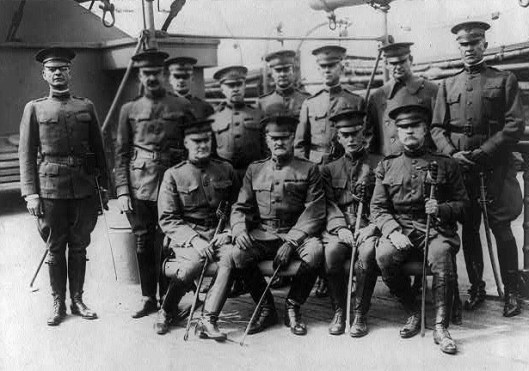
Pershing (seated second from left) and his staff, June 1917

The above quotation may sound like hyperbole–because it was–but that was the mood on board the RMS Baltic when she was pulling into Liverpool one hundred years ago tonight with Major General John Pershing and his entourage of nearly two hundred on board. As the pilgrims had once sailed from the Old World to the New, so their descendants were doing nearly three centuries later. At least that is the way one diarist captured it for the New York Times as the Baltic was met by the American destroyers coming into port. It had been almost two weeks since Pershing had left Governors Island and sailed from Sandy Hook. The trip had been a quiet one, largely because Pershing and his staff were so busy planning, but the mood was now ebullient when land was seen. Everyone knew this was Next Phase in the war.

The Great War was to be an extraordinary challenge for the American military, which had been hampered by all kinds of logistical problems in the relatively small campaigns in Cuba and Mexico over the previous two decades. Men like Pershing; J. Franklin Bell, still back in New York Harbor commanding the Department of the East; Chief of Staff Peyton C. March in Washington; and the Regular Army officers at the new bases materializing across the United States whose job it now was to train the raw recruits, had learned many lessons from these experiences. Leaving the United States was itself a lesson learned. Pershing’s voyage was the worst kept secret in New York; everyone knew something was afoot when they saw the docks operating with greater urgency than usual. It didn’t help either when the cannoneers on Governors Island set off a salute as the Baltic set forth. So much for confidentiality.

Pershing’s first night in Europe was fairly anti-climactic. The Baltic pulled into the River Mersey at 11:00 pm and docked for the night. The real action would begin the following morning. Everyone was anxious and excited to see what they next day would bring.

(image/Library of Congress)


Remembering Normandy

My gosh, was it six years ago that I posted this originally? Even 2011 when I penned this seems like forever ago. My step-grandmother’s brother parachuted into France on D-Day and ended up stuck on the roof of a French family’s house. I wish I had had the chance to talk more with him when I was growing up, but that’s the way it goes. As I wrap up with mu morning coffee I am wondering how many people will mention it to me over the course of the day. We shall see,

I could not let the 67th anniversary of D-Day go unnoticed.  When I was younger this was a much bigger deal than it is today.  It is only a bit of a stretch to say that I have measured the events of my life according to the anniversaries of the Normandy invasion.  In June 1984 I was still in high school, getting ready to start my senior year at the end of the summer.  Ten years later I had graduated from college, but was unsettled and still trying to figure out what I wanted to do with my life.  By 2004 I had gone to graduate school and moved to New York City.  Now I am married and in full middle age.

The arc of D-Day presidential ceremonies, or lack thereof, paints a fascinating portrait of the postwar decades.  In 1954 President Eisenhower, the Supreme Allied Commander of the invasion a decade earlier, skipped France altogether and instead vacationed at Camp David.  His only public comment was a small proclamation about the Grand Alliance.  For the 20th anniversary Ike did record a television special with Walter Cronkite entitled D-Day Plus Twenty Years: Eisenhower Returns to Normandy.  The footage of the journalist and the retired president was filmed in August 1963 and is quite moving.  On June 6, 1964 Johnson, who had taken office only seven months earlier after the Kennedy assassination, was in New York City speaking to the Ladies Garment Workers Union.  In the waning days of Vietnam and the Nixon Administration in 1974 Americans were too tired and cynical to care about World War 2.  Reagan’s address in 1984 remains the most memorable of the anniversaries.  At Pointe du Hoc he addressed a sizable audience of veterans still young enough to travel but old enough to appreciate their own mortality.  President Clinton’s address on the beaches of Normandy during the 50th anniversary symbolized the passing of the baton from the Greatest Generation to the Baby Boomers.  In 2004 current events overshadowed the 60th anniversary and the ceremony painfully underscored tensions in the trans-Atlantic alliance.

Today only one person mentioned it to me.  Alas we have reached the tipping point where most of the veterans have either passed on or are too aged and infirm to participate in the observance.  In other words it has become part of history.  Makes me feel old and a little sad.

It was fifty years ago today

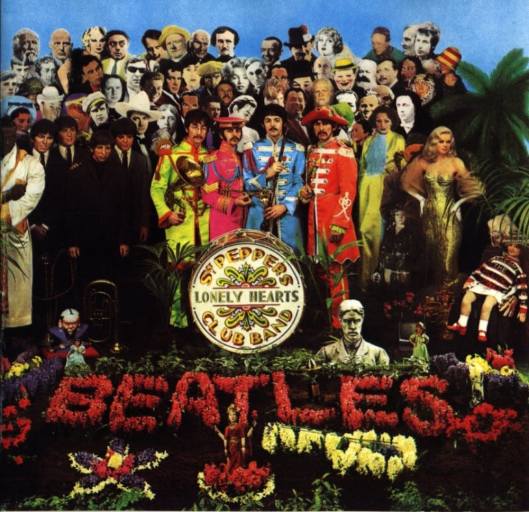
I was teaching a class this past semester in which the topic was the style wear of pop musicians of the 1960s and 1970s. (The course was on the business of the fashion industry.) Students had been tasked to find an iconic image of this or that pop star and discuss the hows and whys of the style of dress. I urged one student to analyze Elton John’s Savile Row bespoke white suit, for instance. Anyways I began the bibliographic instruction session with a discussion of the psychedelic military-inspired suits the Beatles wore on the cover of Sgt. Pepper’s Lonely Hearts Club Band. The words were just out of my mouth when a student scoffed at my saying the Sgt. Pepper is probably the most culturally significant rock album ever made. Not necessarily the best rock album ever made–it might not even the best Beatles album ever made–but the most culturally significant, I averred. I was taken aback briefly until it dawned on me that said student, flush with the confidence of youth, probably had no concept of what Sgt. Pepper represented when it was released. Born in the mid to late 1990s, the student literally might not have known who the Beatles were. Rock music itself is no longer the cultural signifier it once was; rap and hop hop surpassed it a long time ago. Even the “record album” itself is passé; iTunes, Spotify, etc. are where today’s youth get their music. The album itself is no longer the unit of currency. I am not a Luddite but I would argue we have lost something in that, in particular the shared experience that a Sgt. Pepper represented to a cohort.

Sgt. Pepper has been going in and out of style of half a century now and paradoxically feels dated and relevant at the same time. It’s playing quietly in the background while I have my coffee and type these words. In that class a few months back I was trying to explain to the students how the muted greys of Austerity Britain were giving way in the tangerine brightness of mid-1960s Swinging London. Britain’s baby boomers were looking to their past, especially to the styles of pre-Great War Edwardian England, for inspiration. It’s not an accident that there was a clothing store in mid-60s London called “I Was Lord Kitchener’s Valet.” I remember watching Nightline on June 1, 1987, twenty years after Pepper’s release, and the panel discussing the album’s social and cultural impact. That itself was thirty years ago. Look around today and I am sure you will see or hear a reference to the album the provided the soundtrack to the summer of 1967.

Grand Army Plaza, June 11

I was at the Brooklyn Museum of Art this afternoon to meet with officials about the walking tour I am doing on Sunday 11 June from 12:00 – 1:00 pm for the museum. The idea was to do a walkthrough of the presentation to see if it fits into the time slot and to decide if any changes or additions might be in order. I ran two people though the walking tour, and we had a fun and productive time running though the thing. I got some good feedback as well. There is nothing like the live audience to keep you humble. Grand Army Plaza was laid out by Calvert Vaux and Frederick Law Olmsted in the years just after the Civil War. The area is one of the places of Civil War memory not just in New York but in the United States. So many people walk past it all every day with no idea. I am looking forward to this event.

Decoration Day 1917, cont’d

Decoration Day, what we now call Memorial Day, originated in the years just after the American Civil War. In 1966, just after the Centennial, President Johnson and Congress pronounced somewhat dubiously that Waterloo, New York was the locale where Decoration Day had begun in 1866. In all likelihood it didn’t happen that way; citizens were showing up independently at local cemeteries throughout the North and South in that first full spring after the war’s end. Tending flowers on graves was timed with the planting season. Still, we do know that two years later John Logan, leader of the Grand Army of the Republic, called for all G.A.R. members to reserve 30 May 30 1868 as the official Decoration Day for members of the organization. This imprimatur added to the institutionalization of Decoration/Memorial Day. I say all this because it did not occur to me until yesterday that this made Decoration Day 1917 the 50th such observation. And yes, that means 2017 is the 150th.

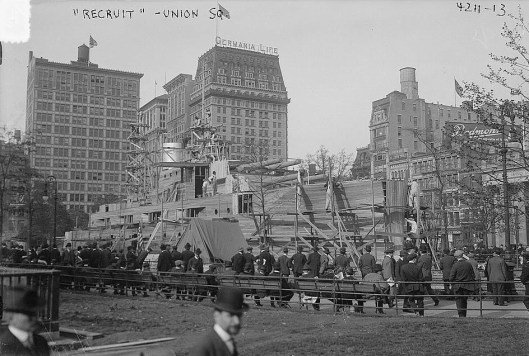
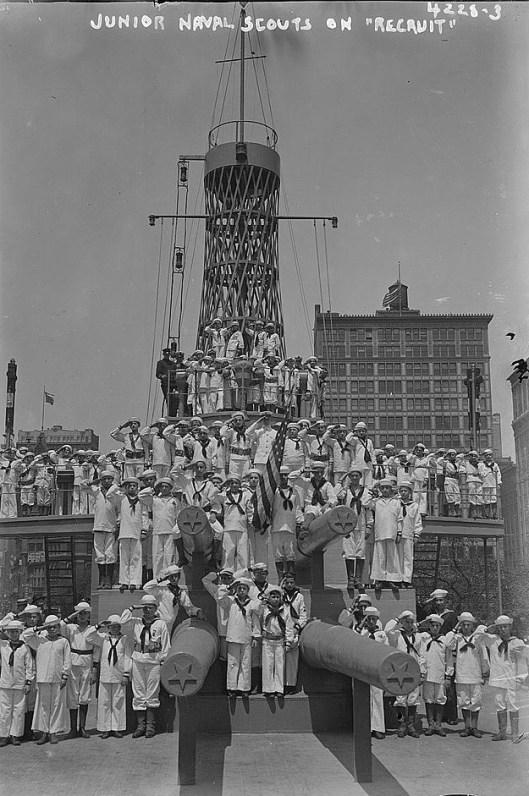
It is unclear if local, state, and federal leaders understood all this in May 1917 but, however coincidentally, it worked out well for the Great War effort. While Governor Whitman was reviewing troops with J. Franklin Bell uptown on 30 May 30 1917, Mayor John Purroy Mitchel was in Union Square christening the U.S.S. Recruit. The ship was just that, a scaled-down mock-up of a battleship built to promote recruiting for the Navy. Mayor Mitchel had long been a proponent of Preparedness and as such was an ally of Theodore Roosevelt, Leonard Wood, and Governor Whitman. Mitchel built the Recruit under the auspices of his Committee on National Defense. Decoration Day 1917 appears to have been something of a tag team affair, with Governor Whitman and General Bell reviewing the Army and National Guard troops uptown while the mayor focused on the Navy farther south. To be sure there was some Navy and Marine involvement in the uptown parade, but it was primarily an Army and Guard event.

New York’s ports were more important to the local economy than they are today–and the Brooklyn Navy Yard was still going strong–but the Navy was nonetheless small and removed from the daily lives of New Yorkers. Hence the idea for the Recruit. Remember, there was no television let alone internet in this era. To see what Navy personnel did–and how you might contribute yourself–the mayor and his allies figured a living model might be helpful. One could buy Liberty Bonds there as well. Here are a few images from that event one hundred years ago today.

(Note: all photographs are via the Library of Congress and were taken on 30 May 1917 with the possible exception of the top most image, which did not have a specific date. I included it to give a panoramic view of the U.S.S. Recruit, which ran about two hundred feet long and forty feet at its widest point.)


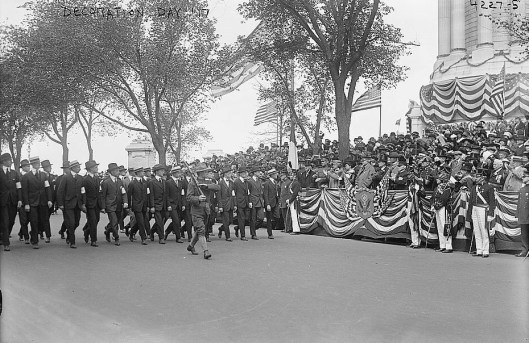
Decoration Day 1917

I wanted to share a few images from Decoration Day 1917. These photographs were taken near the Soldiers’ and Sailors’ Memorial Monument in Manhattan’s Riverside Park. Turn out was higher than for Decoration Day parades in recent years, which is not surprising given that this was the first Memorial Day since the call for war. The parade route was actually cut shorter in 1917 to accommodate the increasingly infirm veterans of the Grand Army of the Republic. About four hundred GAR veterans marched in New York City’s 1917 Decoration Day parade, one hundred and thirty fewer than just a year earlier. Veterans of the Spanish-American War and New York Guardsmen recently returned from Texas fell in behind. All told, 18,000 men and women marched in the parade through the Upper West Side. For the first time ever there was a regiment of Negro troops included in New York City’s Decoration Day parade. Though many would not have grasped it at the moment, the perceptive understood that this was an early sign of the coming of what became the New Negro Movement.

That is Major General J. Franklin Bell, commander of the Department of the East on Governors Island, and Governor Charles S. Whitman on the review stand. In the two middle image, they are there on the right in the box. Conspicuously absent is Leonard Wood, though his spirit in a sense was present. Before leaving New York City several weeks earlier he had given his blessing for a parade of the Public School Athletic League. While the veterans’s event was going on, a separate parade comprised of 40,000 schoolchildren was taking place south of here.

Memorial Day also means baseball. Just north of the Soldiers’ and Sailors’ Memorial Monument in the Polo Grounds Grover Cleveland Alexander of the Philadelphia Phillies lost 5-1 to the New York Giants. He went on to win thirty games that season. The following year Alexander was in France fighting the Germans. The Yankees were in Philadelphia playing the other team from the City of Brotherly Love, the Athletics. The Yankees won a double header and held the A’s scoreless over twenty-four innings. The Dodgers, then still the Brooklyn Robins, lost 2-0 to the Braves in Boston. It’s worth noting that the American League was less than twenty years old at this time and very much a competing association with the National. American League owners consciously put teams in cities were the Senior Circuit already had a presence. It says something about the size and influence of Gotham that unlike Boston, Philadelphia, and other cities New York ended up with not just two but three teams.

Enjoy your Memorial Day, everyone.

(images/Library of Congress)

Sunday morning coffee

I read with sadness yesterday about the death of Greg Allman. He was the second from the Allman Brothers Band to die in 2017. Drummer Butch Trucks committed suicide in January. I am listening to Live at the Fillmore East as I type this. Personally I never thought the band was the same after the 1971 death of Duane Allman in a motorcycle accident. The band was still tight and had its moments but Duane was the true artist. The death of his younger brother is nonetheless sad. Seeing them play during one of their annual month-long stints each March at the Beacon Theater on the Upper West Side was something I always thought about but never got around to doing. Now that will never happen.

I was in Green-Wood Cemetery yesterday playing tour guide for a friend. Afterward we had lunch in an Italian restaurant near the 5th Avenue entrance. The cemetery was buzzing with activity. There were at least three funerals happening all at once. Perhaps there were so many because the officials and families usually do not hold burials during the winter months. Instead the departed are kept in a temporary resting place before final interment come spring. I came across the trailer you see above on my way through the cemetery to see my friend. It’s a hearse on motorcycle. I had a ten minute talk with the fellow responsible for the vehicle. He said that about eighty people on motorcycles were to be in the procession. Sure enough, we saw the motorcade go by about an hour later.

Hubert V W Card’s headstone and weathered flag from a past ceremony. Boy Scouts were out in force yesterday putting fresh flags on the headstones of other veterans in preparation for Memorial Day.

Leaving the house yesterday, I ran into my neighbor walking her dog. I explained that I was meeting a friend in the cemetery and that Green-Wood has been a focus of Decoration/Memorial Day observations going back almost a century and a half. I saw teams of Boy Scouts putting flags on veterans’ headstones. One of them even offered me a flag but I said no thank you, figuring the banners were meant for the veterans themselves. I wanted to take a picture of the flag planting but it didn’t seem appropriate. When I got to the other side I saw that cemetery workers had already set up the tents for tomorrow’s Memorial Day program. As I said remembrance events in Green-Wood date back to the Grand Army of the Republic’s call for a Decoration Day in the late 1860s. GAR veterans were joined by soldiers from the Spanish-American War, the Great War, and our other engagements in subsequent decades.

One thing I have always wondered is if there was a drop-off in Memorial Day ceremonies in such New York City places as Green-Wood Cemetery in previous decades. There was a demographic shift from New York City to the suburbs and the Sun Belt in the 1950s-1990s, which took many veterans and their families away from Brooklyn and the other boroughs. It would seem too that the hard years of the 1970s and 1980s would have led to a drop-off in heritage tourism and public ceremony even in gated places like Green-Wood. New Yorkers found their history again in the 1990s when the city itself began revitalizing and became safer. I myself am part of these trends.

Remember that Memorial Day is more than barbecues and a day off.