Arthur Miller’s Brooklyn

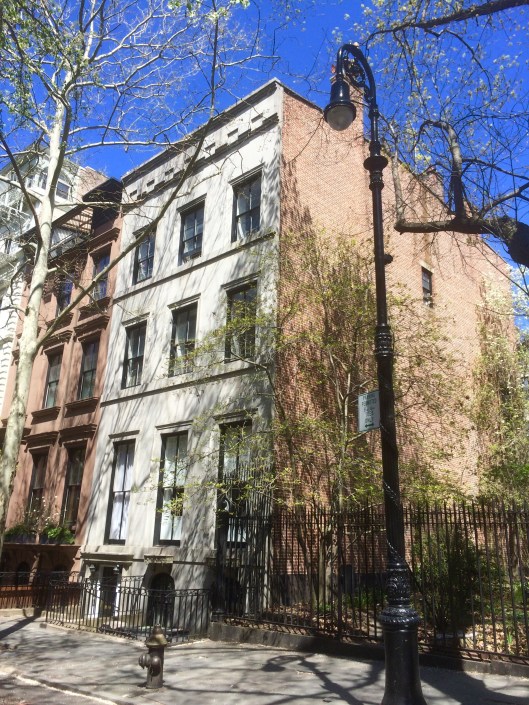
Arthur Miller's house in the Heights. The playwright lived in several Brooklyn locations before divorcing and marrying Marilyn Monroe.

Arthur Miller’s house in the Heights. The playwright lived in several Brooklyn locations before divorcing, marrying Marilyn Monroe, and leaving the borough.

I’m sorry about the lack of posts recently. Being the weeks before spring break, it has been a busy time. Plus I got sick with a cold I just could not shake for about two weeks; It really threw off my routine. Today my class and I went to Brooklyn Heights, where we had arranged for an Arthur Miller scholar to talk about the cultural significance of the neighborhood. Walt Whitman, Truman Capote, Hart Crane, and Miller himself are just a very few of the writers who lived in the area at one time or another. Incredibly the Heights as we know it would have been destroyed had Robert Moses gotten his highway where he wanted it. Personally I think Moses gets a bad rap, but in this case it’s tough to argue that his was the right position.

Arthur Miller lived in several houses in Brooklyn Heights, first as a renter and then as a homeowner when his plays began hitting it big on Broadway and the money started coming in. The house above is one that he owned until he sold it and bought a place a few blocks away. According to the story we heard today, he wanted a new place because his ground floor tenants were too demanding. The new house, which we also saw, was smaller but came with no renters to bother him. I’m sure he had way more money by then as well. Incredibly Arthur Miller sold the house you see above to none other than W.E.B. Dubois. Yes, that W.E.B. DuBois. The two knew each other from their mutual involvement in Civil Rights and other causes. That was the craziest story I have heard so far this week.

We always tell our students: history is all around you if you open your eyes to it.

The American Ambulance in Russia

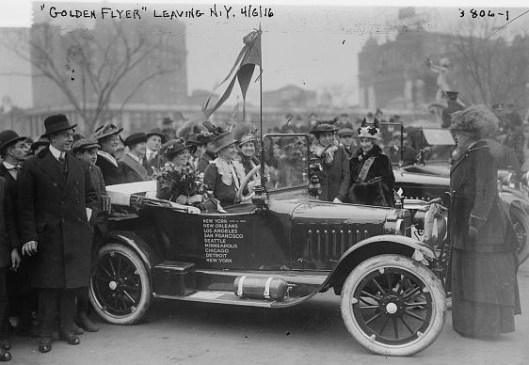
New Yorkers turn out at the the Russian Consulate, 22 Washington Square, for the blessing of Studebaker ambulances headed for the Eastern Front.

New Yorkers turn out at the the Russian Consulate, 22 Washington Square, for the blessing of Studebaker ambulances headed for the Eastern Front.

New York City’s centrality to the Great War effort is lost on many today. It should not be surprise anyone, though, that Gotham played an outsized role. The city, with its great ports and access to human and financial capital, is right here on the East Coast. What’s more, there were so many Europeans from the various belligerent nations already living here; the 20+ years prior to the war were the decades of the Great Migration. Immigrant communities often lived in their own enclaves with their own churches, schools, and home-language newspapers, and were tuned in to events overseas. Still it must have be an unusual sight when, on 10 April 1916, passersby in Washington Square came across the dedication and blessing of fifteen Studebaker ambulances soon headed for the Eastern Front. An American physician and West Pointer, Dr. Philip Newton, was to be put in charge of the ambulances on the Eastern Front. He had married a Russian the year before and would eventually be made a general by Czar Nicholas II. Russia of course would not remain in the war much longer. There was already growing unrest in the country and the Revolution took place the following year. Still in the spring of 1916 there was still hope.

21442v


(images/Library of Congress)


The Golden Flyer

21391r

The social changes that the Great War wrought are sometimes overlooked. Certain issues, most notably the Civil Rights Movement here in America and independence for Europe’s colonies–showed some progress in the 1920s and 30s but did not come to fruition until after the Second World War. Two that did succeed were Prohibition and Suffragism. It was not coincidental that the 18th and 19th amendments passed just after the war’s end. Calls for Prohibition and women’s right to vote went back decades prior to American involvement in the war. In 1916 proponents of both did all they could to influence that November’s presidential election, and state and local elections too of course.

3b10974r

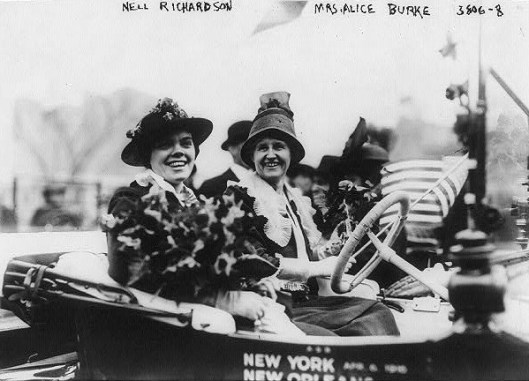
On the early spring day of April 6, 1916 suffragists Alice Burke and Nell Richardson left New York in their Golden Flyer for the West Coast. Their objective was to raise awareness and interest in the female vote. They visited forty-two states, by-passing New England, and drove over 10,000 miles in the April-October excursion to California and back. Keep in mind that there were no highways at this time. It was even three years prior to the Army’s 1919 Motor Transport Corps convoy in which Dwight Eisenhower participated. And that one only went 3000 miles.

It is somewhat surprising that the Burke/Richardson is not better known than it is. I’m guessing that a reason might be that we already have a standard narrative of the Women’s Rights Movement and this doesn’t fit the formula. Of course that is a problem regarding the Civil War and pretty much every historical subject. The heroes and villains get set and that’s it, at least for many people. Whatever the reason for so little interest in this event, it is an amazing story that deserves more attention than it has received.

(images/Library of Congress)

Thinking of Rube Marquard on Opening Day 2016

It’s Opening Day of the baseball season. I am listening to the Pirates and Cardinals on the radio as I type this. Living in Brooklyn it is hard not to think of the Dodgers this time of year, especially with this being Vin Scully’s final year. It’s hard and sad to imagine.

Rube Marquard as he was when he played for the Brooklyn Robins

Rube Marquard (1889-1980) as he was when he played for the Brooklyn Robins

One of the great Brooklyn players was Rube Marquard, who went 13-6 with a 1.58 ERA in 1916. Two years later Marquand and another Brooklyn Robin, as the team was called at that time, enlisted in the Navy when the team was on a road trip in Chicago. Incredibly Marquard even pitched that day–Saturday 20 July 1918–going seven innings and giving up one earned run but getting a no-decision in a 6-4 Brooklyn win. Marquard did not directly enter the Navy. Secretary of War Newton Baker was still deciding whether or not baseball was non-essential to the war effort and thus cancel the rest of the season. Until a decision was made Rube and everyone else was allowed to finish the season. He did not play well that year, which is not surprising given that everyone was on pins and needles waiting to see what would happen in both baseball and the war overseas. Secretary Baker eventually decided to a allow baseball to continue, but with a shortened season ending on September 1.

His draft registration card. It is interesting to note that he lived in Upper Manhattan, which is not surprising given that he played for the Giants before the Robins.

His draft registration card. It is interesting to note that he lived in Upper Manhattan, which is not surprising given that he played for the Giants before the Robins. The card lists his profession as ballplayer and calls the team the Brooklyn Ball Club, its proper name.

Baseball even got a small reprieve when Labor Day 1918 fell on September 2, giving the National League an extra day. Richard William “Rube” Marquard was in uniform three weeks later. He never did go to France. Instead he stayed in Brooklyn, stationed to the Navy Yard, and played for the base team, the Mine Sweepers. It’s incredible to see it below but the War Department did not waste any time letting Marquard go. He was discharged on Armistice Day 1918.

Brooklyn was in Chicago playing the Cubs when he enlisted in the Navy. He pitched later that day. Note that he entered the Navy three weeks after the season began. A Note: All sites I have seen list his birth year as 1886. However, all of his official paper work--military papers, census records--say 1889.

Brooklyn was in Chicago playing the Cubs when Marquard enlisted in the Navy. He pitched later that day and entered the Navy three weeks after the season ended in September. A Note: Most sources list his birth year as 1886. However, all of Marquard’s official documents–military papers, census records–say 1889.

Rube Marquard was a fun loving guy who enjoyed vaudeville and the racetrack. He ended up marrying a showgirl and had jobs working at various tracks in the decades after his retirement. His WW2 draft registration card shows him working at Baltimore’s Pimlico Race Track in 1942. Marquard was virtually forgotten until Lawrence Ritter published his oral history The Glory of Their Times: The Story of the Early Days of Baseball Told by the Men Who Played It in 1966. Five years after that Rube was inducted into the Hall of Fame in Cooperstown by the veterans committee. Many believe he was undeserving and that he is one of the weaker HOF inductees. One argument is that he got in due to the nostalgia factor. It is certainly true that after the exhaustion of the Civil Rights Era, all the assassinations, the Vietnam War, and Curt Flood’s ongoing challenge of the reserve clause the 1910s must have seemed a simpler time. Of course we know better. The past was never as easy or uncomplicated as people believe it to have been.

Marquard retired after the 1925 season. He had played eighteen seasons and finished with a record of 201-177.

(images/top: Library of Congress; middle and bottom: U.S., World War I Draft Registration Cards, 1917-1918 and New York, Abstracts of World War I Military Service, 1917-1919 via Ancestry.com)

Frederick Seward in winter

Frederick W. Seward helped found the Republican Party in New York.

Frederick W. Seward helped found the Republican Party in New York and lived long enough to see the first nine months of the Great War.

I was home working today. I was writing about the creation of the New York State Republican Party, which formed in Saratoga Springs in August 1854 as a response to the Kansas-Nebraska Act. Young Chester Arthur was one of the delegates. In September 1904 during the heat of the presidential race between Theodore Roosevelt and Alton B. Parker–two New Yorkers–the Republicans held a 50th reunion in Saratoga Springs. TR’s running mate, Charles W. Fairbanks, was one of the speakers in Saratoga at that 50th celebration. Members of John C. Frémont’s family were on hand as well, including his son Major Francis P. Fremont who five years later would be court-martialed for a third time in the waning months of the Roosevelt administration.

What caught my eye when reading the 50th anniversary Proceedings was this photograph of the aging Frederick W. Seward. Frederick was of course the son of William H. Seward. He graduated from Union College a year after Chester Arthur and he too would be at the Saratoga Convention in August 1854. Frederick later worked as Assistant Secretary of State for his father in the Lincoln and Johnson Administrations and served in the same capacity for William Evarts for a time during the Hayes’s years, eventually succeeded by John Hay. Seward thwarted the Booth conspirator who tried to assassinate his father and a half a century later was still around to tell the tale. He helped run the Hudson-Fulton Celebration in 1909, a forgotten event today but which among other things involved Wilbur Wright flying from Governors Island, around the Statue of Liberty, and back.Even more incredibly an article in the Smithsonian Air & Space Magazine informs us that passengers aboard the Lusitania witnessed that feat.

Seward died in April 1915, fifty years after the Civil War’s end and two years prior to American involvement in the First World War.

One family’s Battle of Brooklyn

IMG_3011

I hope everyone had a good Easter Sunday. I was walking back from Prospect Park earlier when I came upon this sign in a front yard. I naturally stopped to read it when I noticed that sure enough they had a cannon in their front yard. Note how professional the wayward marker is. In terms of quality and appearance, the battle map looks like something one sees on the Civil War Trust website. My favorite part is the wooden pail, presumably there to imitate a sponge bucket. Color me impressed.

IMG_3012

Louis Auchincloss, 1917-2010

Earlier this month I read Louis Auchincloss’s memoir, A Voice from Old New York: A Memoir of My Youth. I have always found it oddly comforting that cities like New York, Boston and Philadelphia still have remnants of the old families that ran things for, really, centuries. When one goes to a place like the University or Union League Club one can’t help but notice the names from these families of the sons who fought in our nation’s earlier wars. When I read the excerpt about his father and the training base in Kentucky I naturally had to do a small something about it.

Sunday morning coffee

IMG_3010

It’s early Sunday morning. I am sitting here for a spell before going in to work to teach a class. The week is going to be a bit of a push but next weekend I’ll be getting a longer weekend taking off Good Friday. If our early spring continues I may go to the New York Botanical Garden. I wrote about 2000 words this week on the Civil War New York book. The goal is to finish the draft in mid-summer. I spent the day with friends yesterday and then came home last night and wrote about 220 words. It’s amazing how when you just sit down and begin the process takes over. I took the above photo around 10:00 last night as I was wrapping up.

The Wonder of it All

NPS100 full cover.inddI have written about this a bit in the past but today is the official release date of The Wonder of it All, the book published by the Yosemite Conservancy for which I contributed a story. My chapter tells the tale of the first time I took the Hayfoot to Governors Island. One of the guidelines was that the stories could not give names. Here, though, I can point out that the guide we had was the one and only Sami Steigmann. Sami was later the person who talked me into transferring as a volunteer to Governors Island.

Don’t forget that 2016 marks the 100th anniversary of the National Park Service. It was so much fun to be part of a project marking the NPS anniversary. Though the shift of emphasis is different, I approached Wonder in the spirit of Oh, Ranger!, which was itself influenced by a book written by Horace Albright in the 1920s. It is getting warmer by the day. Wherever you are, make the Park Service part of your spring.