Today would have been Frank Sinatra’s 100th birthday. I linked over on the Facebook page to a bit I did for the Governors Island website about Sinatra’s 1945 visits to Fort Jay for his Army physical. His draft board had recalled the singer to see if his 4-F classification should be reconsidered. I’d tell you the rest but then you wouldn’t click on the link. I stumbled upon the story of Sinatra’s visit seventy years ago to Governors Island when reading Earl Wilson’s 1976 biography, which had been sitting unread on my shelves for a few years before I pulled it down last week.
It seems a little wartime Frank is in order. During the Second World War performers recorded these V Discs exclusively for distribution to soldiers overseas. They no doubt wanted to do it for the war effort, but their reasons were not entirely altruistic; the musicians strike that lasted from 1942-44 prevented artists from recording any material. These V Discs were the only exception. All the big names recorded them. The strike had other repercussions but, ironically and thankfully, it worked out to the benefit of the boys in France, Italy and the Pacific.
Longtime readers may remember this post from 2011. It’s hard to believe this was four years ago. As time goes by I cannot help but wonder who will be the Frank Buckles of the Second World War. We’ll find out in 10-15 years. I suppose we will see a big Pearl Harbor observation next year, as 2016 will mark the 75th anniversary of the attack. Until then, here is this from 2011…
A few years ago the father of a good friend of mine happened to be in the food court of a shopping mall on Memorial Day. This is a man, now in his eighties, who served in the Air Force and later played semi-professional football. He still has his leather cleats. Lou is the essence of Old School. Like shopping mall food courts throughout the country, this one was full of teenagers. Striking up a conversation with the 4-5 at the neighboring table he asked them if they knew what Memorial Day was. After the blank stares, one offered that it was a day off from school. My friend’s dad was not impressed.
When I was in school in the seventies and eighties a visit from a World War 2 vet was a HUGE deal, even in the most cynical of times just after Vietnam. (I graduated high school just a decade after the Fall of Saigon.) One vet recounted today that during a recent school visit a girl asked who Pearl Harbor was and why he was there to talk about her.
I offer these stories not to blame our country’s historical amnesia on young people, but to emphasize the educational crisis we face.
I have written about the significance to me of D-Day and aging veterans before. Personally, Pearl Harbor Day 2011 is the end of something tangible, akin to the 75th anniversary of Gettysburg in July 1938 when aged veterans turned out for one final gathering. President Roosevelt was in attendance; three years after dedicating the Eternal Peace Light Memorial in front of the 1,800 veterans and 150,000 citizens that summer day he would tell the country that December 7 would forever live in infamy. Today in Hawaii the Pearl Harbor Survivors Association held its final gathering. There are just too few Pearl Harbor survivors left seventy years later to justify a seventy-first. There will be more World War 2 anniversaries between today and the commemoration of V-J Day in 2015, but for me they will no longer seem the same. By 2015 there will be fewer WW2 veterans, and those remaining will likely be too infirm to participate in any meaningful fashion. Time moves on. It was ever thus.
Sculptor Richard Masloski created this Lincoln piece and other works one will see in the Lincoln Depot Museum.
A friend and I took a day trip to Peekskill, New York yesterday to visit the Lincoln Depot Museum. The LDP opened about fifteen months ago and, though small, is a testament to what can be done through good decision-making and a strong sense of purpose. The founders of the museum created something special. We did not quite plan it this way but it proved a good 1,2 punch with the Transit Museum’s satellite space inside Grand Central Station displaying its annual holiday train display. Trains were the theme of the day. And yes it was like Grand Central: packed with holiday-goers. The timing was not entirely coincidental; I was determined to get there in 2015 while the Civil War sesquicentennial is still technically on.
One can only imagine what Lincoln was thinking as he watched the Hudson Valley roll by on his way to Washington during the secession crisis in winter 1861.
Lincoln was in Peekskill for a whistle stop in February 1861 on his way to Washington City and his inaugural. Four years and two months later his body passed through and stopped in the town once again on its way back to Illinois. I believe the Lincoln Depot Museum is about to close for the season but if one is in New York and has a few hours it is well worth the trek. It is a five minute walk from the Metro North train station with a good bakery and restaurants right there.
Yours truly was at Baruch College for a conference this morning when he came across this statue of Bernard Baruch in the Vertical Campus building. Baruch’s ties to City University of New York dated back to his time at City College in the late nineteenth century. When he died fifty years ago in 1965 he left a sizable chunk of his fortune to what was then the Bernard M. Baruch School of Public Administration. About a year later the Baruch School became the full-fledged, four-year Baruch College. Apparently there are several statues such as this one sprinkled here and there across the country; Barcuh was called the “park bench statesman” for his affinity to mediate on important affairs seated on a favorite perch in Lafayette Park across the street from the White House.
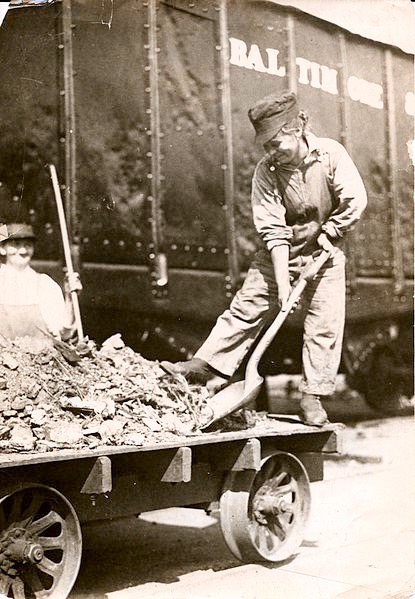
Women working on the railroad in the Allied war effort as part of Bernard Baruch’s War Industries Board, Glenwood, Pennsylvania, circa 1918
Baruch was a consigliere to presidents from Woodrow Wilson, to FDR, Ike and beyond. He ran the War Industries Board during the First World War. Really it was people like Baruch who kept the trains running on time and the goods flowing across the Atlantic. There is something so tactile about statues such as this one, where you can get up close and touch it. Artistically this quite deliberate and allows a person to connect with the subject in way that is impossible when he/she is up on a pedestal. It reminds me of the Lincoln statue in front of the Visitors Center at Gettysburg that always has a crowd around it. I had him to myself at 8:30 but when I left around 4:00 sure enough there were folks sitting next to BB.
(bottom image/War industries Board, National Archives and Records Administration, via Wikimedia Commons)
Empire State doughboys retuning home: Oriskany Falls, August 1919
Blake Seitz of the Washington Free Beacon has written an informative piece about the ongoing project to build a national First World War memorial in Washington D.C. Some readers may know that the WW1 Centennial Commission has been working on this endeavor for some time now, and that the competition is now down to five selections. A winner will be chosen in January. Whichever design wins, there will undoubtedly be a few bugs and details to be worked out. Still, the process has gone fairly well so far. Seitz captures well the purposes of U.S. war memorials, especially how the ones in our nation’s capital reflect the times in which they were built and the individual conflicts they commemorate. There is a reason Lincoln is etched larger than life in granite and the Vietnam Wall stretches semi-below ground with its fatalities listed one-by-one in chronological order. As Centennial Commission Ed Fountain points out in the article, the Great War’s ambiguity has been one of the major reasons it has taken so long to build a national World War 1 memorial in Washington.
It was not always this way. In the 1920s and 30s Americans built approximately 10,000 tablets, memorials and statues across the country. D.C. itself had its own memorial, commissioned in 1924 and finished in 1931 in honor of the men from Washington City who served and died Over There. These were all locals projects however. The Depression and rise of Hitler eventually took away whatever enthusiasm there was to remember the events of 1914-18. I strongly urge you to read Seitz’s article.
I hope everyone got enough to eat yesterday and refrained from waking up at 4:00 this morning for Black Friday. In a sense we have Franklin Roosevelt to thank/blame for turning the day after Thanksgiving into the retail orgy it has become. Since 1863, when Lincoln asked Americans to pause and give thanks for what they had during the difficult days of the Civil War, the country always marked Thanksgiving on the last Thursday in November. Decades later, in the waning days of the Depression, leaders of the Retail Dry Goods Association convinced President Roosevelt that because Thanksgiving fell on November 30 the late date would dent their Christmas sales. And so in August of that year FDR announced that Thanksgiving would fall a week earlier, on the fourth Thursday of the month, November 23.
The cover of the menu for the Marines Thanksgiving dinner, Pearl Harbor 1939. It is unclear if the Marines marked the earlier or later date, though an educated guess would say the earlier being that the directive had come from their commander-in-chief, President Roosevelt. Just over two years later the Japanese would attack the base, launching the United States into World War II.
Thanksgiving at this time was not yet a legal holiday; state governors had the option of setting the date themselves, though by tradition they had usually rubber-stamped what presidents since Lincoln had done. That was not to be in 1939. Roughly half the state governors chose November 23, with the other half opting for the traditional. So the United State had two Thanksgiving that year, and again in 1940 and 1941 as well. Tellingly the most resistance came from New England, especially Massachusetts, where the holiday had originated in 1621. Bay Staters did not see the humor in messing with the traditional date. Roosevelt’s detractors called the president’s proclamation “Franksgiving.” The financial benefits of the earlier date were ambiguous, perhaps because of the confusion with the mulitple. The experiment came to an end three years later; facing so much backlash and resistance, FDR called off the dual celebrations. In a larger sense he–and the retailers–got their way however. Thanksgiving was permanently and legally moved to the fourth Thursday of the November, adding a few extra days to the holiday shopping season.
(image/USMC Archives from Quantico, USA, via Wikimedia Commons)
St. Patrick’s Church, Washington D.C., 26 November 1914: the mood was somber the first Thanksgiving of the Great War
Happy Thanksgiving, everyone. I thought I would share these photographs from the Pan American Mass held at Washington D.C.’s St. Patrick’s Church in 1914. St. Patrick’s Monsignor William T. Russell conceived the idea of a Pan American Mass after hearing President Taft’s Thanksgiving proclamation in mid November. The monsignor pitched the idea to his boss Cardinal Gibbon who signed off on the idea. The Pan American concept goes back to the Pan Am Expo held in Buffalo nearly a decade earlier. That is of course where McKinley was killed and Roosevelt ascended to the presidency in 1901. William Howard Taft attended all four Thanksgiving Pan American Masses during his presidency.
Though undefined in the crowd, William Jennings Bryan was in attendance that Thanksgiving Day. His attendance at the Pan American Mass assuaged concerns of Protestant exclusion and signaled America’s determined neutrality in the escalating war.
Woodrow Wilson was there in 1913 but conspicuously absent in 1914. It seems there was a messy public dispute after the 1913 Thanksgiving mass when Protestants complained about what they saw as the mass’s exclusion. Wilson was at his retreat house in Williamsport, Massachusetts with his daughter, the two quietly celebrating Thanksgiving while mourning the death of his wife and her mother Ellen. Mrs. Wilson had hied the first of August during what turned out to be the first week of the Great War. Three months later peace was the topic of the day in St. Patrick’s. The president’s personal aide, Joe Tumulty, and his Secretary of State, William Jennings Bryan, represented his that Thanksgiving day. Tumulty and Bryan were wise if subtle choices; Tumulty was a practicing Catholic and Bryan a devout Protestant pacifist. With war in Europe entering its fourth month Bryan’s attendance signaled to both domestic and foreign audiences that the United States was determined to stay out of it.
St. Patrick’s marked the Pan American Thanksgiving Mass well into the 1950s, with presidents, ambassadors and Supreme Court justices usually in attendance.
Hemingway in Paris, circa 1924: less than a decade removed from his years as a WW1 ambulance driver and during the time he was writing the notebooks that became A Moveable Feast
An interesting thing has been taking place in France this week: Hemingway’s A Moveable Feast has been making its way up the best-seller list in the wake of last week’s ISIS attacks. Hemingway’s widow published AMF in 1964 three years after the writer’s death. It is a collection of vignettes Hemingway wrote in notebook form while living in Paris in the 1920s as a member of the Lost Generation. He tinkered with the manuscript in the 1950s and prepared what was essentially the final draft before his suicide. Fitzgerald, Gertrude Stein, Ford Madox Ford and Ezra Pound are just a few of Hemingway’s protagonists. Though I’m sure it was coincidence the book was published fifty after the onset of the First World War, which was fitting being that the events of 1914-18 were what set the stage for the anxieties and opportunities of 1920s Paris.
Hemingway in many respects was a stereotypical artist. The multiple divorces, the alcoholism, the posing and sheer blowhardedness, the chaotic personal life and, eventually, the suicide. It was all so messy; yet when it was time to put pen to paper he could bring it like nobody’s business, and all in such a straightforward, no bullshit style. It is no wonder people are tuning to Hemingway and his Paris memoir again at this anxious time, 50+ years after its original release.
(image/Ernest Hemingway Collection. John F. Kennedy Presidential Library and Museum, Boston)
Liverpool (above) was one of Europe’s many port cities from which Europeans flocked to the United States prior to the First World War.
I noted with interest today that the city of Liverpool is to build its own immigration museum. This will not be the first museum in Europe dedicated to the mass exodus from the Old World to the New. Antwerp for one has its Red Star Line Museum, which opened in 2013. In my time volunteering at Ellis Island I always stressed that immigration to the U.S. at the turn of the last century was not a one way street and that the human drama was taking place on the other side of the Atlantic as much as it was at Ellis Island, Baltimore, Charleston, and the other port cities of the United States. Anything less is just half the story.
The Liverpool immigration museum seems to be part of city’s larger strategy to emphasize its cultural heritage. Most famously city leaders plug The Beatles and Mersey’s importance to the band’s sound and rise. And why shouldn’t the city do that?; the rough and tumble town was integral to who the group was. Hamburg, itself another port city instrumental to the Beatles development, opened its own immigration museum, the BallinStadt, in 2007. European immigration to the United States crested a hundred years earlier, 1907, but held steady until the onset of the Great War seven years later, when the sea routes were disrupted and Atlantic travel dropped off precipitately.
I spoke to my brother in France yesterday. He seemed to be holding as well as can be expected in these circumstances. He is a little worried about crossing the border tomorrow, which he has to do sometimes for work. I guess we’ll see what happens. It is important in times of crisis such as now to remember the long ties between France and America, starting with French and American Revolutions, through the world wars, and even in recent years despite strains in the long relationship. One of the most significant moments in Franco-American relations came on July 4, 1917 when men of the 16th Infantry marched to Picpus Cemetery to pay their respects to Lafayette. I thought a little Sinatra on a Sunday morning would make everyone’s day a little brighter. If i’m not mistaken the video comes from the opening of Woody Allen’s Midnight in Paris.





 The Strawfoot