Armistice Day 1935

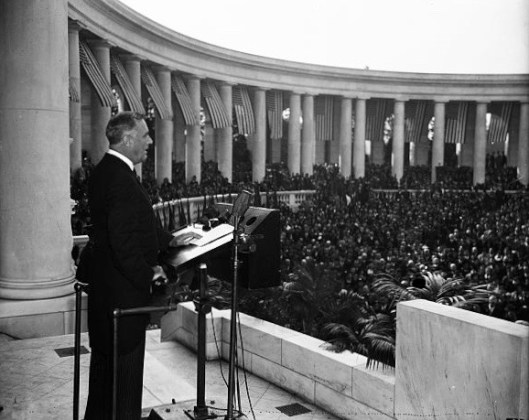
President Roosevelt speaking at Arlington Cemetery, Armistice Day 1935

President Roosevelt speaking at Arlington National Cemetery, Armistice Day 1935

Today is Veterans Day and I am curious to see if anyone mentions it to me over the course of the day. Eighty years ago today Franklin Roosevelt spoke at Arlington National Cemetery. It was a tense time in international relations. Hitler was consolidating his power in Europe and Mussolini’s Army was making its way through Ethiopia. The president’s speech was restrained but hopeful nonetheless that peace could still flourish. It was an interesting moment in many ways. For one thing Armistice Day was not yet a national holiday. FDR’s New York had established November 11 as a legal holiday only the year before, joining nearly thirty other states that had done so previously. Since the Armistice itself presidents had issued proclamations asking the nation to observe the anniversary.

The American Legion had invited Roosevelt to speak a few weeks previously. FDR’s estranged cousin Ted had been one of the founders of the Legion. The Legion was also a supporter of the Bonus Army, who made it clear to President Roosevelt that they were not giving in on their demands for payment of the long-ago-promised stipend. Roosevelt tied to emphasize the positive in his Armistice Day speech, announcing a trade agreement between the United States and Canada that had just been negotiated, as if to show how international cooperation could still work if applied. He emphasized America’s need for preparedness as well, which was a not-so-subtle dig at Wilson’s response to the outbreak of fighting twenty years earlier. He would do the best he could to avoid the same fate during his own administration, through Lend-Lease and other measures, but with mixed results.

One of the most poignant things in the photograph above are the support rails that were presumably built especially for the president’s use. Because of the polio he could only stand for brief periods of time. Usually in photos where Roosevelt is standing there are men standing on either side of him to provide support. Obviously that was not possible for such a solemn occasion as this, and so the rails were there just in case. After this event Roosevelt traveled to Hyde Park for a period and then on to Warm Springs, Georgia where he would spend Thanksgiving.

(image/Library of Congress, permalink: http://www.loc.gov/pictures/item/hec2013015509/)

Visiting the Grover Cleveland Birthplace

The Grover Cleveland Birthplace is today managed by the State of New Jersey.

The Grover Cleveland Birthplace is today managed by the State of New Jersey.

Yesterday a friend and I ventured out to Caldwell, New Jersey to visit the Grover Cleveland Birthplace. We were spurred on by a recent New York Times article extolling the virtues of seeing the presidential sites of our more forgotten leaders. It proved surprisingly easy to do; the trip entailed little more than an hour’s bus ride from the Port Authority. As I wrote about a few months back, Grover Cleveland was a good friend of James Roosevelt, FDR’s father. The 22nd and 24th president was born in Caldwell in 1837 and lived there for four years until the family relocated to the Empire State in the early 1840s. Cleveland’s father was a minister and served in numerous churches in Upstate New York, which was expanding in these years just after the completion of the Erie Canal.

The beautiful Frances Clara Folsom Cleveland Preston as she was around the time of the start of the First World War

The beautiful Frances Clara Folsom Cleveland Preston as she was around the time of the start of the First World War

Cleveland married the 21-year-old Frances Clara Folsom in the White House on July 2, 1886. The couple went on to have five kids. The media was not yet as intense as it would be during the Theodore Roosevelt Administration but the Cleveland kids, especially little Baby Ruth, captured the country’s imagination. Cleveland died in 1908 and the home in Caldwell opened as a historic site in 1913. That same year Frances–still just in her mid-40s–remarried. She and her husband were living in London when the Great War broke out a year later. The newlyweds returned to the United States. Frances was active in the Allied cause throughout the Great War, and indeed was involved in most of the issues of the period. She worked with Theodore Roosevelt on a Liberty Bond drive and became active in the Needlework Guild. Frances also opposed the vote for women, to the extent that she became president of the Princeton branch of the New Jersey Association Opposed to Woman Suffrage. She was vice-president of the state organization as well.

In February 1918 she signed her name to a petition urging the Wilson Administration to ban the production of beer and malt liquor. This initiative had the back of some 6,000,000 signatures. Their main argument was that cutting production of beers and malts would save precious grain for the war effort. There was merit to the argument. That same week representatives from the baking industry were meeting with the Federal Food Board. Herbert Hoover had recently authorized the twelve-ounce loaf, as opposed to the standard sixteen-ounce loaf, in response to the shortage of foodstuffs. The grain petition, as everyone knew, was also part of the wider strategy of the Temperance Movement. Indeed the initiative had the support of the WCTU, with whom Frances had a complicated relationship over the decades.

We tend to think of this stuff as ancient history and yet Frances Cleveland Preston lived until 1947. As my friend and I noted when talking to our tour guide yesterday, Frances and Grover Cleveland’s youngest child, died on 8 November 1995, twenty years ago today.

(bottom image/Library of Congress, permalink: http://www.loc.gov/pictures/item/ggb2005011955/)

The smell of victory in the evening

IMG_2766I got home tonight and there in the vestibule was the author’s copy of The Wonder of It All sent to me by editors at the Yosemite Conservancy. There is nothing quite like seeing your name in print. The official release date is March 15, 2016, but the Conservancy has it exclusively until then. I did not know that Shelton Johnson had written something for the collection. Longtime readers may recall that I interviewed Ranger Johnson two years ago. It’s kinda cool to now be associated with him on a project such as this one for the 100th anniversary of the Park Service. I’m looking forward to reading his and the others’ contributions.

Juilliard’s military tradition

My good friend Molly Skardon, who is the driving force behind the Oral History Project at Governors Island National Monument, has published a piece about military musicians in this month’s edition of the Julliard Journal. I encourage you to check it out. When we think of music and the Great War we inevitably and properly think of James Reese Europe and his jazz men. That is just part of the story, however. Many of the A.E.F. bands have their roots in a program started just before the outbreak of the conflict. Music has always been important to the military. At Governors Island military bands trace their roots as far back as the 1830s. John Philip Sousa led the U.S. Marine Band for years before striking out on his own. It’s difficult for people in the twenty-first century to grasp the cultural impact he still has today. Molly informs us that the Army’s musical tradition began a new chapter in 1911 when the Institute of Musical Art–the institution that became Juilliard–founded the Military Band Department. Some of America’s greatest musicians have learned their art in this musical laboratory.

When the First Army was stationed on Governors Island its band was responsible for performances of all kinds–funerals, parades, state visits, and whatever else the brass came up with. Molly and I, with others, have interviewed some of these people as part of the OHP. Some of these guys are still active as well. We saw one of them play in Greenwich Village a few months back. We never had the good fortune of seeing Michael Rose play, but we did interview him over the summer. Up top is a video of him and his band which he posted just yesterday. Mr. Rose got his start playing as a young trumpeter stationed on Governors Island in the 1950s. He went on to play with Gene Krupa, Benny Goodman, and many others.

Remember that next week is Veterans Day. Here is a slightly different link to Molly’s article, with related links to other stories about Juilliard’s relationship with the military. And by the way if you are a veteran of Governors Island’s First Army Band, or were stationed there in any capacity, please contact me about setting up an oral history interview.

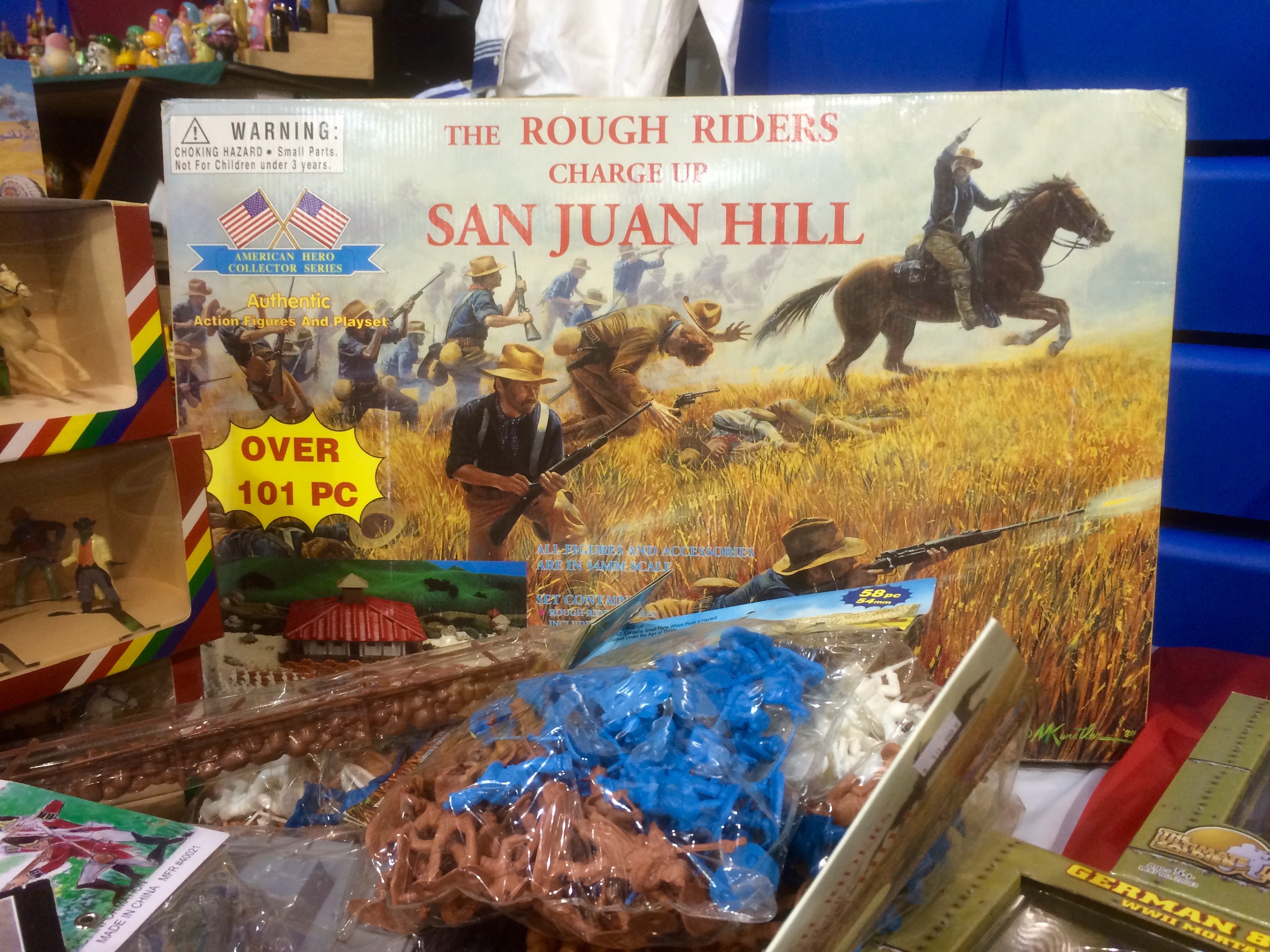
The Rough Riders in 54mm

IMG_2751One thing I love about going to toy soldier shows, especially the big one every November in Hackensack–is that one is pretty much guaranteed to see something that a) one never thought one would see, and b) one never knew existed in the first place. That happened again many time today, not least when I saw this Rough Rider playset. No I did not buy it, but I did make sure to take the above photo. A quick internet search informs us that the set comes with 10th Cavalry Buffalo Soldiers, the 71st New York, and individual poses of both John Pershing and Colonel Theodore Roosevelt. I have no idea why this set is not better known. The cover art was even done by banality maestro Mort Kunstler. Now you know that I’m not much for the painter’s work; he did do a beautiful job here nonetheless. I believe this set is from the late 60s or early 70s. The already impressive set already contains over 100 pieces; coupled with a few more troopers this would make quite the living room battle scene.

It’s interesting how the Spanish-American War was something of a laboratory for the U.S. Army a decade and a half prior to the outbreak of the Great War. It is roughly parallel to what the Mexican-American War did for the Officers Corps that fought the War of the Rebellion. The Boer War was much the same for the Brits. In every case, though, even more lessons could and should have been learned.

Speaking of the Great War, I met a few people who, if things fall into place, with whom I ay get to collaborate on a few small things. Time will tell.


Remembering my Aunt Carol

Gettysburg was one of Aunt Carol's favorite places.

Gettysburg was one of my Aunt Carol’s favorite places.

My mother’s older sister died this past week and I am still trying to process it all. Some may note that Carol Zurlo was a regular commenter here on this website. My aunt was born in Washington DC in 1935, where my grandfather worked in the Navy Yard during the Depression and then throughout the Second World War. The family moved back to Boston in 1945. My own parents lived in Connecticut until we all moved to South Florida in the mid 1970s. My brother and sister and I were cut off from the extended family for the next decade and more. Remember: there was not internet, no cell phones, no text messaging, and no anything else in these years. When you were cut off, you were cut off.

Her last several years were a struggle health-wise but Carol never failed to keep in touch. And it was not just about genealogy. She had an interest in art, history, crafts and quilting, and numerous other things. She was elementary school teacher for so long that she ended her career teaching the grandchildren of some of her original students. After retirement she supervised field trips for her own grandkids’ visits to Gettysburg and elsewhere. Naturally she always filled me in about these excursions. She was also a great Boston sports fan. Over the past dozen or so years each of the four Boston teams have won at least one title. The biggest one, at least as far as my extended family went, was when the Red Sox finally broke through in 2004. I have always been thankful that everyone from these two generations lived to see it. That may sound funny, but it is no small thing.

One of the best things about moving to Brooklyn in the late 1990s is that I was able to reacquaint myself with much of the extended family. When I began tracing my family history about a dozen years ago the two individuals who helped fill in the most about their respective sides of my family were my father and my Aunt Carol. Others filled in gaps as well, and have even generously taken me to the old schools, houses, and final resting places of our relatives. My dad and aunt were the foundation though. This made sense, as they were both the oldest siblings and so had the most memory to fall back on. Now both my father and Carol are gone, but what they passed on to me has been saved.

A snapshot of Governors Island

Garden-Party-Governors-Island-e1445221745818I am sorry for the recent lack of posts. Things have been in full swing at my school. The season has ended at Governors Island but things still come through my in-box, including this photo that I thought I would share. A friend and I were looking at it yesterday and he noted how confining the ladies’ clothes must have been. This image was taken in 1911 and shows how little things had changed style-wise prior to the First World War. This is a full decade after the death of Queen Victoria and one year after the passing of her son Edward VII. One can hardly tell however that the Edwardian Age had come and gone. This scene could have been 1891 just as easily as 1911. The Great War liberated women in a number of ways, including what they wore. Manpower deficits helped put them to work in factories, which meant their clothes had to be more functional; also, shortages in steel and other raw materials made the corset impractical and soon obsolete. Goodbye whalebone, hello brassiere.

This photograph was almost certainly taken in what is now called Nolan Park on May 25, 1911 in recognition of Decoration Day. I say this confidently because there are many similar images taken on that day. This was between Leonard Wood’s stints as commander of the Eastern Department; Frederick Dent Grant was in charge. Note the black cloth hanging as if from a clothesline up top. Images like this are fascinating because we, one hundred years later, know what comes next. Three years later this world of garden fetes and genteel Decoration Days would get swept away by the calamity of the First World War.

(image/Library of Congress via History by Zim)

Sunday morning coffee

Eisenhower Farm in winter

Eisenhower Farm in winter

It is feeling more and more like fall by the day here in New York. I do miss Governors Island but at the same time I must say I have been enjoying these Sundays off. This past week marked the 125th anniversary of Dwight Eisenhower’s birth. Many forget that he was born in Texas and not Kansas. One thing that is so fascinating about that generation is the way it spanned most of the major events of the 20th century. And they did not just witness such events as the Great War, the Russian Revolution, the Depression, rises of Hitler, Stalin, & Mussolini, FDR’s New Deal, the Second World War, and Cold War, they were active participants. Ike was born during the Benjamin Harrison Administration and lived long enough to see the Beatles conquer America.

Eisenhower was in the West Point Class of 1915, known as the class “the stars fell on” because nearly five dozen graduates went on to become generals. Most of them first put what they learned in class to use on the battlefields of France. The lieutenants and captains of 1917 were the major generals of 1942. Ike of course did not go to France; he was too valuable as a trainer and organizer. He spent a great deal of time at Camp Colt in Gettysburg. That is why he and Mamie eventually bought their first and only home there. They were part of the fabric of the local community for decades, and entertained world visitors frequently as well. If you have never been to the Eisenhower Farm, make sure to visit on your next trip to Gettysburg.

Check out these great photos that Penn Live has posted in tribute. One of my favorites is the one with him and the 101 Airborne just prior to the Normandy Invasion. It is almost an outtake of the more famous image one sees all the time. It is amazing how many of photographs, especially the color photographs, appear modern. The cut and styling in the suits were timeless.

(image/Library of Congress byJack E. Boucher via Wikimedia Commons)


A quick tie story

Navy grenadine

Navy grenadine

I was at the New York Public Library doing some work today when at lunchtime I took a break and ran around the corner to the storefront of Winston Tailors: it was my goal to–hopefully–buy one of Paul Winston’s ties. The name may not ring many bells outside the world of men’s clothing but Mr. Winston’s father was the founder of CHIPP, a clothing store once on Madison Avenue across the street from Brooks Brothers. J Press was right there as well. I assume they were where they were due to the proximity to Grand Central Station. Brooks Brothers opened its flagship store at 44th and Madison in 1915, two years after Grand Central opened. CHIPP outfitted Cy Vance and John F. Kennedy among others. I read in an interview after getting home that Mr. Winston accompanied his dad on fitting trips to the Carlyle Hotel when President Kennedy was in town.

CHIPP is gone now but the family tradition continues through Mr. Winston. Now in his mid-70s, he runs his tailor shop out of the lobby of a building on 44th Street between 5th and 6th. He also sells ties through what he apparently considers an entity separate from the tailoring itself; he calls the tie business CHIPP2. When I got to the building today I could not find it, and so asked the concierge. He couldn’t find CHIPP2 in the directory and with incredible graciousness looked it up on his own cell phone and called. (I didn’t know at that moment that the tailor shop was the site too for the ties.)

I did not want any tie but was specifically looking for a navy grenadine: the most conservative of conservative neckwear. Why can’t men dress the way they did between the world wars? As my luck would have it a shipment had come in an 1 1/2 hour earlier. When I told him what I wanted, he literally went behind the counter and pulled it out of the box that the postman had delivered that morning. In other words–as he told me–had I come in at 11:00 instead of 1:00 I would not have gotten the tie. What is more, many in the delivery were pre-orders that were already spoken for. I had never met Mr. Winston before but he is clearly a witty and charming raconteur. It was so strange that I had showed just after he had received the shipment that we had a brief discussion about fate and coincidence. On the way out I thanked the building concierge once again and also shared with him that right there in the building works the man who with his father once made John F. Kennedy’s suits.

Lincoln’s chair to go under the gavel

3a52058rI noted with interest that a chair given to Matthew Brady by President Lincoln is going on the auction block later this month. I have looked at the above image along with several others and cannot make out if this is indeed the chair. This photograph here is of President Lincoln with son Tad in February 1865. It was taken at Alexander Gardner’s studio. The think is, the article says Lincoln gave the chair to Brady in 1864; by that time Gardner was no longer working for Brady. If anyone knows more, I’d like to hear it.

Anything touched by Lincoln’s hand became beatified after his assassination. People understood the significance of the moment even while it was taking place. What is fascinating is that Brady continued to use the chair in his studio to photograph subjects. Indeed four additional presidents posed with the chair in the ensuing years. One can only speculate the extent to which Johnson, Grant, Hayes, and Garfield were aware of the chair’s import. I thought at first that they were using it in tribute to the Great Emancipator, and to an extent they probably were. However, the article in the Daily Mail notes that others, including Robert E. Lee, sat in Lincoln’s seat as well. That leads one to think it was just another piece of furniture for studio use. Check out the great images here. I may have to visit the auction house before the sale on October 26 to see it for myself. I will report what I learn.

(image/Library of Congress)