The Bowery Boys are in the house

The Bowery Boys in the Castle Williams courtyard

The Bowery Boys in the Castle Williams courtyard

We had a pleasant surprise at Governors Island this afternoon when the Bowery Boys themselves came into Castle Williams. They are currently working on a piece about the island. As you might imagine if you are familiar with the BB, these guys are as winning and engaging in person as they are on their podcasts. I had to share with them that a good friend of mine in San Antonio is one of their biggest fans. They got a kick out of this information. If you have never listened to or read the Bowery Boys before, do yourself a favor and check them out here. These guys put the love into what they do.

The First World War’s 50th anniversary

Smoke rises visibly above the U.S. Capitol on 8 April in the wake of the assassination of Martin Luther King Jr.

Smoke rises visibly above the U.S. Capitol on 8 April 1968 in the wake of the assassination of Martin Luther King Jr.

I was at a history-related gathering earlier this week, present at which was a representative of a New York-based military heritage organization. This gentleman was in his seventies and had obviously been involved in his organization’s activities for many years, if not decades. What struck me was that as he was discussing his group’s plans for the WW1 centennial in 2017-18 he made reference to the 1960s. Specifically he was explaining what a tough sell the Great War was at the time given the events of the period. One can imagine that it was.

Those who followed the Civil War sesquicentennial are aware that the 150th was a conscious effort to correct the failures of the centennial. The pageant that such organizers as Ulysses S. Grant III envisioned quickly collided with the realities of the Civil Rights Movement. Instead of a Cold War celebration of national strength and unity, it all turned into a convoluted mess. And for good reason. The same thing happened, in a slightly different way, for the Great War 50th. Nineteen sixty eight was the year of the Tet Offensive, the MLK Jr. and RFK assassinations, the rioting at the Democratic National Convention and so much else. The 50th anniversary of the Armistice fell obviously on November 11, 1968, less than a week after the election that put Richard Nixon in the White House.

France too was turned upside down at this time. The Events of May brought down Charles de Gaulle and nearly the Fifth Republic. What is more, in the late 1960s the French were only just grappling with the occupation–and the collaboration–they had lived through under the Germans during the Second World War, less than twenty-five years earlier. The Great War has a larger place in the memory of the French than the Americans; this is understandable given that most of the fighting on the Western Front took place in France. Given all that was taking place at the time however, I don’t know if the French had the heart to look back and commemorate the Great War. Maybe they did, finding in it some unity and solace. Again, I don’t know. It would be interesting to have a compare-and-contrast between how the Americans and the French looked back at the war through the lens of the turmoil of the late 1960s.

(image by Marion S. Trikosko / Library of Congress [Public domain], via Wikimedia Commons)

New York’s social set

Union League Club, 1919

17 February 1919: Much of New York City turned out to see the return of the 15th NY “Harlem Hellfighters” after their recent return from France. Here Union League Club members review the 15th as they pass the clubhouse.

An interesting piece from Curbed NY about long-standing New York City social clubs came through my in-box. This is something I am especially interested in because the Union League Club plays an important part in my manuscript about Civil War New York. The article traces the history of such clubs all the way back to the colonial period where bewigged men socialized in coffee shops. Soon such meeting places were soon privatized to keep out the rabble. Subtly is sometimes the price for brevity. I think the author simplifies the story of the ULC’s creation in 1863. At the risk of further quibbling, I don’t know if such clubs have “fallen” either. Though it is true that some are doing less well than others, it is difficult to imagine these staid institutions going anywhere anytime soon. New ones are even cropping up to meet the needs of twenty-first century New Yorkers.

There is a tendency to snub one’s nose at such institutions but they played, and still play, an important role in the fabric of the city. Just to stay with the Union League Club for a minute, it is difficult to imagine how New York City could have contributed so much to the Civil War effort without the ULC. It was important, albeit to a lesser extent, during the First World War as well. The Union League Club sponsored many of the Negro regiments in the Great War, just as it had fifty years earlier during the Rebellion. Many members themselves also served in uniform from 1917-19.

Today in the twenty-first century the clubs that remain are important cultural centers. They also provide a sense of continuity. You may recall my writing about visiting The Players NYC on the anniversary of Appomattox.

(image/Underwood & Underwood, Photographer (NARA record: 1123804) (U.S. National Archives and Records Administration) [Public domain], via Wikimedia Commons)


Sunday morning coffee

IMG_2370Another early Sunday here. It’s going to be a hot one today; summer is kicking in here in the city. One of the great things about Governors Island is that there is always that great breeze coming off the harbor. Remember, the island is open seven days a week this season.

I was at the New York Public Library doing some research yesterday when I saw the attention-grabbing title you see above.

It is hard to believe that the WW1 Centennial Trade Show in Washington was a year ago today. That was a fun and productive session. It has been interesting seeing many of the things discussed come to fruition. The next few years are going to offer even more exciting projects and events. Attending that conference was one of the best things I have done. There were so many dynamic people there doing interesting and creative things.

Enjoy your Sunday.


Washington Roebling’s wars

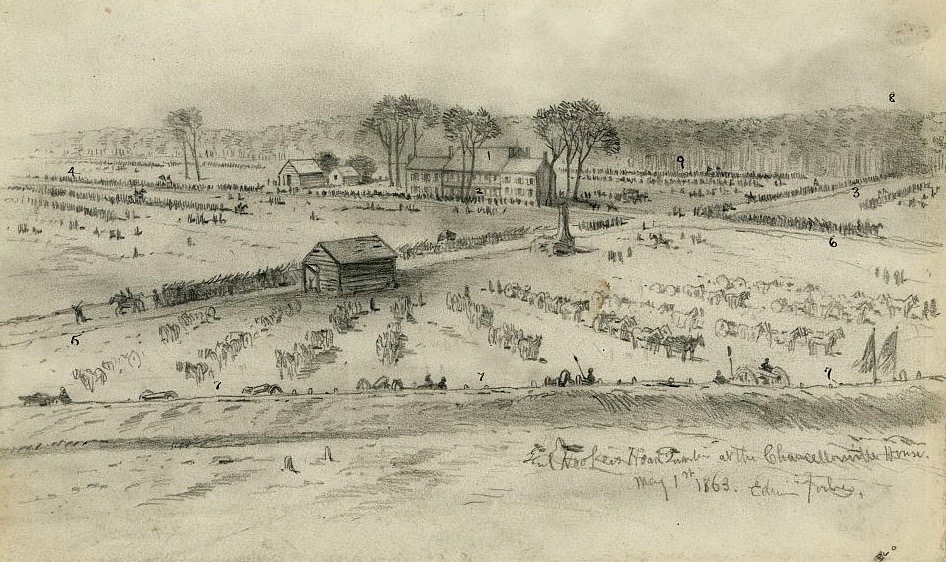
 Major General Joseph Hooker's headquarters at the Chancellorsville house, where Washington A. Roebling served during that battle

Major General Joseph Hooker’s headquarters at the Chancellor House, where Washington A. Roebling served during that battle

Last night I finished Ernest B. Furgurson’s Chancellorsville 1863: The Souls of the Brave. My interest in reading the book was two-fold. First, I am trying to get a better sense of what the New York regiments dealt with during the Civil War. One of my objectives in the Roosevelt Sr. book is to explain how the homefront and the battlefront intertwined. Also, I am trying to nail down my Roebling history a little tighter for my volunteer work at the museum. I was always aware of Gouvernor K. Warren and Washington A. Roebling’s place on Joseph Hooker’s staff. Furgurson’s book fleshed that out a little more. Warren was Roebling’s immediate superior and eventual brother-in-law. After the war Roebling was the younger half of the father-son team that built the Brooklyn Bridge.

Less than a year after Chancellorsville and Gettysburg Warren was placed in command of the V Corps after Meade’s restructuring of the Army of the Potomac. Roebling followed. Until the Overland Campaign the battles in the East were primarily campaigns of movement. The trench warfare of 1864 was closer to what took place on Europe’s Western Front a half century later. Roebling lived until 1926 and would have been conscious of the parallels between the two. We know he didn’t think too much of Ulysses S. Grant, whom he called Useless Grant. The Roebling business was active in helping the Allied cause during the Great War, primarily in the making of submarine netting. Roebling knew war intimately. I cannot help but wonder what he thought about the carnage in Europe after having gone through it himself all those decades earlier.

(sketch by Edwin Forbes, courtesy Library of Congress)


“They deserve their own memorial.”

Pershing Park is to become the location of  the National WWI Memorial.

Pershing Park is to become the location of the National WWI Memorial. The design competition is now underway.

Early this afternoon, as per most Wednesdays, I sat in on the World War One Centennial Commission weekly conference call. I can tell you that many exciting things are being planned for the coming years. One initiative that is moving along quickly is the creation of a national WW1 memorial in Washington. Such projects tend to come in waves. Over the past 35+ years we have seen the creation of the Vietnam War memorial, followed by the Korean War memorial, and then the WW2 memorial.

There is currently no national monument for veterans of the First World War either on the Mall or anywhere in the District of Columbia. What many believe to be a monument to the veterans of 1917-19 is actually a site dedicated to veterans from the District of Columbia. Tourists always walked past this monument, which is happily getting more recognition due to its proximity to the Martin Luther King Jr. memorial. Still, there has never been a national monument for veterans of the Great War.

That brings me back to the Centennial Commission. One of the Commission’s efforts is to convert Pershing Park into a national monument. The park has a number of aesthetic and bureaucratic challenges. For one thing it falls under the jurisdiction of several different local and federal agencies. Nonetheless the project is proceeding smoothly, which is a testament to the dedication and hard work of the Centennial commissioners and staff.

Pershing Park has a lot going for it. It is on Pennsylvania Avenue not far from the White House. Look closely at the image above and you can see the Treasury Building in the background. This will be a real addition to our cultural memory within our nation’s capital. The design competition opened last week. The deadline for phase one submissions is Tuesday July 21, 2015. If you or anyone you know are interested in submitting a proposal check out the details here. You have six weeks.

(image/Tim1965 (Own work) [CC BY-SA 3.0 (http://creativecommons.org/licenses/by-sa/3.0) or GFDL (http://www.gnu.org/copyleft/fdl.html)%5D, via Wikimedia Commons)


Scenes from a no-hitter

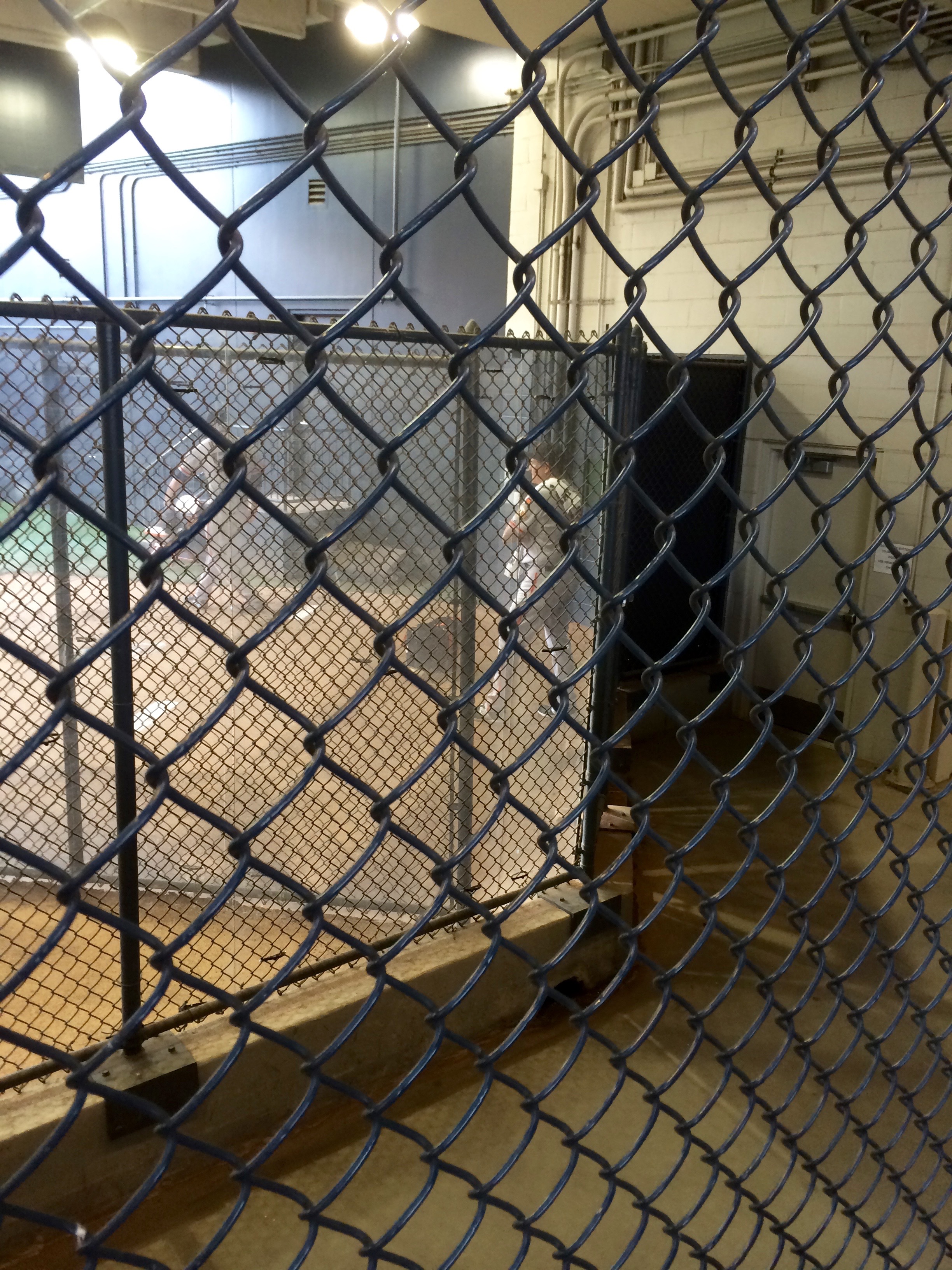
I just returned from Citi Field where we saw Chris Heston of the Giants toss a no-hitter against the Mets. Here are a few pics from the night.

No, this is not Rikers Island. That’s Heston on the left and pitching coach Dave Righetti on the right. As we were watching Heston warm up a few of us began talking about where we were when Righetti threw his no-no against the Red Sox on July 4, 1983. I suppose I am officially old, as I remember that day succinctly.

IMG_2335

I was hoping for American Pharoah to throw out the first pitch but instead it was his jockey, Victor Espinoza. People were really excited to see Espinoza and he got a good hand. Note the seat location. We usually sit high up but right on the first base line. Most action takes places right in front of you that way.

IMG_2336

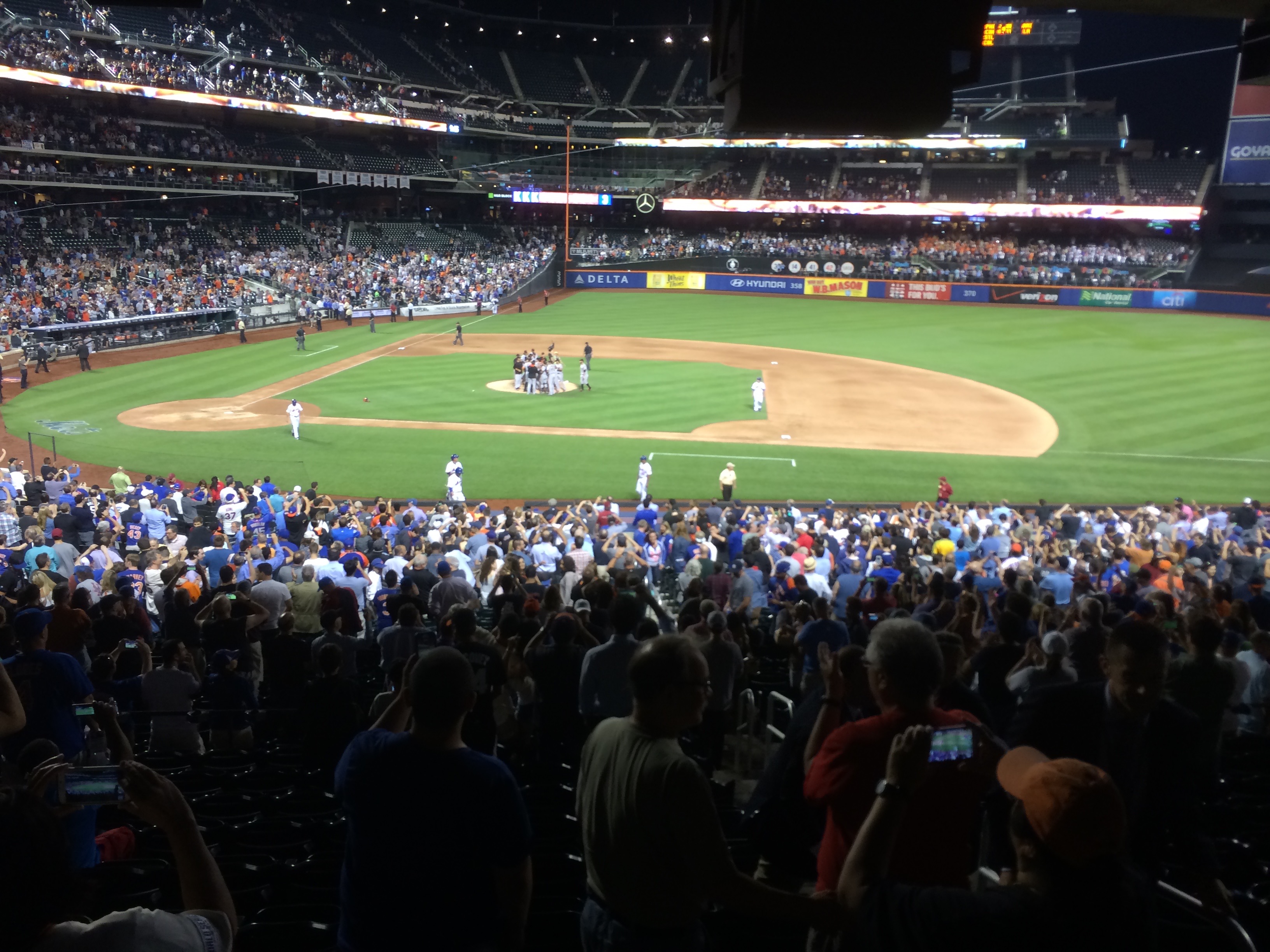
We moved down to Field Level for the bottom of the ninth. So did many other folks. The crowd was wide awake and excited.

IMG_2341

There is not much to say about the performance. The rookie gave up no hits and zero walks. He did hit three batters, though thankfully no one was hurt. He struck out the side in the ninth and this was the scene with his teammates.

You never know what you will see when you go to the ballpark.

IMG_2346


Sunday morning coffee

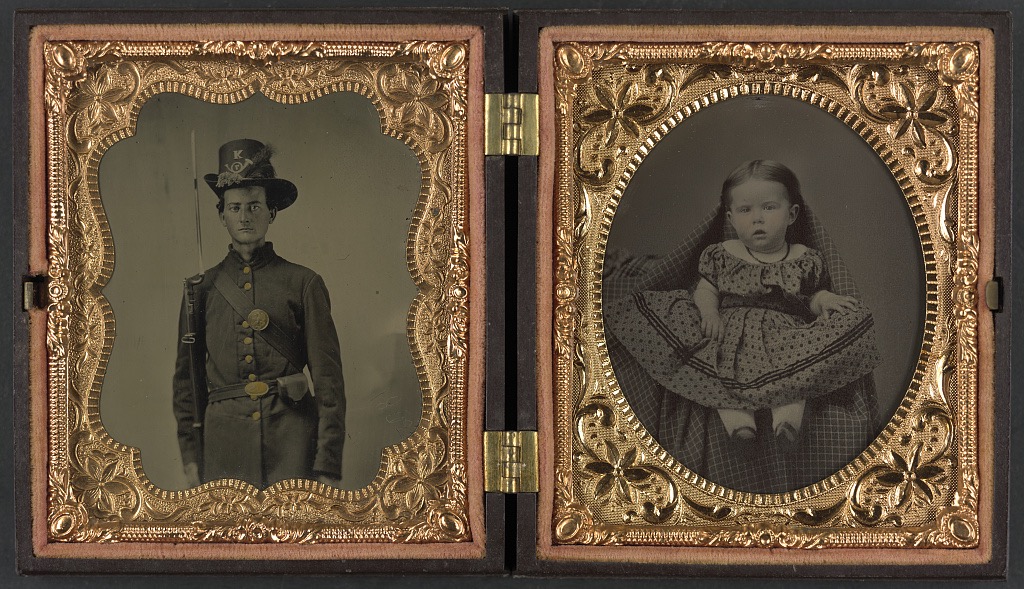
Private Hiram L. Barrett of Co. K, 7th Connecticut Infantry Regiment

Private Hiram L. Barrett of Co. K, 7th Connecticut Infantry Regiment

It’s 6:40 and I am here on the couch having a quiet moment before leaving for Governors Island. Somewhere along the way today I am going to squeeze in a mention of D-Day. When I was growing up June 6 was always a big deal; nowadays the anniversary of the Normandy Invasion barely registers. Only one person mentioned it to me yesterday. I suppose that’s the way it goes.

A few years ago during the sesquicentennial I wrote about the Liljenquist Collection at the Library of Congress. A few years ago the Liljenquist family donated their sizable collection of Civil War photographs and daguerreotypes to the Library of Congress. Soon after that donation the Library put a sizable portion of the donation on display. It is funny how the sesquicentennial is already receding into memory.

The image above came through my email the other day. It is Private Hiram L. Barrett of Co. K, of Joseph Hawley’s 7th Connecticut Infantry Regiment. The little girl is Marrie. The metadata explains that the photo of the baby is probably from 1853. The Liljenquists bought well and wisely. The quality of the images is stunning.

Enjoy your Sunday.

(image/Liljenquist Family Collection of Civil War Photographs, LOC)


Counting the WW2 dead

Though as a general rule I don’t post videos created by others, I wanted to share this film that a friend passed along to me. The Fallen of WWII is a breakdown of the 70 million persons killed in that conflict. Neil Halloran is the filmmaker behind the documentary. I read many of the comments and it seems Mr. Halloran sees this very much as an ongoing project, with updates and corrections coming based on viewer input. One thing that seemed ambiguous to me was his statement that the war began on September 1, 1939. A little later though he talks about deaths in Asia caused by the Japanese offensives. Does this mean his numbers don’t include Japanese actions dating back to the early 1930s?

Halloran adds that this could be the first in a series. I would love to see something about the Civil War and WW1 along with a few other conflicts. The film is a little under twenty minutes but it is worth your time. We toss the numbers around too easily. One must never forget the human cost of war.

Reading Liggett

Hunter Liggett authored  these two books in 1925 (Commanding and American Army) and 1928 )A.E.F.).

Hunter Liggett authored these books in 1925 (Commanding an American Army) and 1928 (A.E.F.).

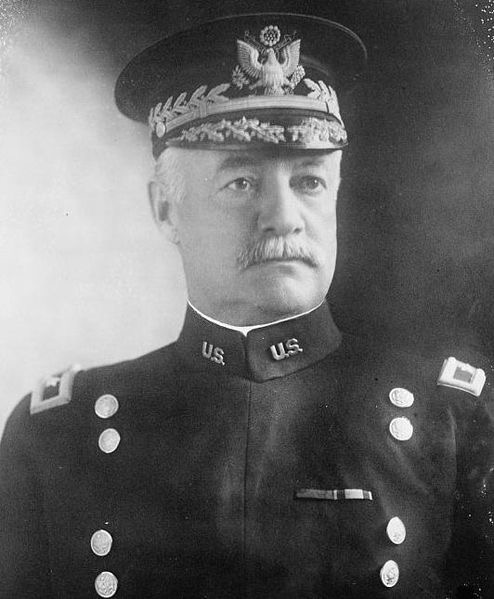
Last week I interlibrary loaned these two books by Hunter Liggett. Yes, this is the Liggett after whom the building on Governors Island is named. WW1 memoirs, or any memoirs for that matter, are notoriously self-serving. These two books work well because they are not so much personal narratives as they are accounts of American involvement in the Great War. I read the one of the left over the weekend and learned a great deal. Liggett recounts his responsibilities as the I Army Corps commander, then First Army commander, and then the III Army Corps commander during the German occupation. He does not mention Ted Roosevelt in this monograph, but I am really hoping to find evidence that General Liggett and Colonel Roosevelt knew each other personally. As an officer in the Big Red One Roosevelt would have been under Liggett’s overall command. I have a feel their paths crossed in the 1920s and 30s. We’ll see what happens.

Liggett Hall on Governors Island is named after Lieutenant General Hunter Liggett.

Liggett Hall on Governors Island is named after Lieutenant General Hunter Liggett.

I was looking at the other volume today. As its title suggests, this one is more a general overview of the A.E.F. in France. Its seven chapters were each published individually in the Saturday Evening Post. One thing he conveys well in this volume is how intertwined the American Expeditionary Force was with the British and French fighting units. Pershing tenaciously and successfully held out against what was called amalgamation. However, brigades and divisions of one Allied nation sometimes inevitably came under the commands of another country. In both books Liggett captures the immediacy of the decision-making process and explains well why many of the decisions made during the war came to be.

(lower image/National Photo Company)