Some bully changes at the Strawfoot

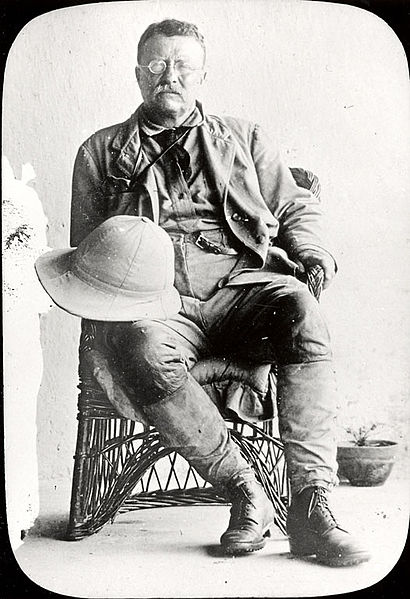
TR in hunting attireAs regular readers can tell, I changed the blog theme yesterday. I did this to highlight that there have been a few changes here on the site and in my working life as well. Yesterday was my first day volunteering at the Theodore Roosevelt Birthplace National Historic Site in Manhattan. This is really an honor and a privilege and I am excited about the coming months. I spent a good part of yesterday shadowing the rangers and getting to know the lay of the house. TR’s life and times were fascinating on so many levels and there are numerous interpretive possibilities to explore. The staff are incredibly knowledgable and bring a passion to what they do. I find it amazing that such a gem of a site is right here in the heart of New York City. If you are coming to town, make it part of your itinerary.

If you look in the lower right corner you will note that I created a Facebook page for the blog. I intend to use it for posting quick comments, photos, etc. of a more social nature than what I might put on the blog. It is very much a work in progress and I sure it will morph over time. I had wanted to do this for a while, and was waiting until I received my new iPhone. With it, I can take video and better photographs. It gives me the means to do some things on the fly as well. I downloaded the WordPress and Facebook apps, which will give me more flexibility in my blogging and social media. I am going to blog and Facebook about the writing of the Joseph Roswell Hawley biography as well. Fall is filling up.

(image/Smithsonian)

The restoration of Richard Theodore Greener, update

A year and a half ago I wrote the post below about the rediscovery of some of the effects of Richard T. Greener. There was great interest and speculation about where these things would end up. Appropriately, they have returned to the University of South Carolina. Find a half hour over the weekend to watch the ceremony that took place earlier this week.

Further update: This was a more complicated story than I first realized. Boston Magazine has more on the story, including a threat to burn the documents. Crazy.

(Hat tip David Jensen)

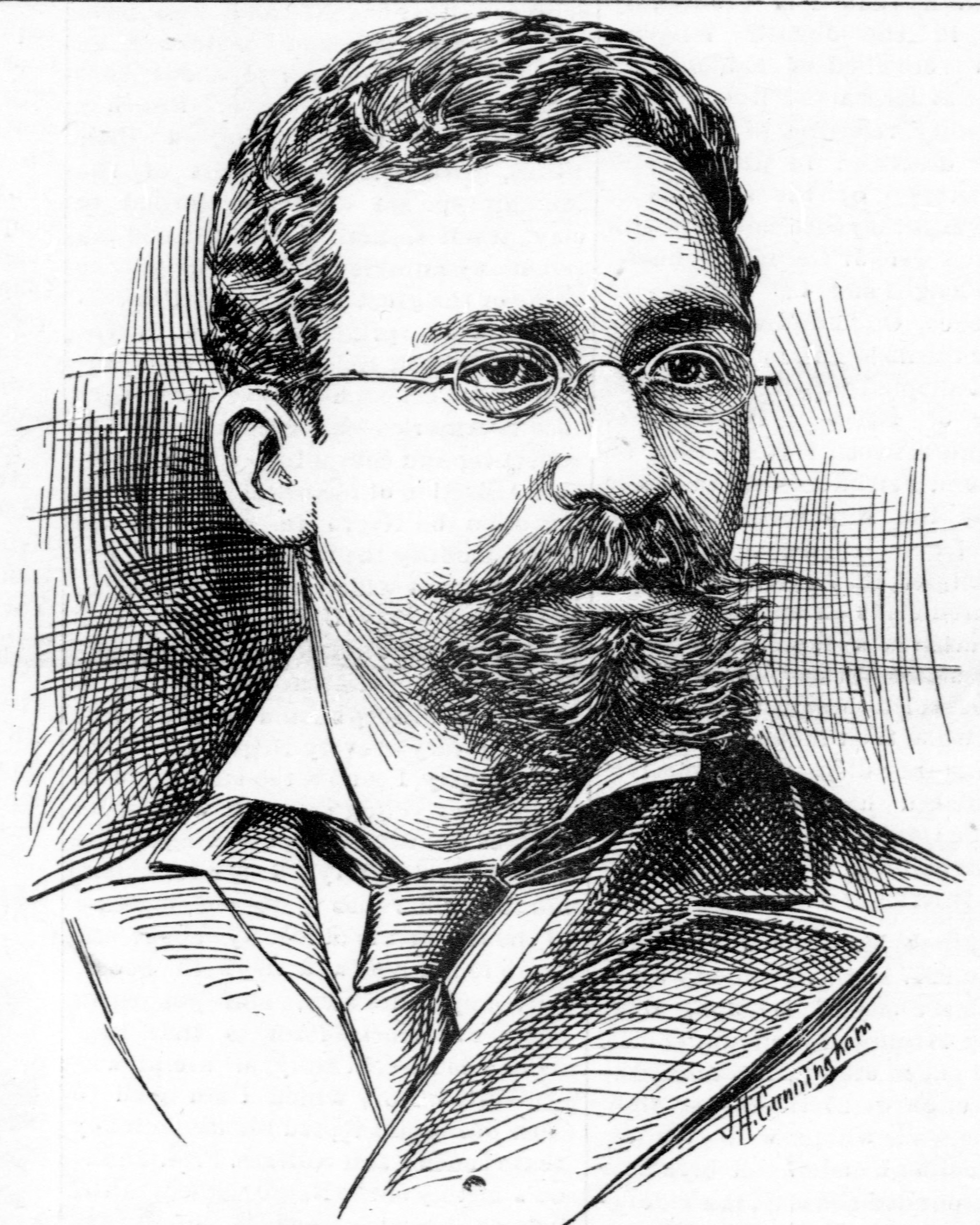
I have written before of my appreciation for the recovery of Long Lost Items. The stories are exciting precisely because of their unexpectedness. You are reading the newspaper one day and learn, for instance,  that a WW2 German U-boat has been discovered off the coast of New Jersey, as actually happened about a decade ago. The other day a friend forwarded me this piece about the discovery of a cache of personal effects once belonging to Richard T. Greener. That many readers might not know who Greener was is unfortunate, because he was very much the equal of Frederick Douglass, Booker T. Washington, and even W.E.B DuBois. Greener was the first African American graduate of Harvard College, entering that institution in September 1865 as a member of the first class to enroll after the Civil War’s end that April. In the early 1870s Greener was the principal of the Male Department in the Philadelphia Institute for Colored Youth. He soon took a similar post at a school in Washington DC. Eventually Greener earned his law degree from the University of South Carolina. While studying there he traveled through the heart of the fire eating Palmetto State preaching the gospel of racial equality, often under considerable threat of violence. Wisely, Greener left South Carolina as Reconstruction was ending. He moved back to Washington where he served as Dean of Howard University’s Law School, but left after a few years to open his own highly successful practice on T Street. Greener was a Republican and a close friend of U.S. Grant’s. He was secretary of the Grant Monument Association and was thus largely responsible for the creation of Grant’s Tomb. He even procured funds from African nations such as Sierra Leone for this endeavor. Later he served in India, China, and Russia in the McKinley and Roosevelt Administrations. (It is always surprising to read/hear of Americans serving in such far flung regions in the nineteenth century.)

Richard T. Greener

In the earlier twenthieth century Greener had fallen into obscurity, eventually moving to Chicago. That so few know who Richard T. Greener is today is partly because his family was not there to protect his legacy. Many had changed their name to Greene and lived their lives passing in White America. Greener died in 1922.

The documents that came to light the other day were found in a derelict house in a rough neighborhood on Chicago’s South Side. A construction worker found them in a trunk in 2009 and saved them by stuffing them in a paper bag. Included are Greener’s Harvard diploma and his personal correspondence with President Grant. How these items came to be found in  a derelict home open to drug addicts is one of the story’s great mysteries. Time will tell where these items will eventually settle. Wherever they do end up, we can only hope they restore Greener to his rightful place in the pantheon of Great Americans.

(image/J.H. Cunningham for The Colored American)

The humble VCR

Parenting PatchOne of my vivid memories of the 1980s was the airing of the final episode of MASH in February 1983. Incredible as it sounds, that was more than thirty years ago. For those under a certain age it would be difficult to understand the cultural significance of this event. There was once a time, young reader, when millions of Americans sat down each week, watched television shows such as this, and talked about them the next day around the water cooler or in the school cafeteria. That is difficult to imagine in the internet/satellite/200 channel cable universe we live in today. And yet it was not that long ago.

That winter night college students skipped their evening classes, parents cut the PTA meeting short, and folks hurried home to make sure they did not miss the 2 1/2 hour finale. The reason people were so intent on not missing it is because if you missed it, well, you missed it. I remember fifteen years ago, in 1998, a friend skipping the Seinfeld finale to play softball. Why bother?, he explained. One can tape it and watch later. In the early 80s a VCR was still prohibitively expensive–as in several thousand dollars–for most people. Still, that was changing quickly. Terry Teachout bought his first VCR around this time, and in a Wall Street Journal piece explains how the device changed his very perceptions of art and culture:

What changed my point of view? The VHS videocassette recorder, which was introduced to the U.S. by JVC in 1977. Like many other Americans, I bought my first VCR in 1983, six years later, right around the time that prices were coming down. “Citizen Kane” and “Grand Illusion” were the first “classic” films of which I owned VHS copies. I’d never seen either one before, and I’ll never forget how thrilling it was to be able to view them at will.

(image/Parent Patch)

Cleaning Tecumseh, cont’d

Manhattan's Grand Army Plaza, 7:15 am

Manhattan’s Grand Army Plaza, 7:15 am

Update: I was in the city running some errand or another last week and noticed that the Sherman statue in Grand Army Plaza was still covered up. I was a little surprised, as the post I wrote about this was some months ago. Still, the stature did need work and I would rather that they do it right. Today’s New York Times has more on the project, complete with video.

I was in the city bright and early this morning running to a dentist appointment when, crossing 59th Street toward 5th Avenue, I noticed that the Sherman statue was covered for renovation. I blogged about the area back in 2011. I had not been in the neighborhood for a while and this was the first I had seen or heard of the project. My first thought when I saw the fencing and signage was, The Central Park Conservancy manages the plaza, along with its Saint-Gaudens masterwork? Then again, why should I be surprised? A quick internet search reveals this New York Times article with the full story from mid-June. The short version is that the pigeons were winning the battle of attrition versus General Sherman. Apparently previous restoration efforts did not go to well; guilding applied in 1989 was too bright, giving the artwork an unnatural hue which angered and upset many in the neighborhood. I have no fears for this current project and am sure the end result will be fine. Keeping the pigeons away permanently is another story.

I am not counting on it but I would love to see a more concerted effort to preserve Civil War New York and see it presented to the public in a more conscious way.

Benjamin L. Perry

I went to the ASDA stamp show at the New Yorker hotel yesterday. I was looking more than anything else. A pack of hinges, a notebook for mint sheets, and a few first day covers were about all I bought. There was a lot to see, and just for fun I was looking through the discount bins of various vendors on the chance that maybe an inverted jenny might have slipped through the cracks. Alas, there were no jennies, but I did come across a fun little thing: this piece of correspondence between the Oklahoma State Board of Pension Commissioners and one Benjamin L. Perry.
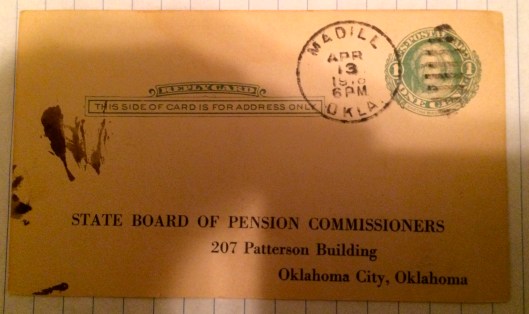
Oklahoma State Board of Pension Commissioners postcard

Oklahoma State Board of Pension Commissioners postcard

Here is the other side.

Benjamin L. Perry pension

Oklahoma State Board of Pension Commissioners postcard (reverse)

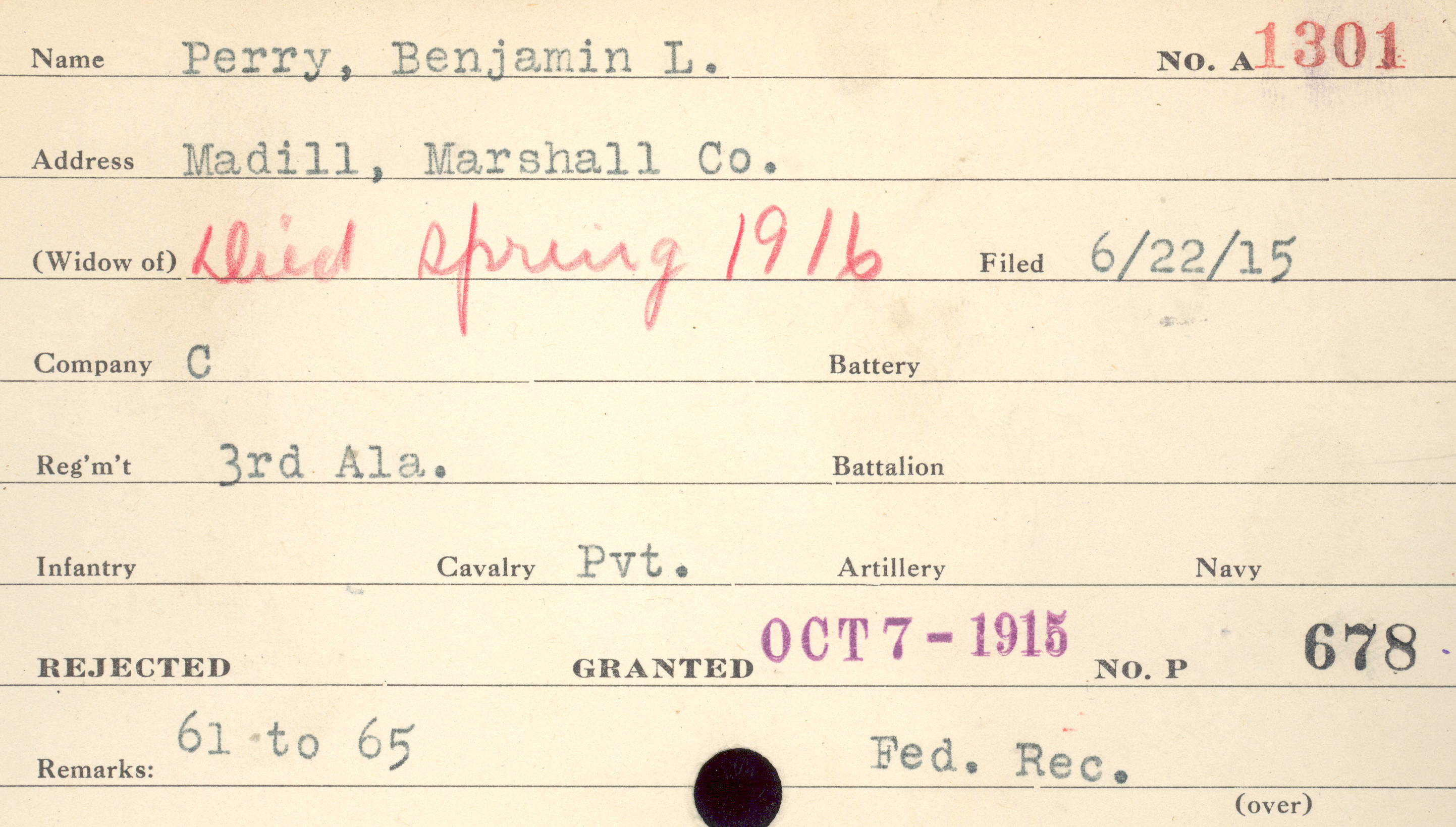
Despite my best efforts, I was unable to find any information about Perry in Ancestry or Fold3. An internet search did reveal this document, however.

Card of Benjamin L. Perry Benjamin, Commissioner of Confederate Pensions, Oklahoma, via Oklahoma Digital Praire

Card of Benjamin L. Perry Benjamin, Commissioner of Confederate Pensions, Oklahoma, via Oklahoma Digital Praire

Oklahoma began issuing Civil War pensions in 1915, fifty after Appomattox. A soldier did not have to have served in an Oklahoma unit to receive a pension. This makes sense, as so many people moved to the territory after the war. As you can see, Perry fought in the 3rd Alabama Cavalry. Perry settled in Madill, which is in southern Oklahoma near the Texas panhandle. The Texas/Oklahoma border was a focal point especially for Alabamians and Tennesseans fleeing the poverty and devastation caused by the war. Sam Rayburn’s family, for instance, was part of this migration. The future House Speaker’s family left Tennessee in the 1880s and settled in Bonhan, Texas. Perry was just a lowly private, not the Speaker of the House of Representatives. I was hoping to find a photograph of his grave, but found none.

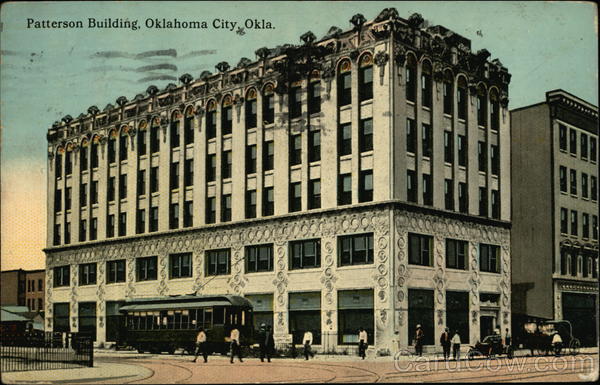
A few things about the postcard itself. First, it has no zip code. We think such things “always” existed but of course this is not the case. Mr. ZIP is only in his fifties. Second, I was intrigued that the building was listed on the address, and so I went looking for a picture of it. Here is the Patterson Building.
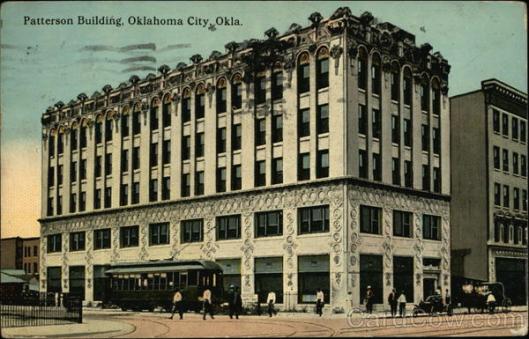
Patterson Building Oklahoma City, OK

Patterson Building Oklahoma City, OK

The Patterson was designed by Solomon Andrew Layton. The building no longer stands, but its renowned architect has no less than twenty-two buildings currently listed on the National Register of Historic Places. It makes sense that such a talented and prolific individual would be working in remote Oklahoma in the early twentieth century. For starters, the region was flush with oil revenue. Art and architecture follow the money. Moreover, the territory achieved statehood in 1907. It stands to reason that officials and citizens would want first-class civic spaces for the new state. That is why the Board of Pension Commissioners landed in this grand structure.

Benjamin Perry applied for and received his pension in 1915, but he did not have much time after that. The postal correspondence signed by him above is from April 1916. He must have died six to eight weeks after that, because as you can see died in “Spring 1916.” I must say I felt a tinge of sadness about the whole thing.

And that is how I spent my Saturday.

(Patterson Building image/Card Cow)

Mount Rushmore isn’t going anywhere. Stay home.

800px-Mount_Rushmore

As the shutdown has dragged on I have refrained from writing too much about how the stalemate has affected the National Parks. Thankfully, others have been covering the story. Kevin Levin has done an especially good job on his important Civil War Memory blog. Suffice it to say that I am distressed over how some people have been gaming the NPS these past ten days or so. It is even worse when those doing the gaming, and blaming, are the very ones responsible for the closings. I can understand why a general citizen might be confused about why he/she cannot walk the grounds of a national park or monument; a public official should know better. Now, a growing number of people are taking it upon themselves to play hide and seek with park personnel. For anyone contemplating this, I would encourage them to refrain from doing so. First of all, there is no capriciousness involved; the closings are required by federal law. Next, you yourself might mean no harm when crashing the gates of Gettysburg, the Grand Canyon, or wherever. Others who visit are less conscientious. Vandalism and relic hunting are a serious problems at NPS sites even when parks are fully staffed. Your presence, however seemingly innocent, only subtracts from the already stretched skeleton crews keeping an eye on things during the shutdown. You are only making their job more difficult. Mount Rushmore is not going anywhere. For the time being, stay home.

In related news, over the past few days some states have begun negotiating with the Department of the Interior to open sites under the proviso that the states will fund the operating costs and be reimbursed later. Some parks in Utah are opening this weekend. New York is contemplating the same thing for the Statue of Liberty. As at Gettysburg and elsewhere, the New York City tourist economy has taken a big hit in the shutdown. This is news we can use. I do hope they can work it out.

(image/National Park Service)

Sunday morning coffee

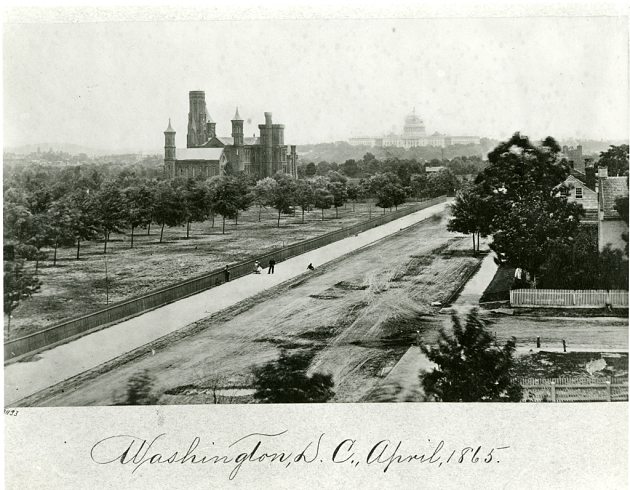
The Castle during the Civil War: This photograph is mislabeled April 1865 but probably dates to 1863, before the fire

The Castle during the Civil War: This photograph is mislabeled April 1865 but probably dates to 1863, before the fire

I am sitting here listening to The Statesmen Quartet, the Memphis vocal group that exerted tremendous on the young and impressionable Elvis. It is great Sunday morning music.

Earlier in the week I received in the mail a publisher’s advanced copy of Smithsonian Civil War: Inside the National Collection and have been enjoying it very much. What I like the most about the Smithsonian Institution is its interdisciplinary approach to its collections and museums. It covers out national heritage from different perspectives—scientific, historic, artistic, cultural, and so on. Since the start of the Sesquicentennial I have visited numerous Civil War-related exhibits at different Smithsonian museums; each one had a different shift of emphasis and added to my understanding of the war. This book takes that approach, drawing on the resources of thirteen different Smithsonian archives and museums. Another thing I like is that the editors have kept Smithsonian itself as the central aspect of the book. Thus, we read how collecting the Civil War started as almost an afterthought and grew organically from there. Books like the recently published Lincoln’s Citadel describe the chaos, violence, and dirtiness of Washington City during the war. Like Lincoln, Smithsonian director Joseph Henry lost his son to typhoid during the war. What we now know as The Castle was partly lost to fire in January 1865. My favorite Smithsonian museum is the National Portrait Gallery, which is housed in the old Patent Office. I recognized many of the artifacts in the book from the NPG, as well as other places. Walking the halls, you half expects to encounter Walt Whitman or Clara Barton coming your way.

There is nothing like seeing the real deal, which is why we visit. In the photographs and concise essays of this new release, the Smithsonian has done a good capturing that excitement.

(image/Smithsonian Institution)

Waiting out the shutdown

Franklin Delano Roosevelt  funeral, Hyde Park , New York; April 1945

Franklin Delano Roosevelt funeral, Hyde Park , New York; April 1945

Had it not been for the Shutdown friends and I would be on Metro North right now on our way to Hyde Park. Weatherwise, it was a perfect day to visit but alas we will have to wait. I was shocked and horrified to see footage of congressmen/women blaming NPS personnel to their face for the closings on the National Mall this week. Blaming federal employees who are stuck in the middle and are trying to make the best of a difficult situation is the height of arrogance. I was glad to see these workers responding with grace and dignity.

(image/National Archives)

Calendar says fall, thermometer says summer

Dusk, Green-Wood Cemetery

Dusk, Green-Wood Cemetery

It was an unseasonably warm day here in the Big Apple, I just got back from a meeting of the Archivists Round of Metropolitan New York at Green-Wood Cemetery. It was a chance to see and hear about some of the behind the scenes activities of the 175 year old garden cemetery. A special treat was to behold the original hand-written list of men from the 14th Brooklyn wounded at Gettysburg. Many of the men from the 14th are now interred there, some having died of their wounds and others having returned from the war to live out the rest of their natural days before meeting again in Valhalla. As I said a few weeks back, I am trying to think holistically in my personal and professional endeavors. Yesterday I started Brenda Dougall Merriman’s Genealogical Standards of Evidence: A Guide for Family Historians, a primer on the basics of proper genealogy. It is part of my longterm plan to become BCG certified.

This morning I emailed a friend who agreed to critique my book proposal to see if he would read it and comment by the weekend after next if I got it to him one week from today. It is part of my plan to keep my feet to the fire. It is so easy not to do it. In a piece of serendipity, a colleague in the library where I work asked in the afternoon if I want to be part of a writing club she is founding. The idea is that once a week the group will get together to check our progress, read each other’s work, and that type of thing. I think this is going to work well.