• About

The Strawfoot

~ a New Yorker's American History blog

The Strawfoot

Category Archives: Those we remember

George H.W. Bush, 1924-2018

05 Wednesday Dec 2018

Posted by Keith Muchowski in Federal Hall National Memorial, George Washington, Those we remember

≈ Comments Off on George H.W. Bush, 1924-2018

President George H.W. Bush (standing illegibly on center platform) at Federal Hall, April 30, 1989. The white specks are not snow but confetti to celebrate the bicentennial of George Washington’s First Inaugural.

Let me be the first to acknowledge that the image here is not the clearest. I wanted to share it however not for its clarity but for its historical significance: in the middle of the image, admittedly impossible to make out, is President George H.W. Bush. This New York Times photo was taken at Federal Hall on Wall Street on April 30, 1989. The occasion was the bicentennial of George Washington’s First Inaugural, which had taken place on the same spot two hundred years earlier. I wanted to share t because today is the day of mourning for the 41st president.

Coupled with the death of John McCain earlier in the year it seems that 2018 really is the end of something, the end of what I am exactly not certain, but the end of something nonetheless. Watching Bob Dole struggle to attention to pay his respects in the Capitol rotunda was profoundly moving. I don’t idealize the past or political figures–I spend half my time telling students not to look away or respond cynically to the sausage making that is baked in to the process. I agreed and disagreed with various aspects of each of these three men’s choices. That said, at their best they represented something better and larger than themselves. Notions of service, grace, kindness, civility, and respect for others. Wherever we are on the spectrum, it is something to think about on this national day of mourning.

Geoff Emerick, 1945-2018

07 Sunday Oct 2018

Posted by Keith Muchowski in Beatles, Those we remember

≈ Comments Off on Geoff Emerick, 1945-2018

I learned yesterday of the passing this past Tuesday of Geoff Emerick, who engineered the Beatles’s catalog from Revolver onward. If the name does not ring any bells that is not entirely accidental: producer George Martin was fiercely territorial of his relationship with the Beatles in the recording studio and did not want others getting credit for what he saw as his domain. Emerick complained justifiably in his memoir Here, There, and Everywhere of him and others being minimized cavalierly as merely “the staff” despite their important contributions. Martin’s accomplishments were of course significant but one can state with strong accuracy that had Emerick not been there in the Abbey Road studios that Revolver and Sgt. Pepper in particular would not have been the albums that we have now been listening to for half a century.

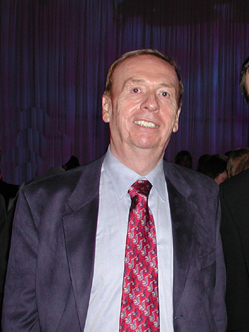
Geoff Emerick in 2003

Emerick worked in a supportive role on Beatle recordings from virtually the outset in 1962 and became their chief engineer in April 1966 when Norman Smith left to produce Pink Floyd. The first song Emerick engineered was “Tomorrow Never Knows.” He was all of twenty years old. The Beatles went on the road that summer for what would be their final tour. When they regrouped in London later that year they began the Pepper sessions, beginning with the double-A side single of “Strawberry Fields Forever” and “Penny Lane.” The pressure was truly on Geoff Emerick at this time because the Beatles had made clear to him that they would no longer be touring and that the studio releases were the band’s authoritative communications. It was his job to take their ideas and and find a way to get them on tape. That was no small task in the days before digitization.

It was a seminal year in British history; 1966 came fifty years after the battles of the Verdun and the Somme, nearly twenty years after V-E Day, and a decade after Suez. England defeated West Germany in the Word Cup that summer. Austerity Britain was giving way to Swinging London. Drab greys were giving way to the technicolor uniforms the Beatles would wear in 1967, the style inspired by the nostalgia for neo-militaria that was common in Britain in those years immediately after the Empire’s collapse. So much of that seems dated and overdone today, a relic of a time gone by. I suppose none of that really matters anyway. All that is left of true importance is the magic of what happened in those studios, in which Geoff Emerick played such an important part.

(image/Clusternote via Wikimedia Commons)

Ulysses S. Grant III, 1881-1968

29 Wednesday Aug 2018

Posted by Keith Muchowski in Civil War centennial, Governors Island, Those we remember, Ulysses S. Grant (General and President), Ulysses S. Grant III, Winfield Scott Hancock

≈ Comments Off on Ulysses S. Grant III, 1881-1968

Ulysses S. Grant III died fifty years ssgo today. To put his long life in some perspective: Grant was present at Mount McGregor when his grandfather died in July 1885; graduated with Douglas MacArthur in the West Point Class of 1903; worked as a White House aid in the Theodore Roosevelt Administration; married Secretary of State Elihu Root’s daughter in 1907; served in the Pacific and Caribbean during the Philippine and Cuban Insurrections, at Veracruz and on the Mexican Border during the Punitive Expedition, in France during the Great War, and in Paris after the Armistice where he helped write the Treaty of Versailles. All before his fortieth birthday.

The 1907 Root-Grant wedding was a major event in Washington society and covered by newspapers across the country.

A few weeks ago at the Tomb I chanced upon a well-known figure from the Civil War blogosphere who grimaced when I mentioned that this month marks the anniversary of Grant III’s death. I wasn’t surprised and cannot say I blame him; Grant is today best known as the first chairman of the doomed United States Civil War Centennial Commission. Many readers will know that the Civil War centennial did not proceed smoothly, coming as it did—not coincidentally—during the Civil Rights Movement. President Eisenhower signed the enabling paperwork creating the Centennial Commission in 1957, the same year that Little Rock High School was desegregated. Grant turned seventy-six the year he assumed the chairmanship of the organization he led for the next four tumultuous years. His reputation, for all he had done over his long career, has never recovered.

Writing in his 2012 book American Oracle David Blight offers a scathing indictment of Grant as “a staunchly conservative superpatriot and racist.” When one looks at U.S. Grant III’s life from a certain perspective it is difficult to argue with Blight’s assessment and I won’t defend Grant or his record in their entirety here. That said, a more charitable interpretation might be that Grant, born in 1881, reflected the views and attitudes of most white Americans born in his era. He toiled for decades in a U.S. Army officered with the sons and grandsons of many of the men who had once fought against his grandfather. Who among us can say with certainty what we would have done had we lived in another place and time?

After the Great War and Versailles Peace Conference Grant held numerous military posts in the 1920s, oversaw part of the Civil Conservation Corps in the early years of the Franklin Roosevelt Administration, and quietly prepared for war with other officers of the Second Corps Area on Governors Island in the late 1930s while Germany and Japan rattled their sabers. Too old for combat service when Pearl Harbor finally came, he coordinated civil defense for the continental United States during the Second World War. Grant’s aptitude as a civil engineer and apparent interest in urban planning led him over this long career to many other positions, including a stint after World War II as a member of the National Capital Park and Planning Commission in Washington D.C. and president of the American Planning and Civic Association.

All of these accomplishments were in the end tarnished by that 1957-61 stint as Centennial Commission chairman. Had Grant and his allies had their way, the Civil War centennial would have been filled with Civil War rrenactments emphasizing the courage  and fighting spirit of Union and Confederate men and officers while studiously avoiding the war’s causes, consequences and unfinished business. The controversies are too detailed to go into here. Things began escalating however until in 1961 New Jersey officials publicly called on Grant to resign. There was pressure from other quarters as well. Grant held on for several months until eventually submitting his resignation to President Kennedy in September 1961. The pretense was his wife Edith Root Grant’s health and indeed Mrs. Root had been ailing for some time, confined now to the family summer house in Clinton, New York for many months as her health deteriorated. General Grant was sincere in his concern for his wife, but the public pressure regarding the Centennial Commission was intense and growing. Mrs. Grant died in 1962 and her widower husband carried on for six more years.
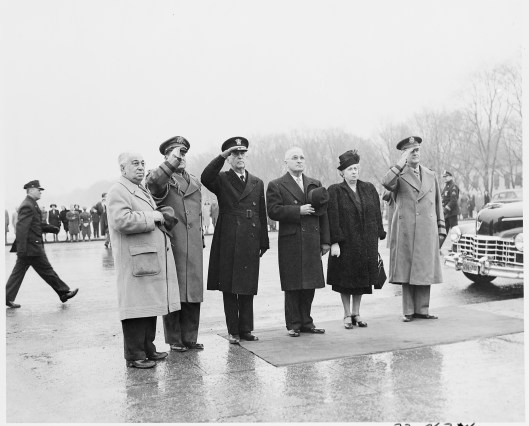
President and Bess Truman with Ulysses S. Grant III (far right), Admiral William Leahy (third from left) and others at the Lincoln Memorial, February 12, 1948.

His grandfather, General and President Ulysses S. Grant, in a very real sense had died at the right time in 1885; with the war over for two decades, Americans, especially white Americans, were eager to move on. Reconstruction had ended eight years previously and General Grant’s funeral was the reconciliationist event that organizer Winfield Scott Hancock, the 60,000 marchers, hundreds of thousands of attendees, and millions of other Americans had wanted it to be. President Grant, try though he did, was unable to heal the nation’s wounds during his administration; the intransigence he faced was just too great. Ironically it was the failures of Grant and the country that contributed to his grandson’s resignation nearly a century later.

Ulysses S. Grant too died during a decisive moment in American history. His passing came on the third day of the 1968 Democratic National Convention, when the party met in the tense August heat of Chicago. With the Vietnam War going poorly and after the many assassinations and riots that had already taken place that year, civil unrest was almost inevitable. We still face the fallout from those tragic days. Much of the worst of it came on August 28, when police and protesters clashed in a violent conflict broadcast on network television and watched live by tens of millions people. Ulysses S. Grant III died at the family home in Clinton, New York the following day.

(images/top, Library of Congress; bottom, National Archives)

Remembering Franklin Pettit Updike

15 Wednesday Aug 2018

Posted by Keith Muchowski in Memory, Those we remember, WW1

≈ Comments Off on Remembering Franklin Pettit Updike

I wrote this four years ago and am re-posting it today, the 100th anniversary of the death of Private Franklin P. Updike in the Great War.IMG_1108I was in Green-Wood Cemetery on Sunday when I came across the headstone of Franklin P. Updike. These WW1 headstones are much rarer than the ubiquitous Civil War markers one sees so often in old garden cemeteries. For one thing, there were fewer American deaths in the First World War than there were during the Rebellion. what’s more, a significant portion of doughboys were interred overseas where they were killed.

Updike, I later learned, lived in Brooklyn Heights and enlisted in the Army a month after the U.S. entered the Great War.

Updike death copy

Updike is somewhat unusual in that he died during the war and was brought home. Note that the headstone was ordered in April 1942, just as the U.S. was entering the Second World War.

Updike grave marker copy

The young private was a wagoner, that is he tended horses and carts. This was a dangerous task; the enemy understood the importance of the enemy’s transport and so did everything to neutralize–kill–it. In his Memoirs George Marshall wrote of the wagoners in his division that at certain periods “the most dangerous duty probably fell to the Quartermaster Sergeants and teamsters who went forward each night.”

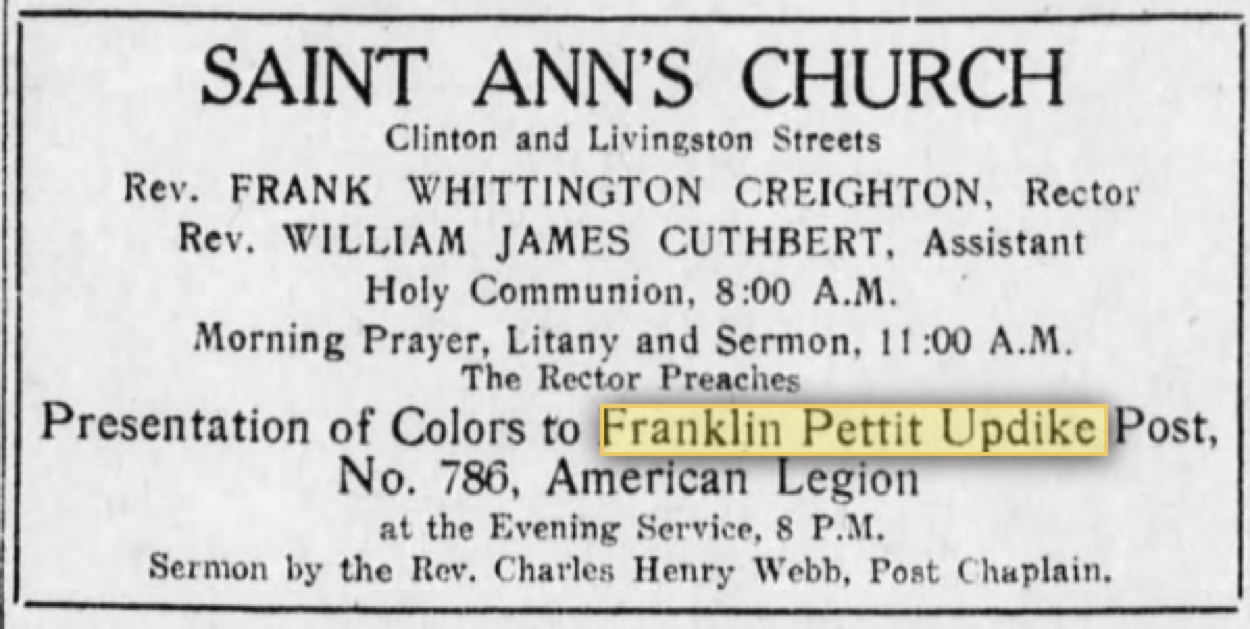
The people of St. Ann’s Church held a service for Updike at Thanksgiving 1918. The war had been over for two weeks by this time. This announcement and the one below are from the Brooklyn Daily Eagle.

Updike St Ann's announcement copy

This afternoon on my lunch break I went to the Heights and took this photo of St. Ann’s as it is today.

IMG_1110

The people of Brooklyn did not forget Updike. Alas I don’t believe it still exists today but they named the local American Legion Post after him. This was in January 1924, ninety year ago this year.

Updike color presentation copy

Ulysses S. Grant, 1822-1885

23 Monday Jul 2018

Posted by Keith Muchowski in General Grant National Memorial (NPS), Those we remember, Ulysses S. Grant (General and President)

≈ Comments Off on Ulysses S. Grant, 1822-1885

excerpt from July 23, 1885 Brooklyn Daily Eagle on Grant’s death

What a special day it was yesterday at General Grant National Memorial (Grant’s Tomb) as we remembered the life and memory of the general and eighteenth president. It was an honor to read the Whitman poem and participate in the wreath laying and placement of the white roses. Frank Scaturro gave a very informative talk in the visitor center afterward. This event gets bigger every year and I am sure will continue to grow as the 2022 bicentennial of Grant’s birth gets closer and closer in the coming years.

Ulysses S. Grant Jr., 1852-1929

22 Sunday Jul 2018

Posted by Keith Muchowski in Governors Island, Theodore Roosevelt Jr (President), Those we remember, Ulysses S. Grant Jr. (Buck)

≈ Comments Off on Ulysses S. Grant Jr., 1852-1929

Julia Dent Grant with Frederick and Ulysses Jr. in St. Louis, 1854. Lieutenant Grant was in the Pacific Northwest at the time and had not yet met his second son. This daguerreotype was discovered in 2016 and sold at auction in Cincinnati for $18,000.

Ulysses S. Grant Jr., Buck to the family, was born on this day in 1852. By this time his father was on his way to California with the 4th Infantry Regiment and a party of about seven hundred wives and children. The 4th was stationed briefly at Fort Columbus on Governors Island before their trip. Quartermaster Grant went briefly to the District of Columbia to see about supplies. While he was in Washington, Henry Clay—the Great Compromiser—died there, bringing things to a standstill. An empty-handed Grant returned to New York City and the regiment sailed for Panama on July 5.

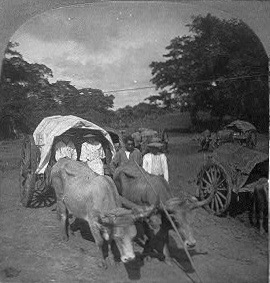
This photograph of travelers crossing the Isthmus of Panama was taken in the early 1900s. The 4th Infantry crossed in much the same way over half a century earlier. One out of seven who made that trip died of cholera. This danger is why Ulysses and Julia decided the family would instead go to Bethel and then St. Louis.

Remember, the canal did not come into being until Theodore Roosevelt picked up where the French had failed. The Panama Canal opened in August 1914 at almost the same moment the Great War was starting. Instead travelers crossed the Isthmus by mule and wagon. To say that it was a hazardous journey would be an understatement. That is why Ulysses and Julia decided she and young Frederick, just two, would not make the voyage. Instead, they would go to Bethel, Ohio and then Missouri. It is a good thing they didn’t; one hundred people in the 4th Infantry’s party died of cholera. The pregnant Julia and the toddler Frederick might well have become two more victims. Instead Julia gave birth to young Ulysses in Bethel. Lieutenant Grant did not learn this until the mail finally reached the 4th Infantry at Fort Vancouver (Columbia Barracks) just before the new year.

(images/top, unknown photographer, taken in St. Louis (Cowan’s Auctions) [Public domain], via Wikimedia Commons; bottom, Library of Congress)

Quentin Roosevelt, 1897-1918

14 Saturday Jul 2018

Posted by Keith Muchowski in Quentin Roosevelt, Theodore (Ted) Roosevelt, Theodore Roosevelt Jr (President), Those we remember

≈ 2 Comments

Quentin Roosevelt died in battle in France one hundred years ago today. It is all the more poignant that he was killed on Bastille Day. Of all the pieces I have done, this may be the most rewarding.

(image/Wernervc)

Percy Grainger, 1882-1961

12 Thursday Jul 2018

Posted by Keith Muchowski in Governors Island, Guest Posts, Jazz, New York City, Those we remember

≈ Comments Off on Percy Grainger, 1882-1961

My good friend Molly Skardon, a fellow volunteer with the National Park Service here in New York City, wrote this guest piece about Percy Grainger, who was born this week in 1882. The musician and composer was already in his 30s when the war broke out in 1914. The next five years however would prove crucial in his personal and artistic development. Molly is uniquely suited to writing about Grainger. She has run the Oral History Project at Governors Island for many years and has interviewed many Army band musicians who were stationed on the island. She also works at Juilliard. New York City was the focal point for the American war effort, and even then becoming a nexus for the nascent jazz scene.

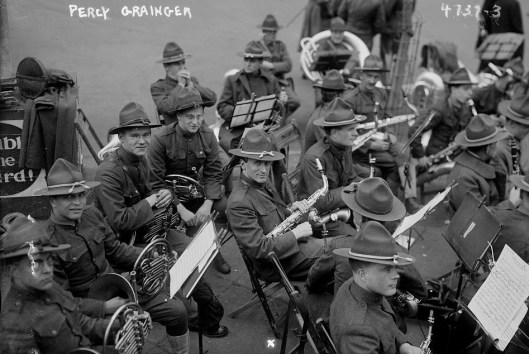
Happy Birthday to Australian musician Percy Grainger, born July 8, 1882. Grainger was pursuing an international career as a pianist and composer when the Great War began in Europe. Publicly criticized for not joining the British war effort, he sailed for America in 1915 and enlisted in the U.S. Army in June 1917, at age 34.

His first Army assignment was with the 15th Coast Artillery Band, stationed at Fort Hamilton, which is the ensemble pictured above. Grainger is the saxophonist in the center, above the small white X. Since it appears to have been chilly when the picture was taken, the time might be late 1917 or early 1918.

In June of 1918, Grainger came to Governors Island as an instructor in the program founded by the Institute of Musical Art (later part of what is now The Juilliard School) to train Army bandmasters and band musicians. Classroom instruction took place at the Institute, at Broadway and 122nd Street in Manhattan, and performing and conducting were taught on the Island.

Grainger was not particularly skilled on either the saxophone or the oboe, which he also played, but he was fascinated by wind, brass, and percussion instruments and wrote a great deal of music for them in various combinations, thus earning the gratitude of concert and military band players of succeeding generations. However, his most popularly known work is probably “Country Gardens,” an old English tune that he arranged for piano while at Fort Jay, as noted at the end of the published sheet music (“Written out, Fort Jay, Governor’s Island, N.Y., June 29, 1918”).

Grainger was discharged from the Army in 1919, and lived for the rest of his life in White Plains, New York just north of the city.

(image/Library of Congress Bain Collection)

John Purroy Mitchel, 1879-1918

06 Friday Jul 2018

Posted by Keith Muchowski in John Purroy Mitchel, Leonard Wood (General), Lusitania, Memory, New York City, Preparedness (WW1), Theodore Roosevelt Jr (President), Those we remember, Woodrow Wilson

≈ Comments Off on John Purroy Mitchel, 1879-1918

Major John Purroy Mitchel in pilot gear, 1918

The have my article up and running over at Roads to the Great War about the life, times, and death of John Purroy Mitchel. New York City’s Boy Mayor was all of thirty-four when he became mayor in 1914. Initially he was an ally of Woodrow Wilson, who in 1913 had appointed him Collector of the Port of New York. Men like Chester Arthur had previously held the collectorship. Mitchel and Wilson soon had a falling out over what the mayor saw as the president’s poor leadership during the war. Soon, Mitchel was very publicly allying with friends like Theodore Roosevelt and Leonard Wood advocating for Preparedness. When he lost his re-election bid, Mitchel became a military aviator. He died in a flight exercise in Louisiana on July 6, 1918, one hundred years ago today.

(image/courtesy of Margaret Maloney via Wikimedia Commons)


Pausing to remember Lincoln in 1918

15 Sunday Apr 2018

Posted by Keith Muchowski in Memory, Monuments and Statuary, New York City, Those we remember

≈ Comments Off on Pausing to remember Lincoln in 1918

Brooklyn Daily Eagle, April 14, 1918

New Yorkers stopped what they were doing in mid-April 1918 to remember the assassination of Abraham Lincoln. It is important to remember that Lincoln’s death was still within living memory for many Americans; it had only occurred fifty-three years previously. With so many young men now in training camps and soon to be on their way to France, the Lincoln commemoration was muted. As the headline here shows, the Brooklyn Riding and Driving Club remembered both Washington and Lincoln at its 27th annual dinner on Saturday 13 April. Present for that event at the Montauk Club were officers from the British and French Armies. During a toast to men for the BRDC who had joined the AEF, one poilu reflected “The German [1918 spring] offensive is to be taken seriously but the real days of anxiety were the days of 1914. Now we know that you are rushing troops to our aid. Then it was a question of ‘to be; or not to be.”

Lincoln was being remembered throughout the city that weekend. In its April 14 edition the New York Times published recently discovered letters by Lincoln and Robert E. Lee. Maybe I am reading too much into it, but it could be that in presenting letters from both Lincoln and Lee the Times sought to balance regional sympathies. That day the Calvary M.E. Church in Harlem hosted Laura D. Prisk, who for the past several years was pushing to officially designate June 14 as Flag Day. (That came to pass in 1949.) There were many veterans from the Grand Army of the Republic on hand to see Mrs. Prisk and others talk about the ongoing war in Europe. Prisk proclaimed that “Much attention is being payed to the long-range gun of the Hun but the real long-range gun is that of America, reaching 3,000 miles to the battle line.” Prisk was in attendance again the next day when she laid a wreath and spoke at the Lincoln statue in Union Square. On hand were sailors from the USS Recruit, the depot established in Union Square the previous May to sell liberty bonds and spur enlistment.


← Older posts
Newer posts →

Enter your email address to subscribe to this blog and receive notifications of new posts by email.

Join 258 other subscribers

Categories

Archives

  • November 2023 (1)
  • October 2023 (3)
  • September 2023 (3)
  • August 2023 (4)
  • July 2023 (7)
  • June 2023 (10)
  • May 2023 (8)
  • April 2023 (6)
  • March 2023 (5)
  • February 2023 (4)
  • January 2023 (4)
  • December 2022 (4)
  • November 2022 (8)
  • October 2022 (2)
  • September 2022 (4)
  • June 2022 (1)
  • May 2022 (1)
  • April 2022 (13)
  • January 2022 (1)
  • December 2021 (2)
  • November 2021 (1)
  • October 2021 (3)
  • September 2021 (3)
  • August 2021 (5)
  • July 2021 (1)
  • June 2021 (1)
  • May 2021 (4)
  • April 2021 (3)
  • March 2021 (4)
  • February 2021 (7)
  • January 2021 (4)
  • December 2020 (4)
  • November 2020 (3)
  • October 2020 (4)
  • September 2020 (7)
  • August 2020 (5)
  • July 2020 (7)
  • June 2020 (11)
  • May 2020 (7)
  • April 2020 (9)
  • March 2020 (9)
  • February 2020 (7)
  • January 2020 (6)
  • December 2019 (7)
  • November 2019 (9)
  • October 2019 (4)
  • September 2019 (6)
  • August 2019 (10)
  • July 2019 (8)
  • June 2019 (6)
  • May 2019 (9)
  • April 2019 (8)
  • March 2019 (6)
  • February 2019 (8)
  • January 2019 (5)
  • December 2018 (10)
  • November 2018 (6)
  • October 2018 (9)
  • September 2018 (11)
  • August 2018 (11)
  • July 2018 (17)
  • June 2018 (10)
  • May 2018 (8)
  • April 2018 (9)
  • March 2018 (8)
  • February 2018 (5)
  • January 2018 (7)
  • December 2017 (11)
  • November 2017 (8)
  • October 2017 (9)
  • September 2017 (11)
  • August 2017 (12)
  • July 2017 (14)
  • June 2017 (18)
  • May 2017 (11)
  • April 2017 (10)
  • March 2017 (9)
  • February 2017 (11)
  • January 2017 (14)
  • December 2016 (7)
  • November 2016 (8)
  • October 2016 (8)
  • September 2016 (9)
  • August 2016 (6)
  • July 2016 (12)
  • June 2016 (8)
  • May 2016 (9)
  • April 2016 (6)
  • March 2016 (12)
  • February 2016 (10)
  • January 2016 (9)
  • December 2015 (9)
  • November 2015 (11)
  • October 2015 (8)
  • September 2015 (9)
  • August 2015 (13)
  • July 2015 (14)
  • June 2015 (11)
  • May 2015 (11)
  • April 2015 (18)
  • March 2015 (10)
  • February 2015 (8)
  • January 2015 (8)
  • December 2014 (12)
  • November 2014 (13)
  • October 2014 (16)
  • September 2014 (11)
  • August 2014 (16)
  • July 2014 (12)
  • June 2014 (13)
  • May 2014 (10)
  • April 2014 (10)
  • March 2014 (11)
  • February 2014 (12)
  • January 2014 (10)
  • December 2013 (11)
  • November 2013 (14)
  • October 2013 (14)
  • September 2013 (14)
  • August 2013 (13)
  • July 2013 (17)
  • June 2013 (9)
  • May 2013 (13)
  • April 2013 (13)
  • March 2013 (16)
  • February 2013 (15)
  • January 2013 (15)
  • December 2012 (18)
  • November 2012 (18)
  • October 2012 (21)
  • September 2012 (14)
  • August 2012 (16)
  • July 2012 (21)
  • June 2012 (22)
  • May 2012 (24)
  • April 2012 (20)
  • March 2012 (23)
  • February 2012 (22)
  • January 2012 (15)
  • December 2011 (23)
  • November 2011 (22)
  • October 2011 (23)
  • September 2011 (18)
  • August 2011 (19)
  • July 2011 (20)
  • June 2011 (29)
  • May 2011 (25)
  • April 2011 (18)
  • March 2011 (21)
  • February 2011 (11)

Meta

  • Create account
  • Log in
  • Entries feed
  • Comments feed
  • WordPress.com
Creative Commons License
This work is licensed under a Creative Commons Attribution-NonCommercial-ShareAlike 4.0 International License.

Enter your email address to subscribe to this blog and receive notifications of new posts by email.

Join 258 other subscribers

Categories

Archives

  • November 2023 (1)
  • October 2023 (3)
  • September 2023 (3)
  • August 2023 (4)
  • July 2023 (7)
  • June 2023 (10)
  • May 2023 (8)
  • April 2023 (6)
  • March 2023 (5)
  • February 2023 (4)
  • January 2023 (4)
  • December 2022 (4)
  • November 2022 (8)
  • October 2022 (2)
  • September 2022 (4)
  • June 2022 (1)
  • May 2022 (1)
  • April 2022 (13)
  • January 2022 (1)
  • December 2021 (2)
  • November 2021 (1)
  • October 2021 (3)
  • September 2021 (3)
  • August 2021 (5)
  • July 2021 (1)
  • June 2021 (1)
  • May 2021 (4)
  • April 2021 (3)
  • March 2021 (4)
  • February 2021 (7)
  • January 2021 (4)
  • December 2020 (4)
  • November 2020 (3)
  • October 2020 (4)
  • September 2020 (7)
  • August 2020 (5)
  • July 2020 (7)
  • June 2020 (11)
  • May 2020 (7)
  • April 2020 (9)
  • March 2020 (9)
  • February 2020 (7)
  • January 2020 (6)
  • December 2019 (7)
  • November 2019 (9)
  • October 2019 (4)
  • September 2019 (6)
  • August 2019 (10)
  • July 2019 (8)
  • June 2019 (6)
  • May 2019 (9)
  • April 2019 (8)
  • March 2019 (6)
  • February 2019 (8)
  • January 2019 (5)
  • December 2018 (10)
  • November 2018 (6)
  • October 2018 (9)
  • September 2018 (11)
  • August 2018 (11)
  • July 2018 (17)
  • June 2018 (10)
  • May 2018 (8)
  • April 2018 (9)
  • March 2018 (8)
  • February 2018 (5)
  • January 2018 (7)
  • December 2017 (11)
  • November 2017 (8)
  • October 2017 (9)
  • September 2017 (11)
  • August 2017 (12)
  • July 2017 (14)
  • June 2017 (18)
  • May 2017 (11)
  • April 2017 (10)
  • March 2017 (9)
  • February 2017 (11)
  • January 2017 (14)
  • December 2016 (7)
  • November 2016 (8)
  • October 2016 (8)
  • September 2016 (9)
  • August 2016 (6)
  • July 2016 (12)
  • June 2016 (8)
  • May 2016 (9)
  • April 2016 (6)
  • March 2016 (12)
  • February 2016 (10)
  • January 2016 (9)
  • December 2015 (9)
  • November 2015 (11)
  • October 2015 (8)
  • September 2015 (9)
  • August 2015 (13)
  • July 2015 (14)
  • June 2015 (11)
  • May 2015 (11)
  • April 2015 (18)
  • March 2015 (10)
  • February 2015 (8)
  • January 2015 (8)
  • December 2014 (12)
  • November 2014 (13)
  • October 2014 (16)
  • September 2014 (11)
  • August 2014 (16)
  • July 2014 (12)
  • June 2014 (13)
  • May 2014 (10)
  • April 2014 (10)
  • March 2014 (11)
  • February 2014 (12)
  • January 2014 (10)
  • December 2013 (11)
  • November 2013 (14)
  • October 2013 (14)
  • September 2013 (14)
  • August 2013 (13)
  • July 2013 (17)
  • June 2013 (9)
  • May 2013 (13)
  • April 2013 (13)
  • March 2013 (16)
  • February 2013 (15)
  • January 2013 (15)
  • December 2012 (18)
  • November 2012 (18)
  • October 2012 (21)
  • September 2012 (14)
  • August 2012 (16)
  • July 2012 (21)
  • June 2012 (22)
  • May 2012 (24)
  • April 2012 (20)
  • March 2012 (23)
  • February 2012 (22)
  • January 2012 (15)
  • December 2011 (23)
  • November 2011 (22)
  • October 2011 (23)
  • September 2011 (18)
  • August 2011 (19)
  • July 2011 (20)
  • June 2011 (29)
  • May 2011 (25)
  • April 2011 (18)
  • March 2011 (21)
  • February 2011 (11)

Meta

  • Create account
  • Log in
  • Entries feed
  • Comments feed
  • WordPress.com
Creative Commons License
This work is licensed under a Creative Commons Attribution-NonCommercial-ShareAlike 4.0 International License.

Enter your email address to subscribe to this blog and receive notifications of new posts by email.

Join 258 other subscribers

Categories

Archives

  • November 2023 (1)
  • October 2023 (3)
  • September 2023 (3)
  • August 2023 (4)
  • July 2023 (7)
  • June 2023 (10)
  • May 2023 (8)
  • April 2023 (6)
  • March 2023 (5)
  • February 2023 (4)
  • January 2023 (4)
  • December 2022 (4)
  • November 2022 (8)
  • October 2022 (2)
  • September 2022 (4)
  • June 2022 (1)
  • May 2022 (1)
  • April 2022 (13)
  • January 2022 (1)
  • December 2021 (2)
  • November 2021 (1)
  • October 2021 (3)
  • September 2021 (3)
  • August 2021 (5)
  • July 2021 (1)
  • June 2021 (1)
  • May 2021 (4)
  • April 2021 (3)
  • March 2021 (4)
  • February 2021 (7)
  • January 2021 (4)
  • December 2020 (4)
  • November 2020 (3)
  • October 2020 (4)
  • September 2020 (7)
  • August 2020 (5)
  • July 2020 (7)
  • June 2020 (11)
  • May 2020 (7)
  • April 2020 (9)
  • March 2020 (9)
  • February 2020 (7)
  • January 2020 (6)
  • December 2019 (7)
  • November 2019 (9)
  • October 2019 (4)
  • September 2019 (6)
  • August 2019 (10)
  • July 2019 (8)
  • June 2019 (6)
  • May 2019 (9)
  • April 2019 (8)
  • March 2019 (6)
  • February 2019 (8)
  • January 2019 (5)
  • December 2018 (10)
  • November 2018 (6)
  • October 2018 (9)
  • September 2018 (11)
  • August 2018 (11)
  • July 2018 (17)
  • June 2018 (10)
  • May 2018 (8)
  • April 2018 (9)
  • March 2018 (8)
  • February 2018 (5)
  • January 2018 (7)
  • December 2017 (11)
  • November 2017 (8)
  • October 2017 (9)
  • September 2017 (11)
  • August 2017 (12)
  • July 2017 (14)
  • June 2017 (18)
  • May 2017 (11)
  • April 2017 (10)
  • March 2017 (9)
  • February 2017 (11)
  • January 2017 (14)
  • December 2016 (7)
  • November 2016 (8)
  • October 2016 (8)
  • September 2016 (9)
  • August 2016 (6)
  • July 2016 (12)
  • June 2016 (8)
  • May 2016 (9)
  • April 2016 (6)
  • March 2016 (12)
  • February 2016 (10)
  • January 2016 (9)
  • December 2015 (9)
  • November 2015 (11)
  • October 2015 (8)
  • September 2015 (9)
  • August 2015 (13)
  • July 2015 (14)
  • June 2015 (11)
  • May 2015 (11)
  • April 2015 (18)
  • March 2015 (10)
  • February 2015 (8)
  • January 2015 (8)
  • December 2014 (12)
  • November 2014 (13)
  • October 2014 (16)
  • September 2014 (11)
  • August 2014 (16)
  • July 2014 (12)
  • June 2014 (13)
  • May 2014 (10)
  • April 2014 (10)
  • March 2014 (11)
  • February 2014 (12)
  • January 2014 (10)
  • December 2013 (11)
  • November 2013 (14)
  • October 2013 (14)
  • September 2013 (14)
  • August 2013 (13)
  • July 2013 (17)
  • June 2013 (9)
  • May 2013 (13)
  • April 2013 (13)
  • March 2013 (16)
  • February 2013 (15)
  • January 2013 (15)
  • December 2012 (18)
  • November 2012 (18)
  • October 2012 (21)
  • September 2012 (14)
  • August 2012 (16)
  • July 2012 (21)
  • June 2012 (22)
  • May 2012 (24)
  • April 2012 (20)
  • March 2012 (23)
  • February 2012 (22)
  • January 2012 (15)
  • December 2011 (23)
  • November 2011 (22)
  • October 2011 (23)
  • September 2011 (18)
  • August 2011 (19)
  • July 2011 (20)
  • June 2011 (29)
  • May 2011 (25)
  • April 2011 (18)
  • March 2011 (21)
  • February 2011 (11)

Meta

  • Create account
  • Log in
  • Entries feed
  • Comments feed
  • WordPress.com
Creative Commons License
This work is licensed under a Creative Commons Attribution-NonCommercial-ShareAlike 4.0 International License.

Blog at WordPress.com.

  • Subscribe Subscribed
    • The Strawfoot
    • Join 229 other subscribers
    • Already have a WordPress.com account? Log in now.
    • The Strawfoot
    • Subscribe Subscribed
    • Sign up
    • Log in
    • Report this content
    • View site in Reader
    • Manage subscriptions
    • Collapse this bar
 

Loading Comments...