Sunday morning coffee

s-l1600Where the F Train rises above ground to cross the Gowanus Canal once stood a sign for Eagle Clothes. Eagle opened its plant here in Brooklyn in 1951 and did a fair business in Ivy Style and gentleman’s clothing until closing in the late 1980s, a victim of outsourcing as well as our nation’s unfortunate turn to casual wear. When Mayor Vincent R. Impellitteri toured the site in July 1951 he called it “one of the most complete and best equipped factories he has ever seen.” It provided over a thousand jobs, no small thing given that the the Brooklyn Navy Yard was scaling back and would eventually close in the mid-1960s. In the decades after the World Wars there was no longer a need for battleships.

Eagle plant literally outfitted The Man in the Gray Flannel suit, manufacturing the wardrobes for the production of that 1956 film right here in Brooklyn. That’s just one example of Eagle’s reach. Abraham & Straus was a major Eagle retailer. Rod Serling wore Eagle Clothes for much of his time as producer, writer, narrator on The Twilight Zone. (He also wore Kuppenheimer for a time as well.) Every time I saw that Eagle sign in the fifteen years since my move here until its tearing down three years ago I could not but help to think of Rod Serling. The photo here came to me yesterday and I thought I share on this Sunday morning.

The trees of Eastern Parkway

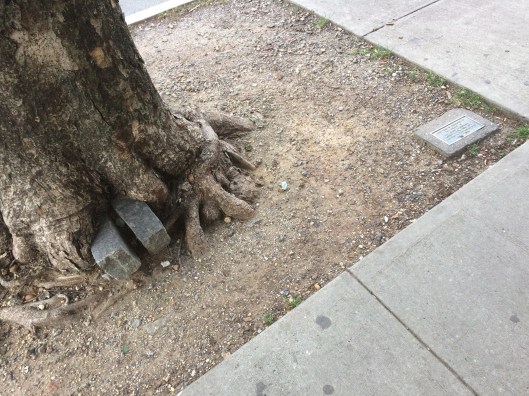
I was at the Brooklyn Museum of Art this morning and afternoon for two separate meetings. On the way, going up Eastern Parkway, I came across the small plaque you see here. I have seen these several times over the years and have even written about them here a little. There used to be many in Cadman Plaza as well, but they seem to have disappeared during the recent renovation. If anyone saved them I have no idea. Note how the tablet says “Died in the World War.” That means it was placed in the 1920s or 1930s. If it were dedicated later, the marker would say “First World War,” or words to that effect to differentiate it from the later conflict.img_3590

The tablet is nearly a century old but as you can see the tree in the small plot is obviously much younger. You can see the marker in the upper right hand corner of the little square.

img_3595

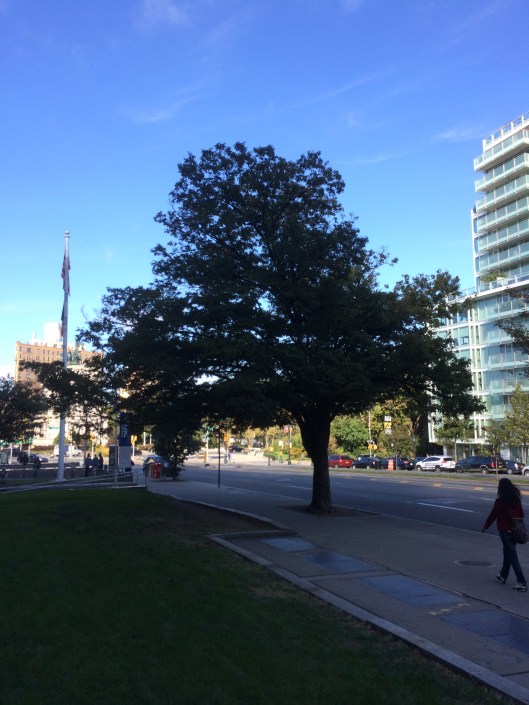
This got me curious about the other trees. Directly behind the one you see above is this larger tree with its own tablet dedicated to another doughboy. I imagine, given its size, that this big boy goes back to the time of the placing of the marker.

img_3597

img_3596

For even greater perspective, here are the two trees in one image.

img_3598

To give you some perspective if you live in Brooklyn, the trees above are on the eastern side of the Brooklyn Public Library’s central branch. Now a little up the parkway, almost in front of the botanical garden, are these two stumps. My guess is that these trees too were dedicated for Brooklyn’s Great War fallen and that they were felled somewhere later in their life. Sadly the plaques too are gone.

img_3602

img_3605

Cobblestones embedded in some of the other trees give a sense of time’s procession.

img_3616

img_3617

Vandals too take a toll. Tablets are often stolen and sold for scrap metal. This was a problem especially during New York City’s hardest years in the 1970s and 1980s. Note the stone, sans tablet, in the lower left corner.

img_3618

Sunday morning coffee

img_3577We are getting the front end of the Hurricane Matthew rainfall here in New York City. It makes for a relaxing Sunday, especially when I don’t have to leave the house at 7:30 to go to Governors Island. I was out-and-about yesterday running some errands in the city when I came across this window display in the Oxford University Press office on 35th and Madison. A quick perusal shows that OUP has created a small online site dedicated to the NPS’s 100th. Most passersby certainly walk past this with a sense of incongruity, not realizing that there are at least a dozen Park Service sites in and around Greater New York City.

I always found it curious that Woodrow Wilson created the Park Service in August 1916, what with the presidential election in full swing and Europe mired in the death and destruction of the Great War. Just how important he believe the Park system to be is something I suppose we will never truly know. It is a flawed institution in many ways, for reasons mainly outside of its own control, but our national parks are still, as the saying goes, one of our best ideas.

Private Herman Ruth

General Pershing and Private Ruth exchange salutes, 28 May 1924

General Pershing and Private Ruth exchange salutes, 28 May 1924

The above photo came through my in-box today and I thought that with the baseball post-season beginning this week it would be apropos to share. This is Babe Ruth saluting General John Pershing outside the State, War and Navy Building in Washington D.C. Ruth had recently joined 104th Field Artillery of the New York National Guard at Pershing’s request as a way to generate interest in the Citizens’ Military Training Camps. The Army needed all the help it could get half a decade after the Treaty of Versailles; the military drawback of the early 1920s meant that the United States again had a small fighting force.

A little digging shows that Ruth had sought a khaki uniform in New York but could not find one for his large frame. It is interesting to note that by today’s he is not that large. This is 1924 and he actually looks relatively slim, certainly slimmer than we came to know him as he grew older and stouter due to his excesses. It says something that a man of this physical stature would be considered stout for his time, and that a uniform could not be found in his size in all of New York. Ruth reported to the Quartermaster General’s office in Washington to be fitted early on May 28 and reported to Pershing for this photo op after that. Photo op is the right phrase: a basic search reveals several outtakes of the two men saluting, smiling, and/or shaking hands.

The Yankees were in Washington to play the Senators in on odd two-game road trip that lasted all one day. The Yankees and Senators split a double-header at Griffith Stadium. The Bambino went 3 for 8 in the two games. Ruth visited numerous Citizens’ Military Training Camps in the years after this photo was taken. By the endow the decade Ruth had apparently had enough; in April 1930 he informed Major General Hanson E. Ely, commander of the Second Corps Area at Fort Jay on Governors Island, that he was stepping down. Though again a “civilian” Ruth continued making a contribution, signing bats and balls to be given as trophies at CMTC athletic events until at least the mid-1930s.

Ted Roosevelt’s literary life

img_3566I got home at around 8:30 last night after a long day’s work and there waiting in the vestibule was a package from the editor of the Theodore Roosevelt Association Journal. Inside were a dozen copies, hot off the press, of the current edition, containing my article about Ted Roosevelt and his life as a writer and editor. Ted Roosevelt’s literary story begins in 1919 when he arrived home from the Great War aboard the Mauritania and ends just prior to his rejoining the Army to fight again, this time in the Second World War. Really, however, the story is much deeper than that; so many of the clan had a literary bent and he very much fits into that aspect of the family heritage. It was long my goal to get published in the TRA Journal and I cannot express how happy I am with the experience.

Sunday evening coffee

The morning air had a crispness to it when I left the house early this morning. Fall is arriving. It was the final day of the Governors Island season. Yours truly had a quiet one. I wrote up the summary of an oral history we did two weeks and then with another volunteer interviewed a husband and wife who lived on the island in the mid 1950s. It is always a humbling experience to speak with individuals who played their roles, whatever those roles may have been, during some of our nation’s most dramatic 20th century events. In recent years we have spoken to Korean and Vietnam War veterans, Cold War intelligence gatherers, Coast Guard photographers who filmed ticker tap parades for the moon landings, and scores of others whose stories are as varied as the people who tell them. My one wish is that I could have spoken to a veteran or two from the Great War. I came along too late for that however. That is why I always appreciate what is there for me to take.

I miseed the end of season party yesterday but got a little goodie bag this morning with a little swag.

I miseed the end of season party yesterday but got a goodie bag this morning with a little swag.

The phone, the recorder and the questionnaires are in place for the last interview of the season.

The phone, the recorder and the questionnaires are in place for the last interview of the season.

The ferry pulls out.

The ferry pulls out. Note the blueness of the sky.

Doughboy Day 2016: a snapshot

Yesterday’s Doughboy Day at Governors Island National Monument drew over 12,000 visitors, a significant increase over a usual Saturday. Here with some capsule comments are a few images from the day.

The forty-eight star flag went up over Fort Jay to begin the day.

The forty-eight star flag went up over Fort Jay to begin the day.

Ryan Hegg of the World War One Centennial Committee for New York City spoke of significance of the war.

Ryan Hegg of the World War One Centennial Committee for New York City spoke of the significance of the Great War.

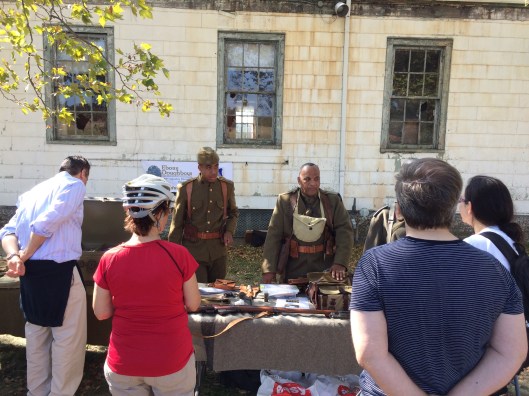
The Ebony Doughboys drew large audiences at venues throughout the island.

The Ebony Doughboys drew large audiences at venues throughout the island.

George King III and colleague Jeff Klinger spoke to many about the Ambulance 255 and the role of the AFS in the war effort.

George King III and colleague Jeff Klinger spoke to many about Ambulance 255 and the role of the AFS in the war effort.

Neil O'Connor introduced The Lost Battalion and answered questions afterward.

Neil O’Connor introduced The Lost Battalion and answered questions afterward.

Living doughboy historians march through the historic district for the closing ceremony.

Living doughboy historians of different units marched through the historic district for the closing ceremony.

Meuse-Argonne Point at the northern tip of the island was where several speakers made the closing remarks of the day.

Meuse-Argonne Point at the northern tip of the island was where several speakers made the closing remarks of the day.

D-Day minus 24 hours

The original Ambulance 255 attending the wounded  in the Woevre, September 1916. Note the bell on the left, which was used to warn of gas attacks.

The original Ambulance 255 tending the wounded in the Woevre, September 1916. Note the bell on the left, which was used to warn of gas attacks.

While you read these words this Friday morning George King III and his
colleague Jeffrey Klinger are loading George’s ambulance onto a
trailer and heading for Governors Island. It is a circuitous route
that will take the two from Connecticut, through White Plains, NY,
into Manhattan, and finally onto the Governors Island ferry sometime
in mid-afternoon.

George King III and his restored Ambulance 255, Paris

George King III and his restored Ambulance 255, Paris 2014

Ambulance 255 is a 1916 Model T Ford ambulance representative of the
1,200 ambulances donated by Americans and driven by U.S. volunteers in
France prior to America’s entry in World War I. This life-saving work
was carried out by the American Field Service. Join the National Park
Service and World War One Centennial Commission tomorrow at Governors
Island National Monument in New York City tomorrow, September 17, when they host Ambulance 255, the Ebony Doughboys, film historian Neil O’Connor and others in a
commemoration of the First World War.

Images: Long journeys are nothing new for George King III and his
restored Ambulance 255. For six months in summer 2014 he and the
ambulance traveled 10,000 miles through France revisiting the places where
the American Field Service performed its life-saving work. See the
ambulance and meet George and Jeff tomorrow.

(images/contemporary image via George King III; historic image courtesy of the Archives of the American Field Service and AFS Intercultural Programs.
http://www.afs.org/archives)

The Lost Battalion

Those who follow the Strawfoot Facebook post in addition to the blog itself have noted that I have been linking to the social media posts I’ve been writing this week in the lead-up to Saturday’s Doughboy Day at Governors Island. Thank you again to everyone at the various institutions who have been graciously posting daily. This morning I wanted to write directly about Saturday’s screening of The Lost Battalion. I met film authority Neil O’Connor at the Hackensack Toy Soldier show and understood immediately that he would be a valuable addition to our commemoration of the Great War centennial. Neil retired from NYNEX several years ago and has since pursued his passion for historic film, founding and directing WUN Enterprises. Neil is based in New Monmouth, New Jersey and keeps a busy schedule speaking at film showings throughout the region. If you will be attending Saturday’s Doughboy Day, please check out Neil in the early afternoon.

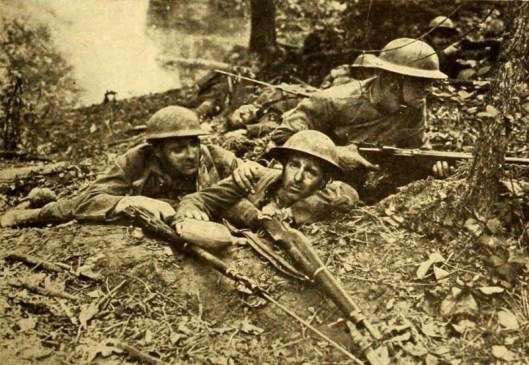
Production still from The Lost Battalion originally appearing in the Hollywood trade publication Moving Picture World June 28, 1919

Production still from The Lost Battalion originally appearing
in the Hollywood trade publication Moving Picture World, June 28, 1919

The 77th Infantry was known as the Melting Pot Division because its
men came primarily from New York City’s diverse neighborhoods. When a
battalion from that unit was involved in one of the most dramatic
incidents of the war, Hollywood took notice and made a film about the
dramatic episode. The Lost Battalion was released in early July 1919,
thus becoming one of the first on-screen depictions of the Great War.
Join the National Park Service and World War One Centennial Commission
at Governors Island National Monument in New York City this Saturday
when they host film expert Neil O’Connor in an introduction and
screening of The Lost Battalion. The program will be in the Fort Jay
powder magazine. Introduction begins at 12:30 pm and the screening at
approximately 12:45. Running time is seventy (70) minutes.

(image/MacManus Corporation via Wikimedia Commons)

9/11 plus fifteen years

Freedom Tower at 8:30 this morning

Freedom Tower from Manhattan’s Lower Battery at 8:30 this morning

There were definitely more people on the Battery this morning than on a usual Sunday morning. As you might guess most of them were headed for the ceremony at Ground Zero. I had never thought about it this way before, but I found the many other war/conflict monuments in the Battery comforting on this anniversary of the Trade Center attacks. This is where we had the commemoration of the sinking of the Lusitania a year ago this past May.

img_3494

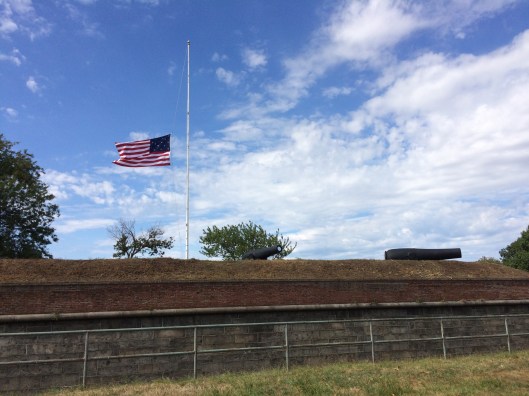
The flag–the Star Spangled Banner, if I noted correctly–was flying at half staff atop Fort Jay. On my way to Castle William for the 11:30 am tour I had to stop and take this picture (below) of these two apartment buildings. Coast Guard personnel who lived on the island in the late 1960s and early 70s have told me that from their living room and bed room windows they saw the Twin Towers go up incrementally over the years. I could not help but think of that this morning.

From these apartment building on the northern tip of Governors Island Coast Guard residents watched the Twin Towers rise nearly five decades ago.

From these apartment buildings on the northern tip of Governors Island Coast Guard residents watched the Twin Towers rise nearly five decades ago. The Freedom Tower is plainly visible.