Sunday morning coffee

Good morning, all. I am sitting on our patio with a cup of coffee enjoying this beautiful day.

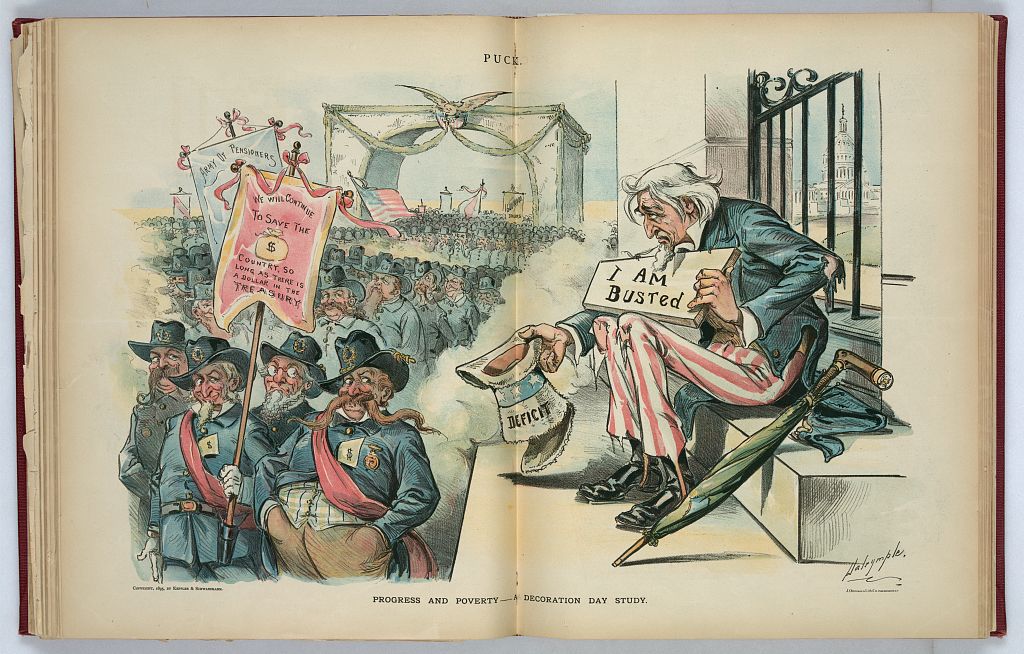
Today’s Puck cartoon comes from Decoration Day 1895. At this time Roosevelt had just taken over as one of New York City’s police commissioners. Before joining the NYPD he had been in Washington running the U.S. Civil Service Commission. In that capacity he tried to rid government service positions from cronyism. He was only partially successful.

"Army of Pensioners" Puck, 29 May 1895

“Army of Pensioners”
Puck, 29 May 1895

Two years into the second Grover Cleveland Administration the United States was mired in a terrible depression. Two of Uncle Sam’s biggest outlays during these lean times were for the Post Office, which Roosevelt had done his best to streamline, and Civil War pension benefits, which the uber-powerful Grand Army of the Republic veterans group protected fiercely and successfully. 1895 was just thirty short years after Appomattox. These veterans were moving from middle age into senior citizenship and their influence would hold sway for a good 15-20 more years.

(image/Library of Congress)


Memorial Day weekend 2014

One of the reasons the posting has been lighter over the past few months is because I have been doing a fair amount of writing for the Theodore Roosevelt Birthplace website and Facebook page. With the season now underway at Governors Island I will soon be doing the same there. One reason I love the TRB so much is that it offers so many interpretive possibilities. Far from feeling I have gotten away from the Civil War intellectually, I believe I am even more close to it. Senator William Seward of New York gave his “Irrepressible Conflict” speech on 25 October 1858 two days before Roosevelt’s birth. Teedie came into manhood in the 1870s and 1880s when the country was getting back on its feet.

I have something a little different for Memorial Day weekend. Between now and Monday I will be posting a few political cartoons from the era.

Puck magazine, 1899 May 31

Puck magazine,  31 May 1899

Sort of The Onion of its day, Puck put this on its cover the first Memorial Day after the Spanish-American War.

Both World Wars helped reunite the North and South. It is well known for instance that George Patton’s grandfather was a Confederate officer. Even though the Spanish-American War was shorter and required fewer men than these wars that came later, it had an even stronger and more immediate reconciliationist element.

For starters Civil War veterans fought in Cuba, which took place just thirty-five years after Vicksburg and Gettysburg. Confederate General Joseph Wheeler, a West Point graduate and veteran of Shiloh and Chickamauga among other battles, commanded the V Corps’s Dismounted Cavalry Division which included the Rough Rider regiment. General Fitzhugh Lee, nephew of Robert E. Lee, led the VII Corps.

By the time Puck put this on its cover Theodore Roosevelt had been back from the fighting in Cuba for nine months, feted around the country, and elected governor of New York.

(image/Library of Congress)


The unknown biography of a well-known photograph: a mystery solved

Update: The week before last a few of us at the Theodore Roosevelt Birthplace got to talking about this photograph. That led me to do a little online digging. which in turn led me to this piece by Heather Cole, the Manuscrips/Curator of the Theodore Roosevelt Collection at Harvard’s Houghton Library. The photo is from a 1912 political cartoon that also featured William Howard Taft and Woodrow Wilson. Alas, Theodore indeed never rode the moose. It would have been a great story if real but the truth is the greatest story there is.

I reached out to Ms. Cole to share both my post below and the story of the conversation the rangers and I had at the TRB and she graciously returned my message. I’m glad she researched this and shared it on the Houghton Library blog.

I was searching for something in The Letters of Theodore Roosevelt this morning when I stumbled upon a photograph I have seen numerous times. I was startled because it was one of those things I had only seen online and had assumed to be a fake. Here it is as I snapped it on my cellphone, uncropped to emphasize that it came from his Letters.

IMG_0707

I was so surprised because although I have seen this photo a number of times it has always been online. What’s more, it is usually accompanied with a cheeky quote or comment pasted onto it. I have even posted it myself on the Facebook page. It seemed–and still seems–like one of those pics that seems to good to be real. One always semi-assumed that when one saw it.

This was not the internet however. Roosevelt’s Letters were edited in eight volumes for Harvard University Press in a early 1950s by a team of esteemed scholars. It has been in continuous print for sixty years. That would seem to have a little more cachet than just something one sees online.

Photoshopping obviously did not exist back in the day, but the manipulation of images is as old as the photography itself. I would love to know more about this photograph and whether it is indeed the real thing.

Sunday morning coffee

East 20th Street, 17 May 2014

East 20th Street, 17 May 2014

I am having my morning coffee with Magical Mystery Tour on the turntable. I’m relaxing a bit before heading off to work. My library is open the last two Sundays of every semester for students to study for finals. I am always moved by the hard work and studiossness students put in at crunch time.

I snapped the above photo yesterday from the front steps of the Theodore Roosevelt Birthplace. One of the rangers and I stepped out to get lunch at noon and were talking on the way of how interesting it is to work/volunteer in the Gramercy Park neighborhood. It is such a fascinating area and once the center of New York City shopping and leisure life.

In my 15+ years of living in Gotham I never spent much time there. It is not an area that brings in tourists, what with Union Square 5-6 blocks to the south and Times Square 20 blocks north. Of course that is no excuse not to visit the TRB.

If one looks closely at the smaller building there is a painted advertisement for a furrier on the side. It is quiet faded because it has been eastward and getting the morning sunlight for decades now. The best preserved are exposed when a building is torn down uncovering an ad for some long forgotten product or company.

USSC

When I was at the New York Public Library last night I came across this fascinating photograph of various members of the United States Sanitary Commission. New Yorkers such as these played an outsized role in supporting the Union Cause and yet their contributions often go unnoticed. That is why I am having so much fun working on this book about Theodore Roosevelt Senior and his colleagues. Many of these individuals did so much from 1861-65 and then contributed to national life for decades to come.

(image/NYPL)

Showtime plus thirty years

The Losa Angeles Forum, where Showtime happened

The Los Angeles Forum, where Showtime happened

Last night before crashing and burning exhausted I finished Showtime, Jeff Pearlman’s new book about the great Laker teams of the 1980s. Because my family roots are in Boston cheering for the Lakers would have been heresy. Thirty years later I don’t have to care. Call it the miracle of growing older.

The NBA Finals that always sticks out most in my mind was the 1984 contest between the Lakers and Celtics. By this time my family had been uprooted and marooned in South Florida for nearly a decade. Rationally or not, we saw the series as a connection to something deeper than just who would win the NBA trophy.

One must remember that this was still the period before the NBA had become the streamlined entertainment juggernaut it is today. Just a few earlier the NBA finals were not shown live on television; so inconsequential had the league become that the network televised the finals on tape delay after the late news. Read that sentence again.

Lakers vs Celtics had everything. It was East Coast vs West Coast, Bird vs Magic, the return of a historic rivalry, and yes there was a strong racial element added into the mix, though I personally never got caught up in that.

The Celtics took that series in seven games and won at home in the old dump that was Boston Garden. What I remember the most is that the following week my family and I returned to Boston for my grandparents’ 50th wedding anniversary. My grandfather picked us up at the airport later on the same day that the team had its parade. For reasons I have never understood he was curiously determined to downplay the entire thing. Because it was the pre-internet days my brother and I walked down to the corner store and bought both the Globe and Herald over the few days we were back where our roots lay.

The Lakers and Celtics played in the finals the following year and again in 1987. For me though it was never the same. The 1980s have a strong before and after element. I graduated high school in 1985; after graduation I was another young person trying to figure out my place in the grand scheme of things.

Showtime began in 1979 ran its course until Magic Johnson’s announcements that he was HIV positive in November 1991. Reading Pearlman’s excellent narrative reminded me of how long that was and what I left behind.

(image/Eddy Lambert)


Washington then and now

The Boltbus has been a part of my and the Hayfoot’s life since we met six years ago. At first it was her going to meet a friend for the weekend. Then, as we knew each other better we would both go down to see the sites. It was in a Washington hotel room that I proposed. Now, with her working in the area one of us is on the bus every few weeks. It is part of our everyday life.

One thing I always note when the bus is approaching DC is how there are two Washingtons: the official one that tourists and public officials inhabit and the inner-city version one sees entering town. Like New York City Washington has gentrified a great deal over the past 15-20 years. The Boltbus itself is a product of that gentrification. Still, there are pockets here and there where one sees signs of the civil unrest of the 1960s. No, I am not old enough to remember the 1968 riots there and elsewhere, but I have been around enough to remember when the wounds were still raw. It is something I think about every time the bus is pulling in.

Here is some incredible, recently discovered film footage courtesy of media company CriticalPast. Looking closely at some of the additional footage, I noticed that some of the soldiers were from the Big Red One, which until a few years perviously had been stationed at Governors Island.


The other Roosevelt Island

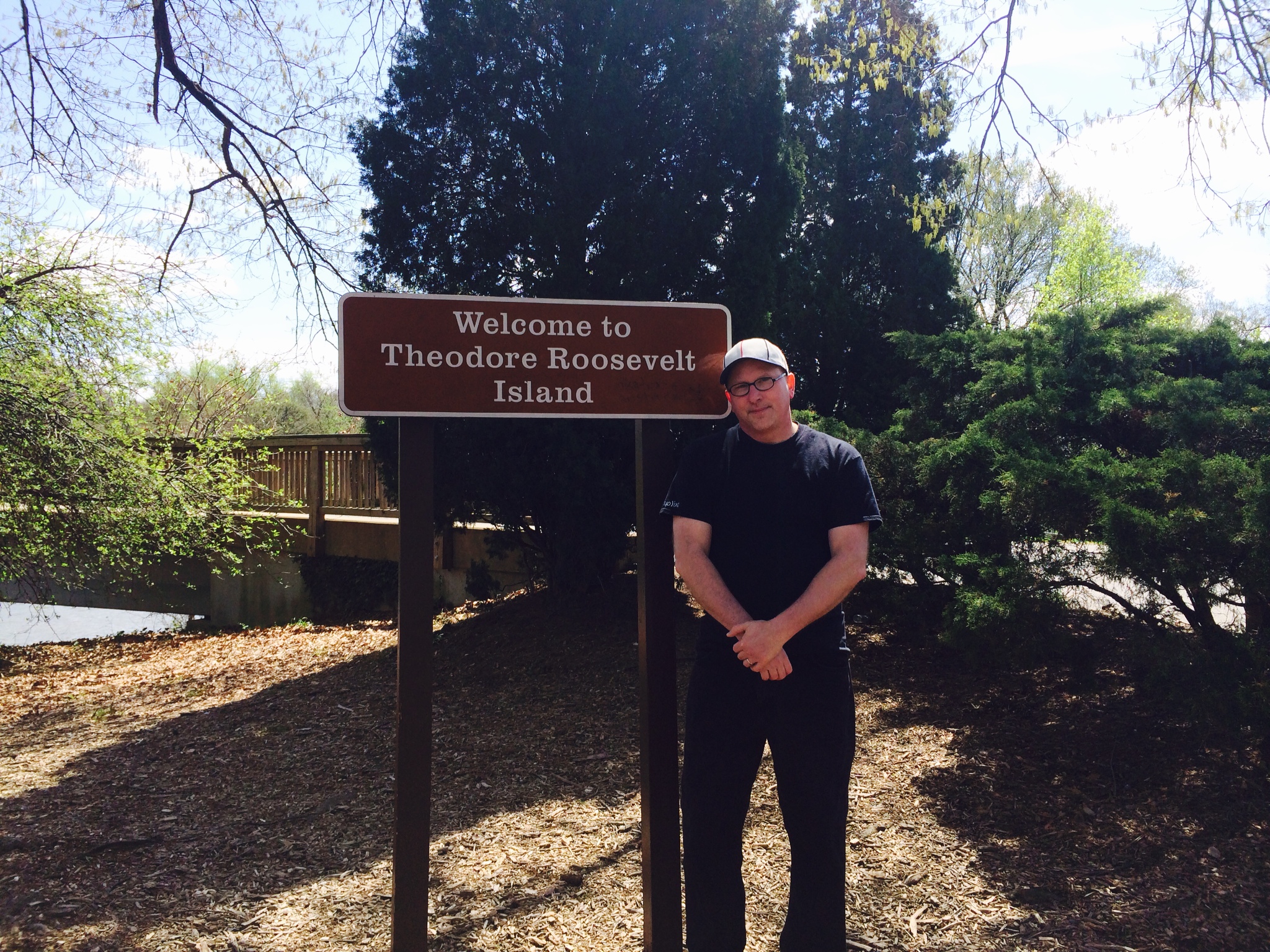
When in Washington over spring break the Hayfoot and I went to Roosevelt Island. This out-of-the-way site is something most tourists never see, which is understandable given that it is a little difficult to get to. Still, as the crow flies it is only a mile or so from the Lincoln Memorial. Roosevelt Island rests in the Potomac River and can be reached from the Roslyn stop on the Blue Line. The Iwo Jima statue is at the same stop but we missed that this time around.

Roosevelt Island sign

The Potomac River

The Potomac River

IMG_0664

Look closely through the trees and you can see the skyscrapers of Arlington, Virginia from the island. Landscape architecture is fascinating because the designer must be thinking decades down the line as to what his creation will look like when the trees and foliage fully mature.

One of Roosevelt Island’s charms is its tranquility so close to the Greater DC sprawl. The degree of difficulty in reaching the island is intentional. The planners wanted people to visit but also intended it to be a refuge. Believe me, you have to want to get here. Again, this is just a long toss from the Lincoln Memorial and the other sites on the Mall.

It may seem like pristine nature, but the island and memorial were a planned environment built by the Roosevelt Memorial Association in the 1930s. The RMA purchased the island from the Washington Gas Light Company for $364,000 and donated it to the American people in 1932.

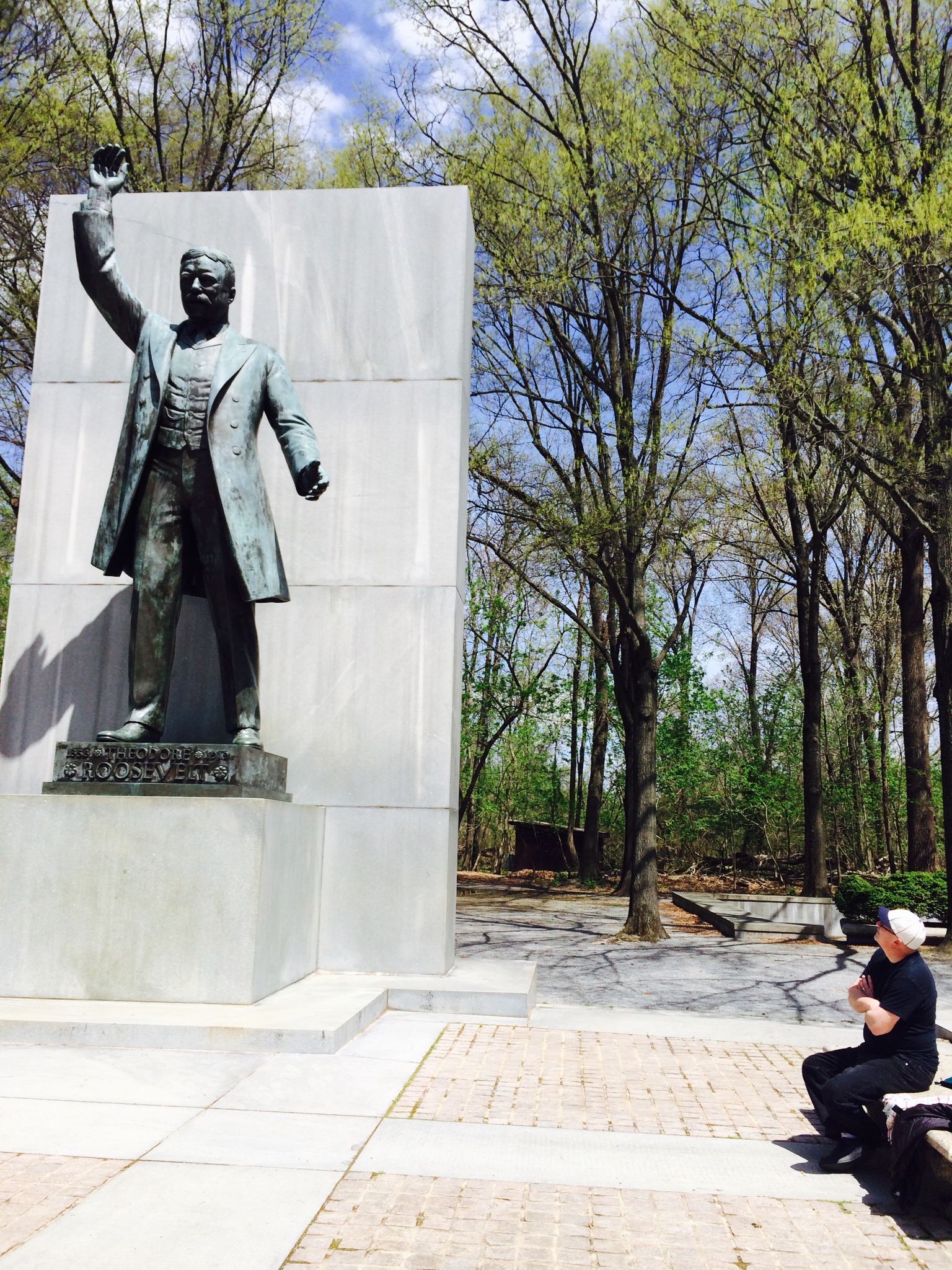
KM looking at TR

Paul Manship designed the statue. It is more severe in photos than in person. The surrounding tress soften the subject’s commanding size and pose. Frederick Law Olmsted Jr. created the ninety acre island’s landscaping.

The statue came several decades after the memorialization of the island itself. The Depression, World War II, and other issues took precedence over the statue’s  creation. Lyndon Johnson dedicated the statue on 27 October 1967 with Alice Roosevelt Longworth in attendance.

LBJ and Alice Roosevelt Longworth, October 1967

LBJ and Alice Roosevelt Longworth at the statue dedication, October 1967

"Manhood"

“Manhood”

This monolith is one of four. Each notes an attribute considered important by Theodore Roosevelt.

Our only mistake was not bringing lunch. I have a feeling we’ll be back come summer.

(LBJ and Alive Roosevelt Longworth image from Theodore Roosevelt Digital Library. Dickinson State University)

When Audrey Met Alice: an author interview, part 2

Here is the second installment of the interview with Rebecca Behrens, author of When Audrey Met Alice. In case you missed yesterday’s segment, this just-releaed novel tells the story of first daughter Audrey Rhodes, who discovers the secret diary of Theodore Roosevelt’s teenage daughter Alice in the floorboards of her White House bedroom.

The Strawfoot: And your novel’s protagonist, Audrey Lee Rhodes, Tell us about her and her family.

Rebecca Behrens: After Audrey’s mother becomes the first female president of the United States, her family relocates from the Twin Cities to Washington. Her father takes on the role of “First Gentleman” as well as maintaining her career in scientific research at a university. Unlike Alice Roosevelt, Audrey is an only child, and a few years younger than Alice was during her time at the White House. But Audrey still forms a real connection with Alice by reading the diary entries—their emotional experiences of living in the White House and being the children of important politicians is similar, despite the century separating them.

You visited the Theodore Roosevelt Birthplace with your parents, both of whom knew a fair amount about the twenty-sixth president. Did they inspire your interest in history?
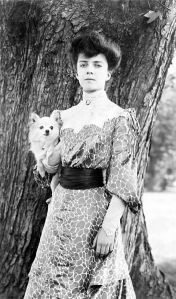
Alice Roosevelt as she was in 1902

Alice Roosevelt as she was in 1902

Absolutely! I was very lucky to be raised by two history-loving parents. We were also a family that enjoyed travel, and our road trips always included stops at historic sites. Specifically, interest in Theodore Roosevelt runs in my family—my great-grandfather was present at the famous speech TR gave in Milwaukee, Wisconsin, right after having been shot in an assassination attempt. My father has done a lot of reading and independent research on the Roosevelts (and has visited almost all of the Roosevelt NPS and NHS sites, from the Inaugural Site in Buffalo to Sagamore Hill on Long Island to Theodore Roosevelt National Park in North Dakota). I first learned about Alice from my dad’s Roosevelt stories. I found her fascinating and decided I needed to find a way to write about her, one day.

What other historic sites, especially Roosevelt sites, have you visited?

I’ve visited Sagamore Hill and Youngs Memorial Cemetery in Oyster Bay, and I’ve spent time in Washington, DC, although I need to look up Alice’s house there. I also unknowingly visited where Alice’s Auntie Bye (TR’s sister Bamie/Anna Roosevelt Cowles) lived in New York City, at what once was 689 Madison Ave and 62nd Street. It was while I taking a walk and stopped for a break at that very intersection that I came up with the initial idea for the plot of When Audrey Met Alice. Later I found out that not only was that a Roosevelt family site, but Alice spent a fair amount of time there as a young person. Weird!

You are a children’s book editor. What advice might you have for aspiring writers?

I think that the most important qualities you need to be a writer are patience, dedication, and curiosity. Writing and publishing a book is a wonderful experience—but it’s also a long haul! Curiosity can lead you to a great concept, dedication is necessary to see it through, and patience is essential because writing is often slow, at all stages of the publishing process. I’m not a historian, so I had to work hard to try to do this setting and subject justice. But because I found the subject so fascinating, it was easy to keep trying.

Did your recent trip to the White House live up to expectations?

Absolutely! It was thrilling to be there in person. Looking out toward the Washington Monument from the inside of the South Lawn was a surreal, fantastic moment. My visit was also very useful in terms of improving the factual accuracy of my book. I got to experience visitor security firsthand, understand the scope of the space (I expected the lawn to feel larger and more exposed than it does), and soak up sensory details—like how the grounds smell and what ambient noise is around.

Where can people go to find out more about When Audrey Met Alice?

There is more information about the book as well as links to resources like an educator’s guide and an annotated version of Alice’s diary on my website, www.rebeccabehrens.com.

(image/Library of Congress)


When Audrey Met Alice: an author interview

Early this spring children’s book editor and first time author Rebecca Behrens visited the Theodore Roosevelt Birthplace National Historic Site. After the house tour she introduced herself and told me about her first novel. When Audrey Met Alice. I read the book recently and enjoyed it a great deal. Here is the first of a two part interview.

The Strawfoot: Your new book, When Audrey Met Alice, tells the story of Audrey Rhodes and her experiences as first daughter. What inspired you to write the novel?

When Audrey Met Alice final coverRebecca Behrens: The White House seems like such a serious, powerful place—but it’s both a historic site and a home, one where first kids can have tea parties, build tree houses, and play hide-and-seek. When I made that connection as a kid, after seeing photographs of the Kennedy children playing in the Oval Office, I became fascinated by the idea of families in the White House. After President Obama was elected in 2008, I wondered how the lives of his daughters would change as they headed to Washington. I imagined that there would be a lot of wonderful and exciting opportunities for them in the coming years—and probably some hardships, too. The idea of a “first daughter” feeling a little isolated and constrained stuck with me, and soon developed into Audrey’s character.

Audrey is thirteen and discovers the fictional diary of the very real Alice Roosevelt in the floorboards of her closet in the Yellow Bedroom. Alice was also a teenage first daughter, or FIDO. How did you research and write the diary?

author Rebecca Behrens

author Rebecca Behrens

Much of my research was done the old-fashioned way: heading to the public library and checking out lots and lots of books on Alice Roosevelt and White House life. I used many online resources, including official White House websites, the White House Historical Association, National Parks Service sites, newspaper archives, and unofficial pages that detail White House history. I also read fiction set around Alice’s time to get a feel for how language was used. And I looked up a lot of words in etymology dictionaries to try to figure out if they were ones Alice Roosevelt and her family might have used. To write the diary entries, I started by making a timeline of events and experiences during the real Alice’s life. Then I retold them in the fictional Alice’s voice. Occasionally, I even worked in a real quote from Alice or her father.

Alice was a teenager more than a century ago and yet her experiences were similar to young people’s of every generation, minus the White House bit. What advice do you think she might give to twenty-first century teens?

While researching Alice’s White House years, I was really struck by how universal many of her experiences and concerns were. I wasn’t expecting that! She worried about her looks, her friends, and her future—just like girls who weren’t the daughter of the president, and girls today. What made Alice very unique, though, was her brave (and, at the time, pretty unconventional) commitment to living authentically. She embraced the idea of doing things differently and being true to herself—even if that ruffled some feathers. I think her famous phrase, “eat up the world!” is a great message for teens today.

There were no paparazzi as we know them today during Alice’s time but in many ways she was one of the original modern celebrities. Describe the world she lived in.

There is a great line from one of Alice’s interviews: “Woe betide the girl who emerged from the conservatory at a dance with her hair slightly disheveled. As one’s hair tended to fall down at the best of times it was frightfully difficult trying to keep up appearances.” (Mrs. L: Conversations with Alice Roosevelt Longworth by Michael Teague, p. 66) Girls in her time period were subject to intense scrutiny about their appearances and activities. It’s interesting that while famous people today are subject to invasive paparazzi and a huge amount of attention online, there is much more protection for the first family’s privacy.

The media has an unofficial agreement to not report on the first daughters outside of official events and appearances. Alice, however, had “camera fiends” appearing on the White House doorstep to take her picture. Enormous crowds showed up at her public appearances. Newspapers reported breathlessly about her activities, including her dating life. And they reported a fair number of lies: like false stories about her getting engaged or dancing on a roof in her undergarments.

Tomorrow, part 2