Sunday Morning Coffee

268245 war_1812_npsToward the end of last summer the NPS released The War of 1812: Official National Park Service Handbook. The book was released for the bicentennial of that conflict, which  is passing along with disappointedly little fanfare. Hopefully there will be increased interest as we mark such events as the Siege of Fort Erie all the way through the anniversary of the Battle of New Orleans in January 2015.

When I was on the Mall a few weeks back I picked up a copy at the Eastern National next to the Washington Monument. What I like about the Park Service handbooks is that the chapters are written by first-tier scholars and focus a wide range of topics. As did the Civil War handbook, the 1812 offering covers a wide ranger of economic and social topics, not just the minutiae of the battles.

One of the issues I am most interested in is the generational element between the Revolutionary War, 1812, and Civil War participants. It is intriguing that so many men in both the Union and Confederate armies thought of themselves as carrying on the traditions of 1776 and 1812. This is something that we have all of course know; it hit me with full force two years ago when I saw the Star-Spangled Banner at the Smithsonian’s National Museum of American History. The flag that flew over Fort McHenry was commissioned by George Armistead, the uncle of Lewis Armistead who was mortally wounded in Pickett’s Charge. The flag was in the possession of the Armistead family until they gave it to the federal government in the early twentieth century, which they undoubtedly did as a gesture of reconciliation.

I am looking forward to delving into the handbook. I imagine in the coming weeks I will read an essay each morning during the am commute on the subway.

Rod Serling’s Carousel

One of the most poignant moments in the entire series-run of The Twilight Zone is the scene from “Walking Distance” where middle-aged Martin Sloan meets the young boy he once was on the carousel at the local park. Adult Martin is next admonished by his father about the danger and futility of trying to live in the past. I loved the episode when I first saw it as a teenager all those years ago; now that I too am middle-aged, and so much of my own past is irretrievably gone, I grasp the poignancy in a way I previously had not.

Rod Serling spent most of his youth in Binghamton, NY and in many ways he never left. The town is infused in all of his writing. The carousel in the episode is not the one from Serling’s hometown but it is similar. The one in Binghamton was built in 1925, the year after Serling was born. A few years ago it received a facelift, which included paintings inspired by Serling and his television show. Now, a filmmaker named Jonathan Napolitano is making a film about that restoration.

Sunday morning coffee

I’m sorry about the lack of posts this week. I have been sifting through the paperwork I gathered at the LOC last week. I have also been getting ready for the spring semester at the college where I work, which begins tomorrow.

D.C. War Memorial

D.C. War Memorial

Last week when I was in DC I spent a few hours on the National Mall. One of my favorite memorials is one that no one ever visits, the D.C. War Memorial. Granted there is not a whole lot to see there, but it would be nice if it got a bit more foot traffic. When the monument was dedicated on Armistice Day 1931 President Hoover gave the speech and John Philip Sousa came out of retirement to conduct the U.S. Marine Band. The first time I saw the memorial was in July 2005 when I was in D.C. with a friend, and it had fallen into a state of disrepair. It was refurbished in 2011 and looks much better. Still, as you can tell, no one stops to take in its subtle details. Why the monument is so seldom visited would be a great Interpretive opportunity. These are the types of stories I hope get told during the Great War Centennial that will begin this summer. I for one will be working it in at Governors Island.

King on the Emancipation Proclamation

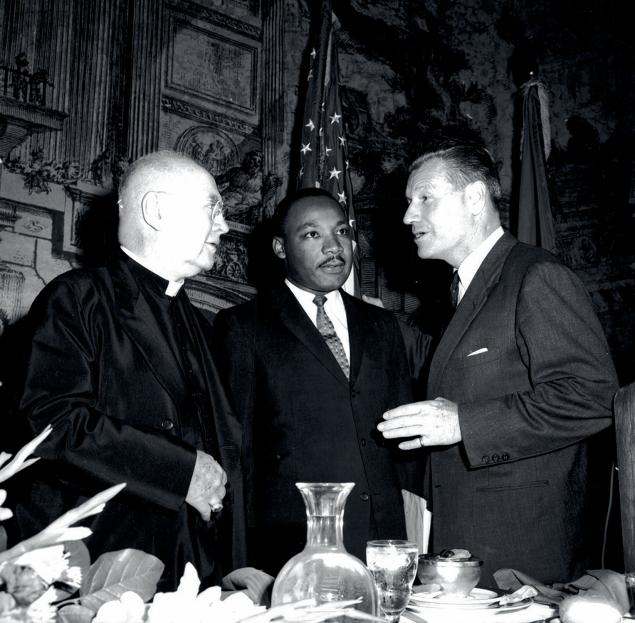
Kimg with Governor Rockefeller and Cardinal Spellman at the September 1962 dinner

Kimg with Governor Rockefeller and Cardinal Spellman at the September 1962 dinner

It is hard to believe it was almost 1 1/2 years ago that I posted about our trip to the Schomburg in Harlem to see Lincoln’s handwritten draft of the Emancipation Proclamation along with the official Preliminary EP. That and being in Gettysburg late last June have been my highlights of the sesquicentennial, so far. In that September 2012 post, I mentioned that also on display was a typewritten excerpt from a September 1962 speech given by Martin Luther King, Jr. to the New York State Civil War Centennial Commission. I vividly remember seeing the many cross-outs and red ink on the King draft.

Well, incredibly, officials at the New York State Museum in Albany recently turned up an audio version of that speech that no one knew existed. Here it is, released by the museum two days ago on MLK Day:

It does not take much to understand the influence of the Civil War Centennial on the Civil Rights Movement. King was giving this speech during the desegregation crisis at Ole Miss over the enrollment of James Meredith.

In attendance at that dinner were Bruce Catton, Chairman of the Commission, and Governor Nelson Rockefeller. The New York State Commission did some good things, but unfortunately did not make it through the Centennial. The state legislature pulled the funding in 1963 and the group disbanded in March of that year. Thankfully we have now have their recording of one of their most important endeavors.

(image/New York State Archives)

Sunday morning coffee

WW2 Memorial, National Mall

WW2 Memorial, National Mall

I had a productive week on my Hawley biography at the Library of Congress. I wrote some “Roosevelt’s Washington” posts for the Theodore Roosevelt Birthplace Facebook page as well. Now we are relaxing and taking it easy with coffee. It is one of those cold and bright mornings. Later while I am listening to the football games I am going to sort out everything  photocopied at the LOC and make some notes and outlines.

A friend sent me a link the other day about the death of Hiroo Onoda. I have written several times about the passing of the WW2 generation. The 70th anniversary of Pearl Harbor marked the end of something for me personally. It seems that the commemorations went from “distant current events” to “history” with that 2011 ceremony.

Hiroo Onoda (standing) and his younger brother  Shigeo during the war

Hiroo Onoda (standing) and his younger brother Shigeo during the war

For those who may not know, Hiroo Onoda was Second Lieutenant Onoda in the Imperial Japanese Army. He and a handful of others lived for decades in the Philippine jungles refusing to believe that the war had ended. He finally surrendered when in 1974 the authorities flew in his commanding officer to convince him to do so.

The frozen tundra of the National Mall

I was on the Mall today and am here to say it was COLD, and with a bone chilling wind to add insult to injury. I must say it kept the tourists away, even on MLK Jr. weekend. Hours later my ears are still ringing.

Last March I took a pic of what was then the hole that will eventually become the Smithsonian’s National Museum of African American History and Culture. Well, ten months later we still have a hole but it is starting to fill up.

Smithsonian National Museum of African American History and Culture, January 2014

National Museum of African American History and Culture construction site, January 2014

I have no doubt that they will do a great job. A few months ago the Smithsonian folks were at the Brooklyn Museum appraising people’s artifacts. Earlier this month they were doing the same thing in Fort Lauderdale while I was down there. It is going to be a varied and disparate collection. The only thing that concerns me is that the Mall, especially this part of the Mall, is on low ground and is susceptible to flooding.

The U.S. Army Museum

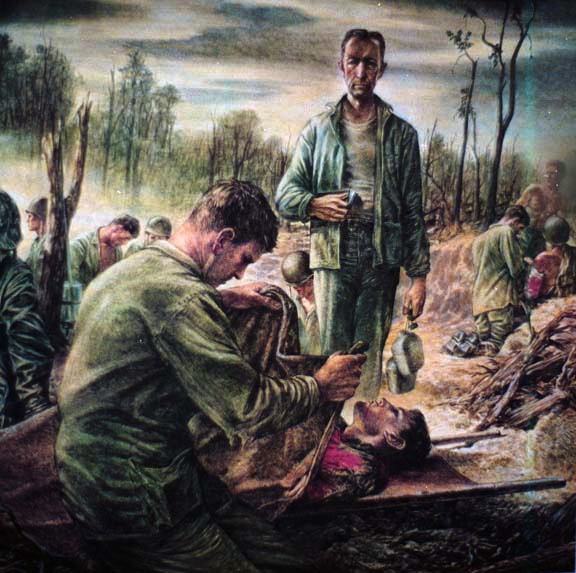
An Army chaplain performs the last rites, Bliliou (Peleliu) Island,, 1944

An Army chaplain performs the last rites, Bliliou (Peleliu) Island, 1944

Last summer in a post I mentioned a film called They Drew Fire. That PBS documentary was about the artists who painted and sketched the Second World War  as they witnessed it in both Europe and the Pacific. When we think “art” and “war” we think of Winslow Homer, Conrad Wise Chapman, and various others who sketched for Harper’s, Leslie’s Illustrated, or what have you. I suppose that the newsreels and photojournalism one saw in Life magazine, not the paintings and sketches that came from an artist’s hand, are the dominant iconography of the WW2. That the branches of the American Armed Services commissioned dozens of individuals to go forth and record what they saw is a story that has yet to be told fully. What is most incredible is the free rein they had.

Many of the thousands of works these artists produced from 1941-1945 are sitting in a modern storage facility in Fort Belvoir, Virginia, just outside Washington. The photos remind me of the Luce Center storage one sees at the Met Museum, New-York Historical Society,  the Brooklyn Museum of Art among other places. The goal is to move them into the National Museum of the United States Army that is currently being built within four years. I am interested to see how this project plays out.

(painting by WW2 artist Tom Lea, courtesy NPS)

DC doings

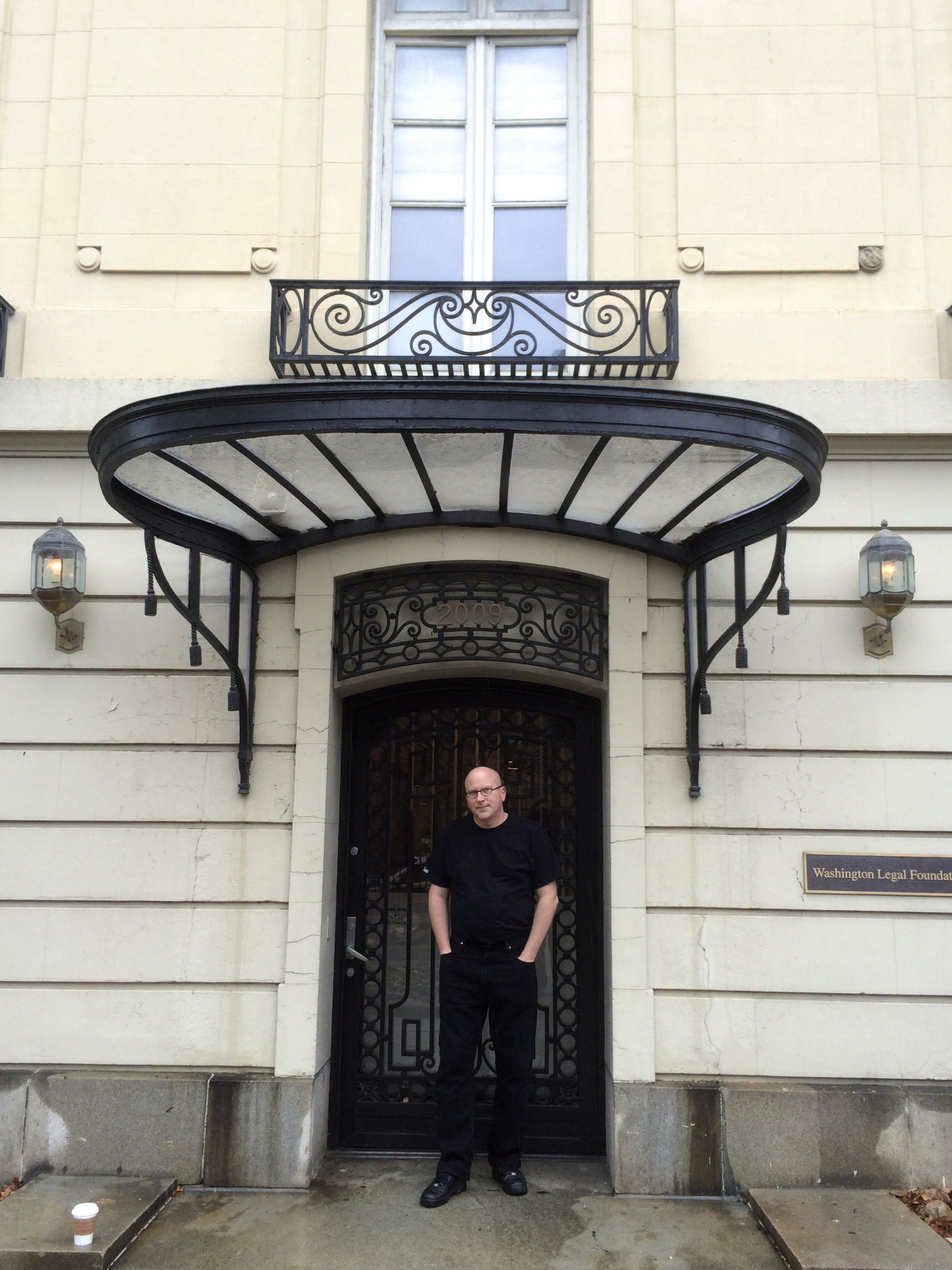
The entranceway of Alice Roosevelt Longworth's Dupont Circle house

The entranceway of Alice Roosevelt Longworth’s Dupont Circle house

I am sorry for the lack of posts this week, but I have been busy. I am in Washington doing research at the Library of Congress for my Joseph Hawley book. The Hayfoot and I have also been hitting some Theodore Roosevelt-related sites. They have not been posted yet, but I am writing a series of posts for the Roosevelt Birthplace Facebook page about various Roosevelt-in-Washington places. Look for those later this week on the TRB Facebook page.

We intentionally chose three in the Dupont Circle area to make it easier logistically. When we visited Alice Roosevelt Longworth’s house (2009 Massachusetts Avenue, NW), a dour lady from the Washington Legal Foundation, the site’s current occupant, told us it is not a public space and shut the door in our faces. Oh well. We had a good laugh about it.

My table at the Library of Congress

My table at the Library of Congress

The book is very much in the nascent stages but it is finally starting to gel. Looking at reels and reels of microfilm is exhausting but the hardest part was realizing the scope and tome of the book. I had that epiphany the other night and when I did the load got a lot lighter. I guess the whole thing from start to finish will be a process with forward and backward steps. It is amazing what can happen when you just start.

Working on this book project and writing content for the TRB website, along with my volunteering duties at the site, are going to be my intellectual pursuits for 2014. Despite a few crises of confidence it has been so far so good.

The original Lombardi comes home

Several years ago your humble writer was walking though midtown Manhattan when, turning onto 5th Avenue, he saw something that made him pause. In the window display case of Tiffany & Co. was the World Series trophy. I had long known that Tiffany’s made the trophy for both MLB and the NFL. It is just not something one sees everyday. Even better for me, although I obviously had no way of knowing it that early fall evening, it was the World Series trophy the Red Sox themselves would win a few weeks later. As you can imagine, it is one of those random events that has stayed with me.

The first three of the Green Bay Back Super Bowl trophies. The team would add a fourth the year after this photo was taken.

The first three of the Green Bay Packers’ Super Bowl trophies. The team would add a fourth the year after this photo was taken.

In a story I have been loosely following for the past few months, I read today that another Tiffany creation–the original Lombardi trophy–has returned to Newark, New Jersey after a forty-seven year hiatus. Ulysses Grant Dietz, the gr, gr. grandson of Ulysses S. Grant, is the museum curator responsible for bringing it back. The Newark Museum is one of the great places in the New York Metropolitan area. Waking there from the PATH train, the observant walker sees vestiges of the city’s heyday in the architecture and public artwork. Among the many other things the city was know for was its silversmiths and jewelry makers. The Lombardi Trophy from Super Bowl I is part of a current exhibit on Newark’s history of precious metalsmithing.

The exhibit is not entirely coincidental. This year’s Super Bowl is going to be held in New Jersey at the stadium where the Giants and Jets play. Hence, the museum’s administrators figured they would have some kind of tie-in. Shooting high, they went for–and got–the Lombardi.

On the plane from Florida the other day I had a conversation about this with the man next to me. We could not understand why they are playing in an outdoor stadium in the Northeast in February. But they are.

No, I will not be attending the Super Bowl whatever the weather. I will be making the trek across the river to see the original Lombardi trophy along with the other treasures the museum has to offer.

(image/Globe199)

The future of New York Harbor

Flying back into New York City last Friday I had one of the best views one can have of the metropolis when the plane flew directly up the harbor and passed over the city on its way to LaGuardia. We were so low it was like getting a helicopter-view of what was below. The buildings were cool, but my favorite part were the islands in the harbor. It gets lost on many New Yorkers that they live and work on an archipelago. Manhattan Island. Long Island. Staten Island. Roosevelt Island. Ellis Island. Liberty Island. Governors Island. Randall’s Island. So on and so forth.

Flying in I could see the outline of Fort Jay on Governors Island, which was all the more dramatic for being covered in snow. I tell people during my tours of the island to think of everything that has happened in the world over the past two centuries and to think that Fort Jay and Castle Williams have been standing watch in New York Harbor all that time. From above, one also sees how exposed the islands are there in the water. National Geographic has a fascinating piece about how Ellis and Liberty Islands were effected by Superstorm Sandy and what might happen to them and the other islands in the future with global warming.