McCoy Tyner, 1938-2020

People have been emailing and texting these past 24 hours with the news of the passing of jazz pianist McCoy Tyner. He is the final member of the John Coltrane classic quartet to pass away. In one email back and forth I mentioned to a friend, a very observant individual and part of the New York jazz scene in the 1970s, how one can scarcely if at all articulate in words what the Coltrane classic quartet created, that they tapped into a Higher Force or whatever one might choose to call it. My friend and I wondered if even the four of them were even able to put the experience in words, or if the force passed through them and they accepted it. Years after it was all over, when asked how they accomplished what they did, the drummer in that quartet, Elvin Jones, told an interviewer, ‘You gotta be willing to die with the motherfucker.” It is not clear that Jones was joking. Maybe that’s as close to the articulation as one can get.

Here is that classic quarter playing “Naima” in Belgium in 1965. This footage is near the very end for the Tyner, Jones, Garrison, Coltrane lineup. Tyner for one would strike out on his own not long after this and pursue his solo career. Coltrane died two year later.



Women’s History Month at the Theodore Roosevelt Birthplace


If you are looking for something to do in recognition of Women’s History Month in the coming weeks I might suggest the above programs at the Theodore Roosevelt Birthplace on these successive Saturdays. A guy with my initials even goes off on the 21st.

These past few weeks I have been pulling together my presentation, which focuses on the Roosevelt family’s response to the American Civil War. Young Teedie’s parents supported different sides during the conflict. His mother Mittie was a Georgia belle from a slave-owning family with a brother and several half-brothers in Confederate uniform; Theodore Roosevelt Sr. was a Union man, a friend of Abraham Lincoln’s personal secretary John Hay, who had his mail sent to the White House in care of Hay while out in the field registering men of the Army of the Potomac up for the allotment of their pay to their families back home. I tell the story in more detail in the manuscript of “Incorporating New York,” my history of Civil War Era New York City that will hopefully get published sometime in the future.

There is a rich assortment of speakers lined up for the house on East 20th Street in the coming weeks. Come out and take part in Women’s History Month in these waning days of winter.

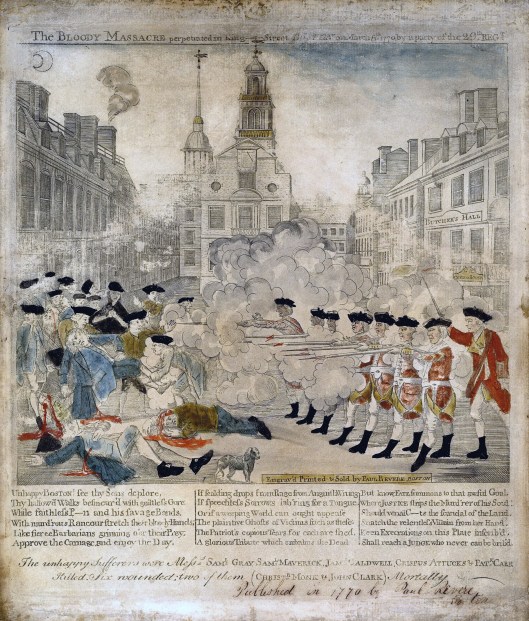
The Boston Massacre 250th

Paul Revere’s interpretation of the Boston Massacre

I do not have much to say about the events of March 5, 1770 at the moment but I would be remiss if I did not at least briefly mention that today is the 250th anniversary of the Boston Massacre. I don’t believe it is saying too much to aver that we are now fully in the American Revolutionary War sestercentennial. There will be many events over the next six years, climaxing of course in July 2026. That seems far away but will be here before we know it. I am old enough to remember the bicentennial of the Revolutionary War in 1976. That 200th anniversary was just two years after Watergate and one year after the Fall of Saigon. Talk about the need for a usable past.

While I was too young to understand at the time how scholars used the 200th anniversary as a moment to explore our understanding of the war, I was very much aware of how the commemoration played out in the public consciousness. You couldn’t miss it in 1976; it was just all around you. I know that many communities are already preparing for events coming over the next six years. Publishers, too, are no doubt planning on releasing numerous works that will add further nuance to our understanding. Our current moment is an opportune time to study and reflect on the events of the 1770s, so far away and yet closer and more relevant than ever, and take to heart the lessons that the men and women of that time–our forbears–learned at such great cost.

(image/Library of Congress)

February 27, 1933: the Reichstag burns

I would be remiss if I did not stop and at least briefly note that today is the anniversary of the Reichstag fire, the burning of the German parliament building in Berlin one month after Hitler’s ascension to the chancellorship. The exact circumstances of the fire remain in dispute almost eight decades after the incident, though Nazi arson is often given as the most likely cause. What is clear is that Hitler used the incident as a means to secure greater control of his tenuous coalition; immediately following the conflagration, with the ashes still smoldering, they persuaded President Paul von Hindenburg to issue the Decree for the Protection of People and the Reich, known also as the Reichstag Fire Decree, clamping down on freedom of the press and other civil liberties. I have never understood why people do not take what public figures say at face value, especially when said figures are perfectly clear about their intentions. In Hitler’s case he had already made his objectives clear in the autobiography he had published in the mid-1920s. With the Reichstag fire the new German chancellor was one step closer to those goals.

(image/National Archives)

a “New Valley Forge”

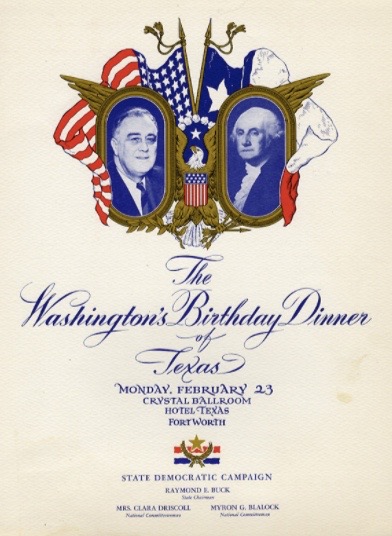
Here are a few more images from my presentation this past Monday at Federal Hall on Presidents Day. Here we see an announcement for a Washington Birthday Democratic fundraiser held in Fort Worth, Texas on February 23, 1942. This was less than two months after Pearl Harbor in those tense days when the United States was getting up to speed in its war effort. The U.S. had been the “arsenal of democracy,” manufacturing tanks, bullets, jeeps, and whatnot for the Allies long prior to Pearl Harbor. Now American fighting men themselves would join the fray. As we see from the announcement the dinner was held on February 23, not Washington’s actually birthday, because the 22nd fell on a Sunday.

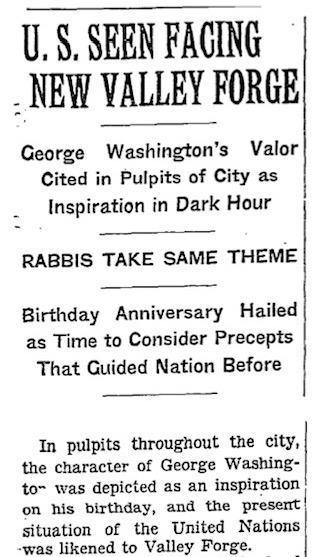
New York Times, February 23, 1942

Roosevelt himself did not attend the dinner, though as we see the Texas Democratic leadership was not hesitant to use his likeness, and on equal footing with President Washington no less. One must remember that Texas in this era was part of the Solid South, comprised, like the rest of the region, of Dixiecrats who since the Civil War eighty years previously had stood against the Party of Lincoln. In the 1930s these leaders, and those who voted for them, were part of the fragile New Deal coalition supporting FDR in cooperation with the Democratic machines of the northern cities. That coalition would hold another three decades until fracturing in the chaos of the Vietnam War and bitterness of the Civil Rights Movement. Roosevelt’s vice-president in his first two terms had been John Nance Garner, a Texan and former Speaker of the U.S. House of Representatives. The tension and unease in their relationship were representative of the strains within the New Deal coalition itself.

Garner was gone by 1942 and now Roosevelt was facing the war in his unprecedented third term. What we see here is the snippet of an article from the February 23, 1942 New York Times describing the mood on Washington’s birthday in those weeks just after Pearl Harbor. The first public observation of George Washington’s birthday had been at Valley Forge in the winter of 1778. Now America was facing a “new Valley Forge.” Attendees at the Fort Worth soiree did not meet Franklin Roosevelt, but they did hear him. That night he gave one of his fireside chats over the radio outlining the progress and stakes of the war, and the lessons to be learned from the experience and difficulties of Washington and the men of his Continental Army all those years earlier.


The New Yorker turns 95

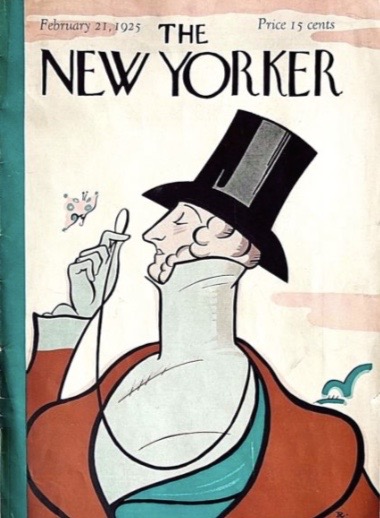
I have a friend who is working on a book manuscript that hopefully will see the light of day in a few short years. I don’t want to go too much into the details here because it is literally not my story to tell. I will say though that his narrative is about the history and evolution of New York City and that he is toiling away diligently on an under-explored aspect of the city’s development. My friend emailed the other day and asked if I could provide a rough outline of American society in the 1910s and 1920s to fill out the story and provide some context for his topic. I offered a few ideas, among them the Versailles Treaty and League of Nations; the influenza pandemic; Prohibition and related rise of organized crime; the Red Scare; the Great Mississippi Flood of 1927. All in all pretty basic stuff. Another topic I added was the rise of magazines during the Roaring Twenties. For instance Henry Luce started Time in 1923 and Harold Ross edited and published the first issue of The New Yorker on February 21, 1925, ninety-five years ago today.

Journalsim has been ht hard in recent years by changes in information technology and other forces. Local newspapers are ceasing publication more than ever. I am old enough to remember when a subscription to Time magazine meant one was up on, well, the times. That magazine today is a shell of its former self. The New Yorker however has restored its footing in recent years after the magazine’s identity crisis during the best-forgotten Tina Brown years. Just yesterday I emailed three people “With the Beatles,” a short story by Haruki Murakami published in the current New Yorker issue. It is an extraordinary tale of loss and memory. My point really is that the magazine remains relevant for both its cultural and journalistic contributions.

I remember reading Nat Hentoff’s memoir many years ago in which he spoke of his admiration for longtime New Yorker chief William Shawn. Hentoff’s admiration of Shawn’s instincts and erudition was dampened only by his disappointment in the editor’s treatment of the staff, especially the non-writing staff, whom apparently Shawn was perpetually nickel-and-diming while hiding always behind a veneer of civility. I remember in the late 1990s–now so long ago–just a few years after Shawn’s 1992 death when a spate of memoir/biographies, laudatory and otherwise, came forth to praise and bury the man. I never read any of them, because literary feuds and gossip are two things I am not interested in.

Good journalism is time-consuming and expensive, which is often lost on us today when we log online each morning and surf the internet for free. We expect it to be free. It is that very reason why journalism is in such trouble today. Valuing journalism is something to think about in our current historical moment when there are people eager and willing to take the truth away from us. The 95th anniversary of The New Yorker is an opportune moment to ponder how good writing and reporting is produced, and how costly that production is. Whatever news and cultural sources you consume, consider throwing them a few shakels via a print and/or digital subscription in order for them to continue their important work.

Presidents Day 2020

April 6, 1861 Harper’s Weekly woodcut of the USS Wyandotte firing a salute in Pensacola Bay on February 22 in commemoration of George Washington’s birthday.

I am having my coffee before jumping in the shower and heading to Federal Hall in a short bit. Here is an image I intend to share today when discussing the history and evolution of George Washington’s Birthday. It is the original USS Wyandotte. Built in 1853 and christened the USS Western Port, the steamer saw action in South America and served in the Caribbean suppressing the slave trade prior to the Civil War. The image we see here depicts the Wyandotte in Pensacola Bay firing a salute to George Washington on February 22, 1861. This very same day President-elect Lincoln was in Philadelphia at Independence Hall marking Washington’s Birthday and raising a flag with an additional star on it in tribute to Kansas becoming a new state. He was on the train journey that was taking him from Illinois to Washington for his March 4 inaugural. It was an anxious time. Earlier this very month Jefferson Davis had been named Provisional President of the Confederacy and had spoken in Montgomery, Alabama on February 18 laying out the cause for secession.

(image/Library of Congress)


Sunday morning coffee

I spent a portion of this morning putting the final touches on an interpretive talk I’ll be giving tomorrow at Federal Hall. The talk is about the history and evolution of George Washington’s Birthday, which historically, with the Fourth of July, has served as a key part of America’s civic religion. There is a very human need for a usable past. On the federal level there is technically no such thing as President’s Day; the three-day weekend in which we are now in the middle is in commemoration of George Washington.

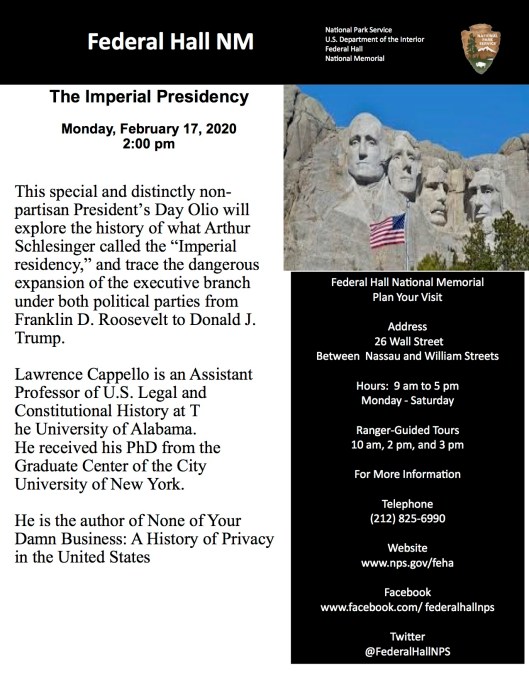
It will be good to be back at Federal Hall, where I have not been since Labor Day Weekend when it was last open on weekends. Later today I will go over my notes and outlines in preparation. The rotunda is closed for renovation but there will still a lot going on tomorrow if one is looking for something to do. That includes the talk by historian Lawrence Cappello. Come and get your history on.

Abraham Lincoln, 1809-1865

Today is Abraham Lincoln’s birthday. My gosh, was the bicentennial of his birth actually eleven years ago now? I remember it so vividly. Lincoln’s birthday, along with Washington’s, used to be a major holiday in the United States. Or more precisely, Lincoln’s was a major holiday in half the United States; in parts of the Old Confederacy they observed the birth of Robert E. Lee (January 19, 1807), Thomas “Stonewall” Jackson (January 21, 1824), or some combination of the two. If one has followed the news the past several years one knows that they are still sorting out how to deal with that Lost Cause narrative of which Lee and Jackson are the quintessential embodiment. Lincoln’s birthday has itself been used and abused. I did not know until the other day that Senator Joseph McCarthy’s “Enemies from Within” speech in Wheeling, West Virginia, which he delivered seventy years ago this week on February 9, 1950, charging wild insinuations about the State Department, was delivered during a Lincoln birthday commemoration. It is a reminder of the need for public figures to speak carefully and honestly, and what we stand to lose when they do not.

Congressman Joseph Cannon reciting the Gettysburg Address on the House floor, February 12, 1920

Here we see Lincoln’s birthday on the House floor as it was commemorated one hundred years ago today. That’s Congressman Joseph G. Cannon of Illinois reciting the Gettysburg Address. Cannon had been House Speaker from 1903-1911 and by the time it was done would serve forty-six years in Congress. February 1920 was a difficult time in our nation’s history, coming as it did after the Red Summer of 1919 here in the United States and increasingly turbulent situation in Europe as well.

The institution where I work might be the last one which closes on Lincoln’s birthday. It is a nice little respite after the grind that is the first few weeks of the semester. I am determined to get out, and am debating whether to go to either the Metropolitan Museum in Manhattan or stay local and hit the Brooklyn Museum.

(image/Library of Congress)


The Fifteenth Amendment

One of the messiest legislative enterprises in American history reached its climax 150 years ago today when the required three-fourths majority of the states–28 of 37–ratified the Fifteenth Amendment. The episode is so convoluted that, while we credit Iowa with being that 28th state and ratifying on February 3, 1870, state representatives had actually done so in January. And that’s just the beginning of the mess. There was even more confusion if the three-fourths bar had in fact been reached. For one thing two state legistlatures of the former Confederacy–Georgia and Mississippi–had also approved the amendment–even though they had not yet been “reconstructed” and legally brought back into the Federal Union. Needless to say, all this sowed further confusion into the legality of the measure designed to give African-American adult males the vote. Still, it is February 3 which we use by common consensus.

In “Incorporating New York,” my manuscript about Civil War Era & Reconstruction Era New York, I describe the Empire State’s especially tawdry response to the Thirteenth, Fourteenth, and Fifteenth Amendments. Horatio Seymour had run for the presidency against Ulysses S. Grant in 1868 largely on a platform of resistance to Civil Rights. Grant won that November and just before he assumed office on March 4, 1869, the U.S. House and Senate passed the amendment, on February 25 & 26 respectively to be precise. The New York State legislature ratified the Fifteenth Amendment on April 14, 1869 over the veto of Governor John T. Hoffman. Then in January 1870 a newly-installed New York legislature reversed the state’s ratification. Is such a thing permissible? It was, and remains, unclear. As it relates to the Fifteenth Amendment however all that became moot the following month when a fully required 28 states had done so. The Harper’s Weekly cartoon we see here is from March 12, 1870. It depicts annoying, but ultimately insignificant, flies representing various holdout states trying to impede the African-American man’s vote. There is only one fly with a human face, and in a great jab on Harper’s part it is that of John T. Hoffman.

Of course the Fifteenth Amendment’s gains proved short-lived. Poll taxes, grandfather clauses, literacy tests, and other restrictive measures became the law of the land north and south for decades until passage of the Voting Right Act of 1965.

(image/NYPL)