Hancock and Armistead say goodbye in Los Angeles

Detail from the Gettysburg Cyclorama depicting the mortal wounding of Lewis A. Armistead

About six years ago a friend and I hired a licensed battlefield guide to take us around Gettysburg. Even then I knew the outline of the battle pretty well, and had walked the terrain many times, but we wanted someone to do a deep dive specifically on Day 2. This of course means a strong emphasis on Winfield Scott Hancock. When the tour was over my friend and I had a discussion with our guide about various generals from the war. I mentioned that I volunteer at Governors Island and that Hancock commanded there after the war, and indeed died on the island in February 1886. I noted that it was from Governors Island that Hancock organized Ulysses S. Grant’s funeral in August 1885. The guide asked me about the relationship between Grant and Hancock. I explained that the two were deeply ambivalent to one another but that when Grant died Hancock said and did all the right things.

I say all this because today marks the anniversary of one of the most romanticized moments of the Civil War. It was on June 15, 1861 that Hancock and wife Almira hosted Lewis A. Armistead and others who were leaving immediately afterward for San Diego and then the long journey across the country to join the Confederate Army. Interestingly Almira Hancock later remembered George Pickett as having been there that evening, though he was not. Pickett was out west, in the Washington Territory, and eventually too made his way back East. He was not however at the party, as Almira recounted it in the reminiscences of her late husband that she edited and published in 1887. Some historians speculate that Mrs. Hancock remembered Pickett being there because he passed through Los Angeles shortly thereafter, just ahead of the military authorities seeking his arrest, and that the Hancocks may have secretly and illegally offered George Pickett refuge for a day to two before he went on his way. Looking back on it more than twenty years later, the argument goes, she conflated Pickett’s clandestine stay with the party that had taken place a few weeks previously. It seems plausible.

I am not much for romanticism when it comes to the American Civil War, and I am not succumbing to it here. The scene with Armistead, Hancock and the others has been sentimentalized in books, paintings, and treacly movie scenes countless times over the years. Nonetheless the emotions experienced that day were genuine. It is a very human moment.

(image/Ron Cogswell via Wikimedia Commons)

Flag Day

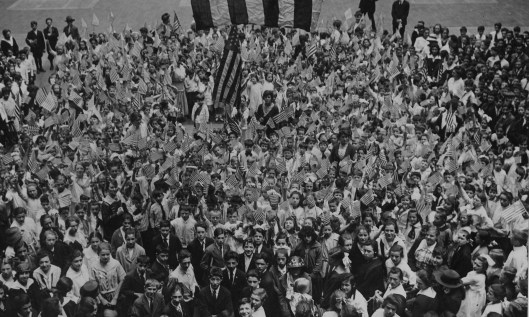
Flag Day 1918 was a fairly big endeavor here in New York City. For one thing, the United States was now fully engaged in the war in Europe. The Battle of Cantigny for instance had taken place just weeks earlier, with significant casualties and American deaths. Labor, management, public school children and other constituencies turned out that June 14 to show their colors. Overall Flag Day 1918 seems to have been a positive thing. However it commenced what to some may have appeared a more worrying event: June 14, 1918 was the kickoff to what national organizers were calling Loyalty Week, in which the foreign-born, especially Germans, were being asked to demonstrate their adherence and show their support for the war effort. Here we see a whiff of the nativism that had been escalating for some time. Anti-German episodes had occurred in the United States since the start of the war and had increased after the Ludendorff Offensive had begun in March 1918.

Still, tens of thousands of New Yorkers from across the five boroughs, including Russians and Slovaks from Brooklyn, Jews and Italians in the Lower East Side, German-Americans from Yorkville, and those whose roots dated the Revolutionary War Era turned out in a celebratory mood. Here are a few photos, just three of many, from that day.

The Sons of the Revolution in the State of New York held this gathering at the Sub-Treasury building near Wall Street. The sign reads: Eat less. Feel better. Look better. Help win the war.

Central Park

New York City schoolchildren

(images/National Archives)


46 years ago today…

I left Grant’s Tomb in mid afternoon and was walking south on Broadway when I saw this at 102nd Street. It’s an electronic billboard that the city uses to let the public know about subway changes and things like that. Actually Elvis recorded two live albums this day, though one of them was not released until twenty years after he died. The King played four shows at Madison Square Garden during his June 1972 stint, the first time he had performed in New York City since the late 1950s. The shows on Saturday the 10th ended up as An Afternoon in the Garden and Elvis As Recorded at Madison Square Garden. The latter was rushed into production and released just one week after the concert, and the afternoon show was released in 1997.

Cocaine and Rhinestones

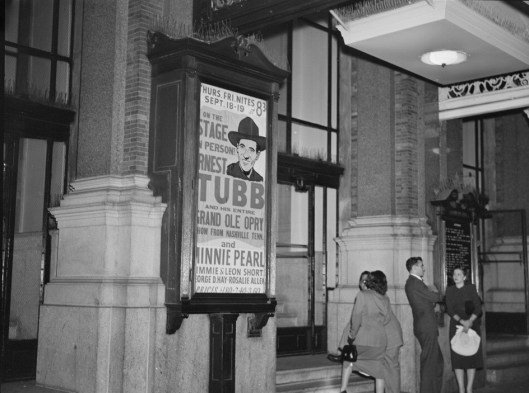
Ernest Tubb played Carnegie Hall in 1947.

When Charlie Parker hung out in the bars he was well known for putting his dimes in the jukebox and listening to country music. Because he was Bird, none of his fellow jazzmen dared try to stop him; if Yardbird Parker wanted to listen to country music, then that’s what was going to happen. When they asked incredulously why he spent his time listening to that genre, his answer was always the same: “Listen to the stories, man.” A great artist–and make no mistake, Charlie Parker is on the shortlist of great artists of the twentieth century–understands that inspiration can come from anywhere and through anyone, whether that be Louis Armstrong, Shostakovich or Hank Williams. The reason I say all this is to highlight a podcast that has been preoccupying me for much of the past week: Tyler Mahan Coe’s Cocaine and Rhinestones.

Tyler Mahan Coe is the son of outlaw country musician David Allan Coe. Tyler spent his childhood years on his father’s tour bus, partying and listening to the stories as he heard them coming from the stage and the back of the bus. Father and son had a falling out somewhere along the way and apparently are estranged today. As Coe points out, everyone in country music is a historian because the music references its antecedents much more than most other styles. Plus, musicians have a great deal of time on their hands and spend a great deal of it swapping stories of what they have seen and heard along the way. Cocaine and Rhinestones wrapped up its first season of fourteen episodes earlier this year. So far I have listened to about 1/3 of those, starting with episode one about Ernest Tubb but skipping around after that. One of the things I like most about Coe’s sensibility is that he states explicitly that there is no purity test for what is and is not country music. Race, region, economic status, educational level: none of these are barriers for who is and is not a “country” artist. The only litmus test is sincerity.

He did an extraordinary job breaking down Loretta Lynn’s mid-1970s hit “The Pill,” explaining the sexism and hypocrisy that went into why more than sixty radio stations across the country banned it. Another episode explores Merle Haggard’s “Okie from Muskogee.” The degrees to which Haggard is parodying and/or paying tribute to Richard Nixon’s Silent Majority has been lost on less reflective listeners for the half century since the song’s release in July 1969. Coe’s conclusions about Haggard’s “Okie” are surprising, and I for one found his argument convincing. I felt Coe was unduly harsh on Herbert Hoover in the early part of this episode however, where he describes the early years of the Depression and the flight of the Okies from Oklahoma and its neighboring states to California. Hoover didn’t cause the Depression and he wasn’t the ogre people made him out to be. Every good story deserves a villain and Hoover was, then and today, the ideal scapegoat for Depression Era America.

Americans in that decade after the First World War began buying radios in record numbers, which transformed our culture much like the internet has transformed our own time. Without the radio there would have been no Babe Ruth as we know him today. The same goes for the music people listened to and shared. Someone, I believe it was Kris Kristofferson, once said that he never worries about country music, that its death has been greatly exaggerated and that it will always be here and move forward. Tyler Mahan Coe does a good job putting the music into historical and cultural contexts and explaining that the music business has always been . . . wait for it . . . a business. Greed, lust, abuse in its many forms, envy, shallowness and vindictiveness have intertwined with moments of great generosity, clarity and understanding within various artists and producers to create the canon that is country music. It’s a human tale, as old as Adam. One would be wise to listen to the stories.

(image/Library of Congress)

Liberty trucks at Grant’s Tomb

I wish the above image were less grainy but it is how it appears in the digitized edition of the 28 April 1918 Brooklyn Daily Eagle. For much of the year leading up to the taking of this picture, the Society of Automotive Engineers had worked exhaustively with the Quartermaster Corps’s Motor Transport Board to standardize a number of vehicles before putting them into mass production. The ones we see here are Standard B “Liberty” trucks. They were brought to Grant’s Tomb in late April 1918 to observe the anniversary of Ulysses S. Grant’s birthday, show the vehicles off, and demonstrate to the public how their Liberty Loan money was getting spent. When the war began most European armies were still using horse-drawn carriages. The United States experimented with trucks somewhat during the Punitive Expedition in Texas in 1916 but was also largely dependent on equestrian transport out in the field. Thus the need for the automotive industry and War Department to brainstorm in 1917-18 before putting the Standard B and other models into mass production. By early winter 1918 through the summer, dozens of factories were turning these and the other models out by the thousands every month.

In the same edition of the Brooklyn Daily Eagle in which this photograph appeared, there was an article stating that the automobile would become increasingly significant in American life after the war. That prediction proved prescient but it is nonetheless jarring to see, given that the United States had not yet fully engaged in the Great War and that the outcome was far from certain. In July 1919,, just one month after the Versailles Treaty, about 275 officers and men of the U.S. Army, including one Dwight D. Eisenhower, engaged in the first Transcontinental Motor Convoy from Washington D.C. to San Fransisco. The convoy’s mission was both to test the efficacy of moving men and material across such a distance and to advertise to the public and military/political leadership the significance of motorized transport.


Sunday morning coffee

I am having my coffee getting ready to head out the door in a bit for my first day at Grant’s Tomb. Yesterday a friend and I took the bus to Philadelphia to visit the Museum of the American Revolution. The Revolutionary War period is something I know little about. My first experience visiting sites related to the period came a few years ago when my aunt and uncle took me to Lexington and Concord. It was an experience that has stayed with me. Of course we have a certain amount of Revolutionary War sites here in New York City as well, though the heritage tourism is less pronounced. Apparently the Museum of the American Revolution now stands on the site of what what used to be a visitor center for the nearby attractions.

The image of me above was taken yesterday outside of Independence Hall. If you look closely at the date, Lincoln’s visit fell on Washington’s Birthday 1861. This was while Lincoln was president-elect and on his way from Illinois to Washington for his inaugural. He was here in New York just a few days before this meeting with Edwin D. Morgan and others. Note that this tablet was put there by a Grand Army of the Republic post, though alas it does not give the year. A tablet next to this one mentions a John F. Kennedy visit to Independence Hall on July 4, 1962. We could not go into Independence Hall because tickets for the day were sold out but we weren’t too concerned because the museum was our main focus for the day. We did sit on an interpretive talk by park ranger of the adjacent Congress Hall. The ranger did a great job telling the audience about the significance of the hall and, among other things, about John Adams’s swearing in there as the second president.

I had an aunt who died about three years ago who lived in Greater Philadelphia. She loved visiting places like this and I’m sure over the years came here regularly with her elementary school students. There was a Boy Scout troop sitting in on the ranger talk and a group of young high schoolers in matching red t-shirts from Ohio in the museum. I love seeing the continuity and had to text my mother and tell her I was thinking of her older sister. Overall it made for a great day. We already have plans to visit again next year and take in the full experience. Now I’m off to the General Grant National Memorial. Enjoy your Sunday.

Fiorello La Guardia’s Memorial Days

John Purroy Mitchel, New York’s boy mayor, died 100 years ago this coming July. Mitchel was in office from 1914-17, thus overlapping almost entirely with the early years of the Great War. Mitchel was a proponent of Preparedness and as such became a natural ally of Theodore Roosevelt, Leonard Wood, and others advocating for American readiness to join the fight. After Mitchel left office he joined the Army Air Service and was killed in Lake Charles, Louisiana when he fell out of an airplane during a training exercise in July 1918. Friends dedicated a memorial to him in Central Park near 90th Street and Fifth Avenue in November 1928. For years, especially throughout the 1930s and 1940s, the Mitchel monument was a focal point of Memorial Day commemorations in New York City. One regular attendee was Fiorello La Guardia, who over the course of his tenure in office from 1934-45 observed at least nine of twelve Memorial Days at the monument to his mayoral forerunner, Fusion Party associate, and fellow World War 1 aviator.

New York Times, May 31, 1934: La Guardia is second from the right.

The photograph above shows La Guardia at the Mitchel monument on Memorial Day 1934. This would have been just over a year into the FDR Administration and with the Great Depression in full effect. This was also La Guardia’s first Memorial Day as mayor. There were still Civil War veterans marching in New York City’s Memorial Day parades in these years, about 25 this year. In the years after this their numbers dwindled into the single digits.

New York Times, May 31, 1944: La Guardia was pressing for full Axis surrender in the tense days before the Normandy Invasion.

The headline here in which La Guardia advocates for an “aviator’s peace” comes from the 1944 Memorial Day observation. While obviously the public did not know the exact day that the offensive to liberate France would begin, Memorial Day 1944 took place one week before D-Day. Thus we see La Guardia pressing for all out victory. Poignantly, 1944 also happened to be the first year that a Civil War veterans did not participate in Manhattan’s Memorial Day observation. Brooklyn and Queens each had one G.A.R. veteran in the ranks. Spanish-American War veterans, doughboys from the First World War now well into middle age, and active duty servicepersons including WACS, WAVES, and SPARS were all represented.

La Guardia was on hand again at the Mitchel memorial on Memorial Day 1945. He had gotten his “aviator’s peace,” at least in Europe. By Memorial Day 1945 V-E Day had passed and everyone was waiting anxiously to see what would happen in the Pacific.

Decoration Day 1886

They have my article up and running at the General Grant National Memorial (Grant’s Tomb) website. It is about Decoration Day 1886, the first Memorial Day to take place after Ulysses S. Grant’s death in July of the previous year. Alas it appears the pictures did not seem to go through, but we’ll figure that out. I hope everyone enjoys the piece as much as I enjoyed writing it.

(image/Museum of the City of New York)

The Military Service Institution of the United States

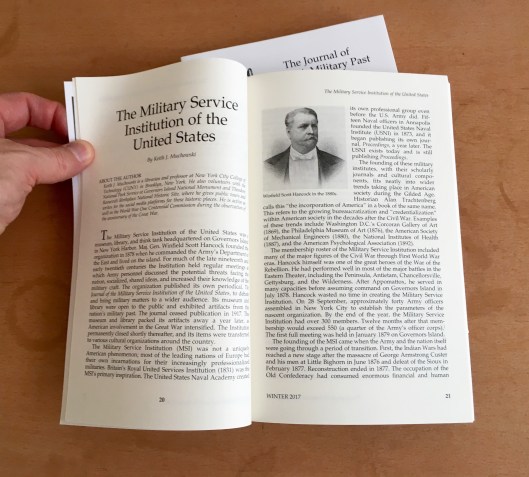
I had a curious incident happen over the past week, one that ended with some good news. Late last week I was compiling my paperwork for my annual self evaluation and noted a “work in progress” that had been laying there dormant for some time. I emailed the editor to inquire if there was any news, and his response was “Oh, I never told you? We published that last year.” When I answered in the negative he told me to email the address and that he’d drop a few copies in the mail. The other day when I opened the box, there they were. The piece is about The Military Service Institution of the United States, a museum and professional organization founded by Winfield Scott Hancock on Governors Island in 1878. Leonard Wood ran the Military Service Institution when he himself commanded on the island just before and during the Great War.

The Journal of America’s Military Past was the ideal vehicle for an article about the Military Service Institution and it meant a lot to me to write the piece. Hancock, Wood, Mark Twain, William Tecumseh Sherman, Dan Sickles, Frederick Dent Grant. These are just a few people who regularly attended events there. Twain of course had published Ulysses S. Grant’s Memoirs in 1886 and in these decades he was a regular on the Civil War reunion circuit. He was a renowned raconteur and ideal after dinner speaker. He once read early chapters of the yet-to-be-published A Connecticut Yankee in King Arthur’s Court to a gathering of officers in the MSI library. The MSI was such an important part of American Army life for decades and has been virtually forgotten since it closed for good in the early 1920s after the First World War. Most the materials held within, including Phil Sheridan’s horse Winchester, went to the Smithsonian in Washington.

A walk past the Newark Paramount

I am having my Sunday coffee and listening to Yusuf Lateef. With the semester in its final few days, it’s going to be a working Sunday. I have already sent a few emails and will tie up various loose ends over the course of the day. Yesterday a friend and I braved the rain and crossed the river to visit the Newark Museum of Art. I had not been there in 6-7 years and can say that officials there have been doing great work maintaining what has always been an outstanding cultural institution. If you live in New York City and are ever looking for a place to visit, I can attest that the Newark Museum is very easy to get to. Top it off with lunch or dinner in The Ironbound, as we did, and you’ve had a good day.

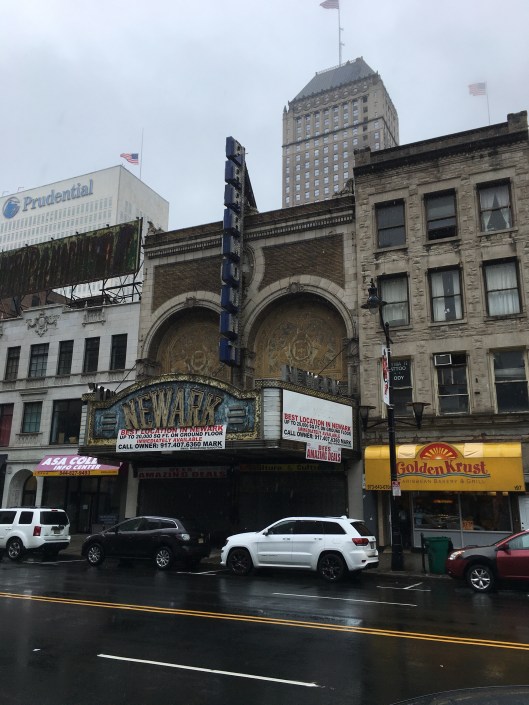
Paramount Theater, Newark, New Jersey

I took this photo of the Newark Paramount theater on the way to the museum. Some readers may know of the old Paramount Theater in Midtown Manhattan that they tore down decades ago. The reason there was “another” Paramount in Newark is because the movie studios owned their own theaters until losing a major antitrust case in 1948, after which Paramount and others had to divest themselves of their movie houses. As you can see, the Newark Paramount now stands empty. If my memory serves, the last time I was in the vicinity this was a storefront in which Rastafarians were selling oils and incense. Some rudimentary internet searching informs me that this opened as a vaudeville theater in 1886. To put that in perspective, that was the year after Ulysses S. Grant died.

The space in Newark came under new management and was expanded in 1916. Expansion in this period makes sense; in 1916 with the Great War raging in Europe there was a great deal of activity in Essex County, New Jersey. The docks were teeming and it makes sense that there would be entertainment options such as this. During and immediately after the First World War this would have meant live stage entertainment, and starting in the late 1920s moving pictures.

Last night on the train home I sent this photo to a friend who was born in the early 1960s and lived in this area until the mid-70s, when his family moved to a Sunbelt State. This led to a philosophical discussion over text messaging about loss and memory. My friend mentioned how this all seemed like eons in the past. The Newark Paramount closed as a movie theater in April 1986–itself now a lifetime ago–and while my friend in all likelihood never saw a film there, it is a good bet his mother and father did in their own early years.

I have a yen for these old theaters, having in the 1990s worked for a large chain bookstore based in old art deco move house that in the 2010s because a Trader Joe’s. The race seems to be on to save the Newark Paramount. A society cannot let things lie literally in ruins just for the sake of holding on to the past, but hopefully some vestige of this old treasure can be incorporated into Newark’s future as things continue to move forward. We’ll see how things develop, no pun intended.