New York’s Great War on social media

index.phpI noted with pleasure earlier this past week that the number of likes on the World War One Centennial Committee for New York City has topped and is holding steady at over 100 likes. That’s pretty good considering that the group is just getting underway. The NYC Committee is actually a sub-committee of the WW1 Centennial Commission and is the only subsidiary of the WW1CC dedicated to a municipality. This is a good thing because Greater New York, in which I am including the ports of Jersey City and that area, played such an outsized role in the war effort. I am not talking just after April 1917 either; New Yorker’s commitment began in that late summer of 1914 and continued through the Armistice and beyond. I know from sitting in on Committee meetings that the group has many exciting things planned for the next several years. This is not the reason I am writing this post, but fyi yours truly has committed to writing a social media post every 7-10 days. I think it manageable; there are so many stories to tell. In case one has never seen it here is the link to the NYC Centennial Committee’s Facebook page. Also, the website itself is scheduled to go live in a few weeks. When it does I will have more.

(image/Art and Picture Collection, The New York Public Library. “Farewell Parade Of U.S. Troops, 1918.” The New York Public Library Digital Collections. 1918. http://digitalcollections.nypl.org/items/510d47e0-daf5-a3d9-e040-e00a18064a99)


Wilson gets a Secretary of War

Newton Baker and General Hugh Scott, circa 1916

Newton Baker and General Hugh Scott, circa 1916

The other day I posted about Major General Hugh Scott’s month as Woodrow Wilson’s interim Secretary of War. One hundred years ago today Newton Baker was sworn in as the full-time secretary. Baker was an excellent choice and he served President Wilson well for the next five years. I uploaded this to the Strawfoot Facebook page this morning, but over at Roads to the Great War they uploaded my article about Secretary Baker. I have always found it odd that Baker is not better known today than he is. I think it may have to do with his break with Franklin Delano Roosevelt in the 1930s over the New Deal. The Democrats seem to have written Baker off. Also, Baker died in 1937 when Europe was getting ready for Round Two. By this time the world was focused on the rise of Hitler, Mussolini’s taking of Ethiopia, and the Japanese threat in the Pacific. By 1945 the WW1 generation must have seemed entirely anachronistic to most Americans.

The Baker piece was the second of a two part series. If you didn’t see it, here is the link to the piece about the February 1916 resignation of Baker’s predecessor, Lindley M. Garrison.

(image/Library of Congress)

Plus ça change . . .

Baruch during the Great War

WIB Chairman Baruch during the Great War

Last week the Pentagon announced that it has appointed former Google CEO Eric Schmidt to lead a new Defense Innovation Advisory Board. What the Defense Department hopes Schmidt can do is update its aging information technology infrastructure, which like most of our government bureaucracies’ it infrastructure is woefully inadequate. Hopefully Schmidt and his colleagues can do something about that. Not least are the hacking threats to which the outdated systems are suseptible. Esquire’s Charles Pierce notes that this is not the first time the American military has turned to C-level talent to fix its problems. During the First World War Bernard Baruch ran the War Industries Board to bring the woefully unprepared American Expeditionary Force up to speed for its task at hand.

(image/Library of Congress)

Recognizing Sami Steigmann

The week before last I attended an event in honor of my great friend Sami Steigmann. We have known Sami for seven years now; he is actually the subject of the story I wrote for The Wonder of it All, which will be officially released in a few weeks. The event a few weeks ago at the Museum of Tolerance was all about Sami. The audience was a cross-section of the many people whose lives he has touched. Sami Steigmann was born in what in 1939 was Romania. In the crazy-quilt bloodlands that were twentieth century Eastern Europe, the national boundaries changed frequently here; his ancestral home is now in Ukraine. Nineteen thirty nine was of course the year the Second World War began in Europe. Sami spent 1941-44 in the Nazi prison camp Mogilev Podolski. What he has gone on to do with his life is nothing short of incredible. What a great evening it was, and Sami we are going to do that interview once and for all this spring.

https://vimeo.com/157100514/62f2615787

Wilson’s temporary Secretary of War

Hugh Lenox Scott (1853-1934) was of the West Point generation too young for the Civil War and too old for World War 1.

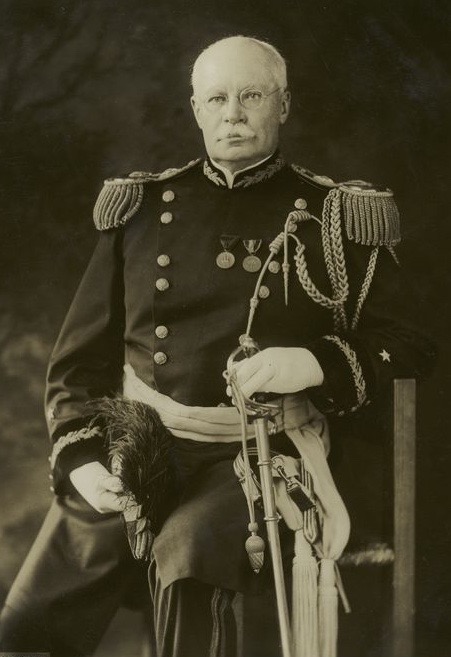
Hugh Lenox Scott (1853-1934) served briefly as both Chief of Staff and interim Secretary of War in the Wilson Administration.

A few weeks back I linked to an article I wrote for Roads to the Great War about the resignation of Secretary of War Lindley Garrison. For most of February into March 1916 President Wilson was without a civilian leader of the U.S. Armed Forces. Filling in as interim Secretary of War was the Chief of Staff, Major General Hugh L. Scott. General Scott was the archetype of a U.S. military officer who came of age in the aftermath of the Civil War. He graduated from West Point in 1876, within weeks of Custer’s defeat at Little Big Horn. It was also America’s Centennial. As a young officer Scott went on to serve in the Indian Wars, in Cuba, and the Philippines. In 1911 he was planning to come to Governors Island for social reasons when he was suddenly sent off to Arizona to settle a dispute with the Hopi Indians, one of the last campaigns between the Army and the Native Americans. It is not surprising the powers-that-be sent Scott. He had long ago acquired a reputation for solving problems through mediation, even becoming an honorary member of several Native American tribes. Scott came of age as a military officer in the age of Secretary of War Elihu Root’s reforms at the turn of the century. Theodore Roosevelt admired him greatly and appointed him Superintendent of West Point in 1906.

Scott was born in Kentucky but grew up in Princeton, New Jersey. That is probably where he came to the attention of Woodrow Wilson, another Southerner who came to make his home in the Garden State. General Scott had replaced William Wallace Wotherspoon as Chief of Staff in November 1914. (Wotherspoon seems to have been an interim choice as Army Chief of Staff while the Wilson Administration decided what to do in the aftermath of Leonard Wood leaving that position seven months earlier and returning to the Department of the East. Scott and Wood got along well.) When Lindley Garrison resigned in February 1916 Hugh Scott filled the breach for several weeks. Wilson liked Scott a great deal but the general’s best attribute at that moment was that he would do what the president wanted. How could he not as a military man serving his commander-in-chief. Still, Scott pushed for better preparedness and made clear that the Army was unprepared for involvement overseas.

When Newton Baker came in as the Secretary of War the second week of March 1916, Scott was left to focus on his military duties. In 1917 he reached mandatory retirement age and was replaced by Tasker Bliss. Still the Army had a place General Scott. He took command at Fort Dix in New Jersey and helped train men to go to France. After the war he accompanied Elihu Root to Russia to inspect conditions during the civil war there.

(image/The Miriam and Ira D. Wallach Division of Art, Prints and Photographs: Photography Collection, The New York Public Library. “Maj.-Gen. Hugh L. Scott, 1853-.” The New York Public Library Digital Collections. 1860 – 1920. http://digitalcollections.nypl.org/items/510d47db-11cf-a3d9-e040-e00a18064a99)


The war will be over by December

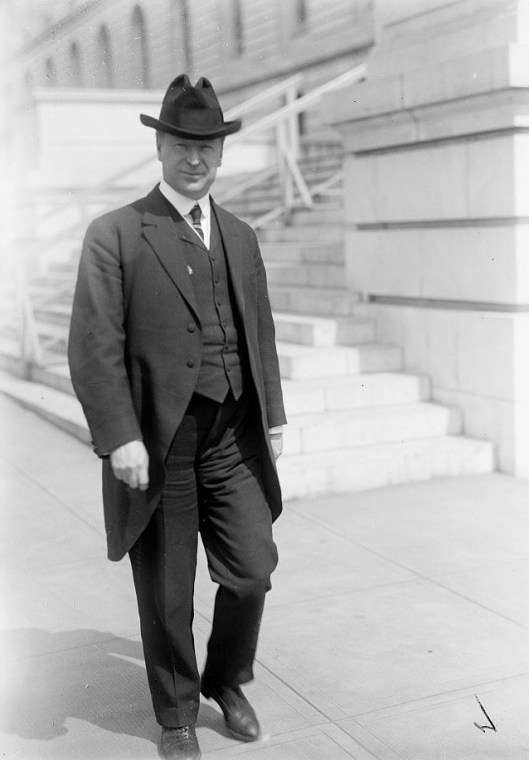
Victor Murdock (1871-1945) led a long productive life as a congressman, newspaperman, and broker. After seeing Europe first hand in 1915 and early 1916 he believed the Great War's end to be imminent.

Victor Murdock (1871-1945) led a long productive life as a congressman, newspaperman, and power broker. After touring much of Europe, including the French front, first hand in 1915 and early 1916 he believed the Great War’s end to be imminent.

That is what former Kansas Congressman Victor Murdock said one hundred years ago today when he stepped off the Nieuw Amsterdam in Manhattan after returning from Europe. That was a bold, curious statement to make with the Battle of Verdun now raging in France. At least a quarter of a million German men were involved in that butcherous campaign, with their French enemies vowing determinedly that “They shall not pass.”

It is easy to scoff but Murdock was no lightweight. He was a respected Midwestern politician and newspaperman. Six months earlier his daughter had married Harvey Delano, a cousin of Franklin Delano Roosevelt. Murdock was also a Bull Moose Progressive, and good friend and political ally of Theodore Roosevelt as well. Indeed he was the National Chairman of the Progressive Party. With the Roosevelts Murdock campaigned for Preparedness ever since the war had begun in 1914. When Theodore Roosevelt declined to run for the White House in 1916 Murdock supported Wilson over Charles Evans Hughes. Thankfully for Murdock the world did not remember his February 24, 1916 statement about peace in our time coming before the end of the year. For his efforts Wilson appointed Murdock a Federal Trade Commissioner.

(image/Library of Congress)

Coming across a piece of the First Army

When we were in the city yesterday we ventured in to a thrift store after breakfast to see what treasures we might find. Such stores in New York can often reveal hidden gems; many people clean out their apartments after decades of living and bring it in without a second thought, not to mention wealthy folks who drop off their high quality clothes, mementoes and what have you just because they’ve become bored with it and are moving on to something else. There’s a whole other way to live.

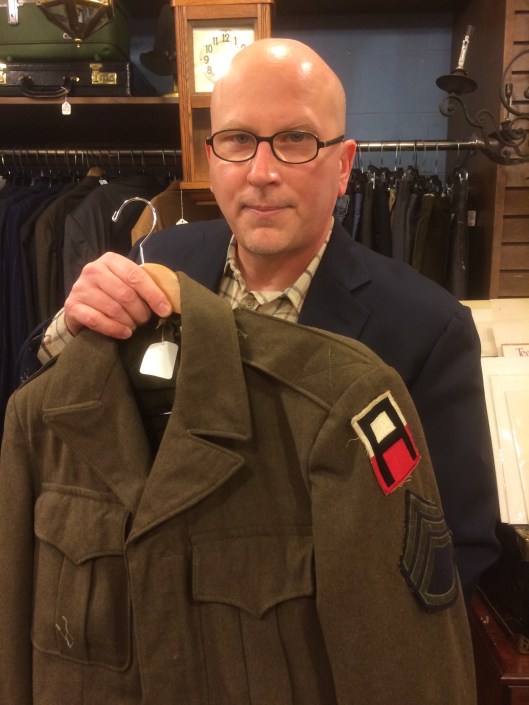
These did not come home with me but I could not help getting my picture taken with this First Army jacket and helmet. It was not clear if the two came from the same person but they were next to each other in the store. I imagine the jacket is from WWII, which means the wearer served in Europe. Note the thick weight of the garment and also its small size. Men were smaller back then, having grown up during the Depression as they did. The jacket itself is in very good condition, as are the First Army insignia and the staff sergeant stripes. The First Army of course dates back to the First World War when it was commanded by Pershing himself and later by Hunter Liggett. Those who have ever visited Governors Island will recognize the latter’s name. It was one of those small things that added an interesting moment to our Sunday.IMG_2969

IMG_2975

Progress at the TRB

IMG_2978

I was in the city this morning meeting a friend for brunch. Afterwards, we were headed somewhere else when I realized we were just a block from the Roosevelt Birthplace on East 20th Street. I had not been past since it closed last April and naturally had to swing by and check things out. Work seems to be progressing on the outside of the house. When I know more about the re-opening, I will keep everyone up-to-date.

Treaties, Trenches, Mud, and Blood

61Pjg26OJOL._SY344_BO1,204,203,200_The other day I finished Treaties, Trenches, Mud, and Blood: A World War I Tale, a graphic novel brought to my attention last summer by one of the rangers at Governors Island. Graphic novels became a thing after Art Spiegelman published Maus in 1986. It is hard to believe that was thirty years ago. Even before then Spiegelman’s work had been published in installments before being anthologized. Spiegelman published Maus II in 1992 and won a Pulitzer Prize that same year. At the library where I work we have an entire section dedicated to the genre. If anything graphic novels have become too big in recent years. The quality of the writing and drawing varies markedly from work to work. It is not an easy thing to pull off, especially when one is writing about history related events. The author/artist must internalize and then condense a great deal of information and then make it understandable to both a general audience and the specialists who might be reading it to get the creator’s take on the topic. At the same time he must be true to historical events and the people who lived through them. And the graphics are equally important. The whole point of a graphic novel is to tell a tell with words and images. That’s why they’re called graphic novels.

One need not worry about that here. The narrative and the sketches here are rendered beautifully and with great thought and care. The narrator is none other than “Nathan Hale,” who in more than one book has avoided the noose by spinning a historical tale from the gallows stand to keep the hangmen entertained and their minds elsewhere. I must say it all works rather nicely. The book is ostensibly written for Young Adult readers but kids of all ages, especially those with an interest in the events of 1914-18, will find this an enjoyable and worthwhile read. Treaties, Trenches, Mud, and Blood captures the entirety of the war, from an international perspective, surprisingly effectively, which is no small feat in a work that is less than 130 pages.